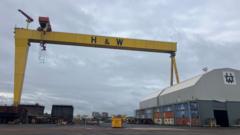
Heavy industrial turnaround strategies frequently fail at the intersection of legacy infrastructure and modern throughput demands. When Navantia UK announced a three-point-one million pound engineering intervention for the Samson and Goliath gantry cranes at the historic Harland and Wolff shipyard in Belfast, public commentary treated the event as a sentimental cosmetic touch-up. This misses the operational reality. The intervention represents a necessary capital expenditure within a broader ninety-eight-point-five million pound recapitalization initiative designed to eliminate a critical bottleneck for the Fleet Solid Support (FSS) ship contract.
Asset longevity in heavy manufacturing requires examining the physical degradation curves of capital equipment installed decades ago. Goliath, built in 1969, stands at ninety-six meters, while Samson, installed in 1974, reaches 106 meters. Each dual-gantry structure commands an 840-tonne lifting capacity. Over decades of intermittent activity and shifting industrial output, these assets experienced severe mechanical dormancy. Without a comprehensive engine overhaul, catenary power cable replacement, and localized structural reinforcement, running these assets at high duty cycles would trigger catastrophic failure under load.
The economic imperative driving this refurbishment is straightforward: module lifting efficiency determines drydock velocity. Building modern naval vessels, such as the Royal Fleet Auxiliary support ships, requires assembling massive pre-fabricated structural blocks off-site or in fabrication halls, then hoisting and positioning them with millimeter precision into the graving dock. If a gantry crane with an 840-tonne capacity fails due to electrical faults or power delivery breakdown via degraded catenary lines, the entire assembly line halts. The resulting demurrage and schedule slippage cost millions per day, dwarfing the initial maintenance outlay.
Resource allocation inside heavy engineering turnarounds follows a strict hierarchy of operational readiness. Capital distribution must prioritize assets that sit directly on the critical path of production.
- Primary Electrical and Power Transmission: Replacing aging catenary cables ensures uninterrupted power draw during heavy continuous lifting cycles. Voltage drops under high load can trip safety cutoffs, stalling suspended multi-hundred-tonne assemblies.
- Mechanical and Hydraulic Renewal: Restoring internal drive engines and hydraulic systems guarantees that synchronization across the rail-mounted bogies remains absolute. Skewing under load places lateral shear stress on the structural legs, risking permanent frame deformation.
- Fabric and Structural Integrity: Comprehensive Non-Destructive Testing (NDT) identifies micro-fissures in welded box girders caused by decades of thermal expansion and wind-induced fatigue.
Execution risk in shipyard modernization centers on temporal alignment. Work on Goliath initiated first, with Samson scheduled sequentially to maintain baseline operational capability should emergency handling be required. However, sequencing upgrades while simultaneously scaling up fabrication workforce capacity creates a coordination hazard. Project management must synchronize asset downtime windows with steel-cutting milestones for the upcoming naval blocks scheduled for early placement.
Operational throughput relies on the mechanical availability factor of primary lifting assets. If the refitted cranes achieve a target reliability metric above ninety-five percent uptime during peak operational phases, the shipyard avoids the compounding penalty costs associated with defense contract timeline breaches.
Deploy technical engineering audits to establish baseline fatigue limits on all primary gantry box girders prior to executing full-load multi-crane lifts for the incoming naval blocks.