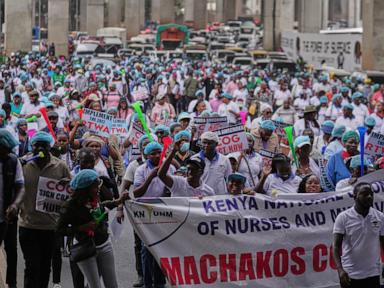
Public health delivery architectures under fiscal decentralization contain inherent structural vulnerabilities that regularly manifest as systemic labor friction. When the Kenya National Union of Nurses and Midwives concluded its forty-one-day nationwide work stoppage, the event was framed in conventional media merely as a temporary truce over localized allowance adjustments. This framing masks the underlying macroeconomic vectors, intergovernmental friction points, and resource allocation failures that govern public sector labor disputes in emerging economies. Deconstructing the forty-one-day crisis requires examining how institutional accountability fragmentation between national and county authorities generates predictable breakdowns in human capital management within state-funded health systems.
The Tripartite Governance Failure Matrix
The structural mechanics of the healthcare paralysis stem from a fractured command chain separating budgetary authority from operational management. Following constitutional devolution, healthcare delivery was transferred to county governments, while macroeconomic stabilization and national revenue collection remained centralized. This created an operational dichotomy where county administrations managed payrolls without matching revenue-raising autonomy.
- Budgetary Asymmetry: County governments operate under fixed ceilings defined by equitable share allocations from the national treasury, leaving little elasticity to absorb multi-year collective bargaining agreements.
- Regulatory Disconnect: National advisory bodies, such as the Salaries and Remuneration Commission, impose strict wage bill controls that frequently conflict with previously negotiated career progression guidelines and historical allowance arrears.
- Enforcement Vacuum: When labor disputes escalate, the absence of an integrated mediation framework forces unions to target administrative bodies like the Council of Governors, which lack unilateral legislative authority to alter national tax policies or overarching fiscal structures.
This tripartite misalignment transforms routine compensation disputes into prolonged systemic shocks. Because county administrators cannot independently adjust revenue collection mechanisms to fund structural raises, negotiations repeatedly stall at the intersection of local budgetary caps and national labor demands.
The Cascading Cost Function of Labor Withdrawal
A prolonged cessation of nursing labor does not merely defer elective procedures; it triggers a non-linear degradation of the entire clinical ecosystem. The forty-one-day stoppage exposed the fragility of operational redundancy within public facilities.
When primary nursing units ceased functioning, patient load vectors immediately shifted toward secondary and tertiary facilities, or collapsed entirely, resulting in unrecorded surges in community mortality. Simultaneously, remaining professional strata—specifically physicians represented by organizations such as the Kenya Medical Practitioners, Pharmacists and Dentists Union—were forced to absorb baseline nursing tasks. This forced substitution creates an unsustainable operational bottleneck. Physician productivity plummeted as highly specialized labor was diverted to perform administrative and basic clinical monitoring tasks, degrading diagnostic accuracy and surgical output across public institutions.
The settlement terms—introducing an incremental rise of eight thousand shillings in risk allowances and five thousand shillings in uniform allowances—represent a localized cash-flow patch rather than a structural reform. By pricing risk and uniform maintenance without modifying the underlying remuneration framework or addressing nine years of accumulated arrears, the fiscal architecture remains vulnerable to identical shocks upon the expiration of current budgetary cycles.
Intergovernmental Friction and Escalation Dynamics
Labor disputes within devolved health systems follow a predictable escalation curve governed by institutional game theory.
- Phase One: Union grievances regarding non-implementation of return-to-work formulas or delayed allowance adjustments are met with administrative inertia or declarations of illegality by judicial or executive bodies.
- Phase Two: Unions deploy visible public demonstrations, shifting the political cost of service paralysis directly onto elected county leadership.
- Phase Three: Secondary labor unions threaten sympathetic work stoppages, transforming a localized sectoral dispute into a systemic crisis that threatens total collapse of the public health apparatus.
The resolution achieved on September 9 avoided Phase Four—total systemic collapse—only through emergency high-level executive intervention at State House. This reliance on ad-hoc political intervention rather than institutionalized dispute resolution highlights the absence of automated stabilizers within public sector employment contracts. True institutional resilience requires binding statutory mechanisms that automatically index public health allowances to inflation and decentralize collective bargaining power into predictable, formulaic budget line items before localized friction metastasizes into national emergency.
Deploy automated, formula-driven wage indexation models within county Integrated Financial Management Information Systems to isolate healthcare payroll negotiations from political discretion and prevent multi-year arrears accumulation.
Nurses end 41-day strike after deal with governors
This video provides direct coverage and official perspectives surrounding the resolution of the forty-one-day nurses' strike in Kenya.
http://googleusercontent.com/youtube_content/1


