Every time demonstrators breach the lobby of a pro-government broadcaster in Belgrade, Western editors reach for the exact same copy-and-paste template. They call it a spontaneous eruption of democratic frustration. They frame the broken glass and occupied hallways as a courageous blow against media authoritarianism.
That framing is completely backward.
If you have spent any real time analyzing Balkan political communication or watching how illiberal democracies operate, you know that physical incursions into state-aligned television studios do not weaken Aleksandar Vucic. They hand him a massive, unforced political gift. By focusing on the visceral spectacle of angry citizens confronting state propagandists, mainstream coverage misses the actual mechanics of power in Serbia. Worse, it actively validates the exact narrative the ruling Serbian Progressive Party (SNS) spends millions of euros every year trying to manufacture.
The Lazy Consensus on Serbian Street Protests
The standard international coverage of unrest in Belgrade relies on a binary fairy tale. On one side, you have the heroic, pro-European opposition fighting for press freedom. On the other, you have an entrenched strongman clinging to power through captured media outlets like Radio Television of Serbia (RTS) or private tabloid networks like Pink and Happy TV.
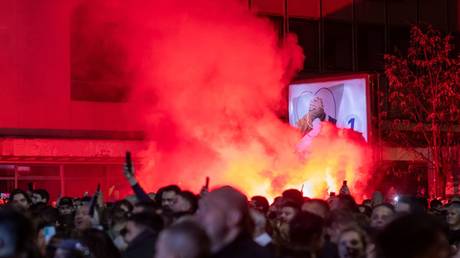
When protesters force their way past security guards at a station like RTS—a recurring flashpoint in Serbian politics from the 2019 "1 of 5 Million" demonstrations to the massive civil unrest following the Novi Sad canopy collapse—foreign correspondents treat the footage like a trailer for a revolution. They assume that disrupting the broadcast signal disrupts the regime's grip on reality.
This is a fundamental misunderstanding of how modern information autocracies function. Political scientists Sergei Guriev and Daniel Treisman coined the term "spin dictators" to describe leaders who rely on media manipulation and controlled public perception rather than mass violent repression. A spin dictator does not rule by hiding all opposition; they rule by curating the opposition to make them look dangerous, chaotic, and unfit to govern.
When demonstrators storm a television building, they stop being aggrieved citizens demanding institutional accountability. On screen, they become a mob. And in Serbia, a country still haunted by the chaotic street politics of the 1990s and the October 5th overthrow of Slobodan Milosevic, stability is the single most valuable political currency on the market.
How Captured Broadcasters Weaponize Chaos
To understand why occupying a studio backfires, you have to look at the audience watching at home. The urban, educated, anti-government demographic in Belgrade, Novi Sad, and Nis already knows that national broadcasters are heavily slanted. They get their news from independent cable channels like N1 and Nova S, or online portals. Storming the state broadcaster does nothing to inform them.
The target audience for RTS and pro-government commercial networks is older, more rural, and deeply risk-averse. Many of these voters do not love the ruling party, nor do they believe everything they hear on the evening news. What they fear, above all else, is institutional collapse and economic instability.
I have watched political strategists across Central and Eastern Europe burn through millions in campaign funds trying to convince undecided voters that their opponents are violent radicals. Usually, it takes months of expensive negative advertising to make that smear stick. When protesters physically breach a media outlet, they do the regime's creative direction for free in a single evening.
Within minutes of any breach, the narrative shifts entirely. The original grievance—whether it is election irregularities, environmental degradation from lithium mining, or systemic corruption—vanishes from the public square. Instead, the national conversation becomes an endless loop of two talking points:
- The threat to journalists: Pro-government pundits immediately wrap themselves in the language of Western press freedom standards, accusing the opposition of terrorizing working reporters and technicians.
- The rejection of democratic norms: The ruling party frames the incursion as proof that the opposition knows it cannot win at the ballot box and is attempting a violent coup.
International observers like Reporters Without Borders (RSF) and the OSCE have repeatedly documented the severe lack of media pluralism in Serbia and the overwhelming dominance of Vucic in national airtime. Yet the moment a protest crosses the physical threshold of a newsroom, international diplomatic missions—including the European Union and the U.S. Embassy—are forced by protocol to condemn the incursion. Vucic gets to stand at a podium the next morning, quote Western diplomats condemning the protesters, and present himself as the sole guarantor of European order and rule of law.
The Myth of "Forcing" Airtime
Ask any protest organizer why they march on a television station, and you will hear the same justification: "They refuse to let us speak, so we will go there and demand five minutes on the air."
It sounds logical in theory. In practice, it is a tactical dead end.
Modern broadcast television is not a single analog switchboard in a basement that you can capture and commandeer. Even if demonstrators reach an anchor desk, they cannot force a live broadcast onto the national grid. Master control rooms are decentralized, digital, and easily bypassed. The network simply cuts the feed to an alternate studio, runs pre-recorded programming, or switches to a live press conference from the Interior Ministry condemning the attack.
You do not get five minutes to explain your platform to the nation. You get thirty seconds of grainy security camera footage showing people yelling at a frightened receptionist, played on a continuous loop for the next three weeks.
Consider the structural differences between traditional media disruption and actual narrative leverage:
| Tactic | Intended Outcome | Actual Political Result |
|---|---|---|
| Breaching a TV Lobby | Force live airtime for opposition demands. | Feed is cut; footage is used to label protesters as violent extremists. |
| Blocking Studio Entrances | Paralyze daily propaganda broadcasts. | Broadcasts continue from backup locations; regime claims victimhood. |
| Economic Boycotts of Advertisers | Starve pro-government networks of commercial revenue. | Forces corporations to weigh political loyalty against actual market share. |
| Hyper-Local Door-to-Door Organizing | Bypass state media entirely to reach disconnected voters. | Builds durable voter trust that television spin cannot easily erase. |
Notice the pattern. Physical confrontations inside media buildings prioritize catharsis over strategy. They make the people in the street feel powerful for two hours, while making the people in power invincible for two years.
Why Western Coverage Keeps Getting This Wrong
If the tactical failure of storming TV stations is so obvious to anyone tracking Balkan polling, why do Western media outlets continue to frame these events as heroic breakthroughs?
Because foreign editors are addicted to visual simplicity.
A complex story about Serbian regulatory capture—how the Regulatory Authority for Electronic Media (REM) distributes national frequencies, how state-owned Telekom Srbija buys up cable operators to squeeze out independent channels, or how municipal advertising budgets are funneled to compliant tabloids—is boring. It requires background knowledge, careful legal definitions, and dense reporting. It does not generate clicks.
A video of angry protesters pushing past riot police into a glass lobby, however, is pure algorithmic gold. It fits neatly into a pre-existing Western mental model of Eastern European politics: the brave masses storming the Bastille of an authoritarian state.
This lazy framing ignores the reality that Serbia in the 2020s is not Romania in 1989. There is no monolithic information blackout where capturing the single state television tower ends the regime. Serbia has a hybrid media environment. Independent journalism exists, investigative outlets like KRIK and BIRN regularly publish devastating exposés on high-level corruption, and social media penetration is massive. The problem in Serbia is not a total absence of truth; it is an asymmetry of amplification and a deep fragmentation of trust.
When foreign journalists celebrate a studio breach as a blow for democracy, they apply a 20th-century romantic lens to a 21st-century political machine. They mistake noise for leverage.
Answering the Wrong Questions About Serbian Dissent
When these videos go viral, the internet immediately floods with predictable questions. People ask if Serbia is on the brink of another revolution. They ask why the police did not stop the crowd sooner. They ask if Vucic is finally losing control.
Every single one of those questions rests on a flawed premise.
First, why didn't the police stop them immediately? Critics often assume a breach proves the security apparatus is fracturing. In reality, interior ministries across the region regularly practice tactical restraint during media protests. If riot police beat demonstrators bloody on the steps of a TV station, the regime creates martyrs and triggers a massive, unified backlash. If the police step back just enough to let a few dozen protesters enter the lobby before calmly escorting them out, the regime gets clean, non-lethal footage of "hooligans" vandalizing public property. Restraint is not weakness; it is stage management.
Second, does storming a broadcaster hurt the ruling party's polling? History says the exact opposite. Following the March 2019 incursion into RTS, the opposition's momentum fractured. Debates erupted within the protest movement over tactics, moderate supporters stayed home the following weekend, and the ruling party consolidated its base ahead of subsequent elections. Whenever street protests pivot from broad, disciplined civic grievances to aggressive confrontations at state buildings, attendance drops and regime approval stabilizes.
Third, is capturing state media the only way to break an information monopoly? No. In fact, treating state television as the ultimate prize concedes the entire battlefield to the government. If your political strategy depends on convincing a captured state broadcaster to treat you fairly, you have already lost.
The Uncomfortable Truth About What Actually Works
Admitting that physical breaches are counterproductive does not mean accepting media authoritarianism. It means recognizing that you cannot beat a modern spin dictator using tactics designed for an analog era.
There is a massive downside to rejecting dramatic street confrontations: disciplined, unglamorous political organizing is agonizingly slow. It does not produce viral video clips. It does not satisfy the immediate emotional need for revenge after years of being smeared on prime-time television. Telling angry citizens to walk away from the doors of a propaganda network requires immense political maturity, and leaders who preach restraint risk being called weak or compromised by their own radicalized followers.
Yet if you look at where illiberal incumbents in Europe have actually suffered real defeats—such as municipal breakthroughs in Budapest, Istanbul, or Warsaw—the winning playbook never involved storming a television studio. It involved bypassing the broadcast megaphone entirely.
1. Decouple Protest Energy from Physical Provocation
Mass demonstrations work when they demonstrate sheer, undeniable scale and moral discipline. Hundreds of thousands of silent or peacefully marching citizens create an image that state television cannot easily spin into a security threat. The moment a small splinter group breaks away to force a door or smash a window, the entire movement loses control of the visual frame. Protest organizers have to police their own perimeter with ruthless discipline, treating anyone pushing for a studio breach as a liability rather than a vanguard.
2. Target the Commercial Ecosystem, Not the Cameras
Private pro-government networks in Serbia survive on a mix of state-linked financing and mainstream corporate advertising. International consumer brands—telecommunications firms, retail chains, banks, and pharmaceutical companies—spend millions placing ads on networks that simultaneously broadcast hate speech and political smears. Organized, data-driven consumer boycotts targeting specific advertisers force corporate boards in Vienna, Frankfurt, and Paris to answer uncomfortable questions about brand safety. Hit the balance sheet, not the reception desk.
3. Build Parallel Distribution Networks
You cannot out-shout a national frequency, so you have to out-organize it on the ground. In districts where cable operators block independent news channels, opposition groups and civil society organizations have had far more success distributing physical print digests, building hyper-local Viber and WhatsApp community networks, and funding direct face-to-face canvassing than they ever had yelling outside RTS. Trust in low-trust societies is rebuilt person-to-person, not through a megaphone in a captured hallway.
4. Weaponize Legal and Regulatory Chokepoints
Instead of treating media bias as a street fight, treat it as a compliance failure. Every time a national broadcaster violates election coverage rules or broadcasting statutes, flood the courts, international media monitors, and European integration committees with granular, timestamped quantitative data. It is tedious work, and it rarely makes headlines, but it creates an undeniable paper trail that complicates the regime's diplomatic standing abroad.
Stop Performing for the Cameras
The next time a crowd gathers outside a pro-government broadcaster in Belgrade, watch closely. Look at who benefits the moment the glass breaks.
It is not the students demanding accountability. It is not the independent journalists risking their safety to report the truth. It is not the citizens desperate for functional institutions.
It is the media strategists sitting inside the presidency, watching the live feed on their monitors, smiling as the opposition writes their next three weeks of prime-time programming for them. Stop mistaking a viral clip for a victory. Walk away from the lobby doors, starve the spectacle, and start doing the hard, unglamorous work of actual politics.