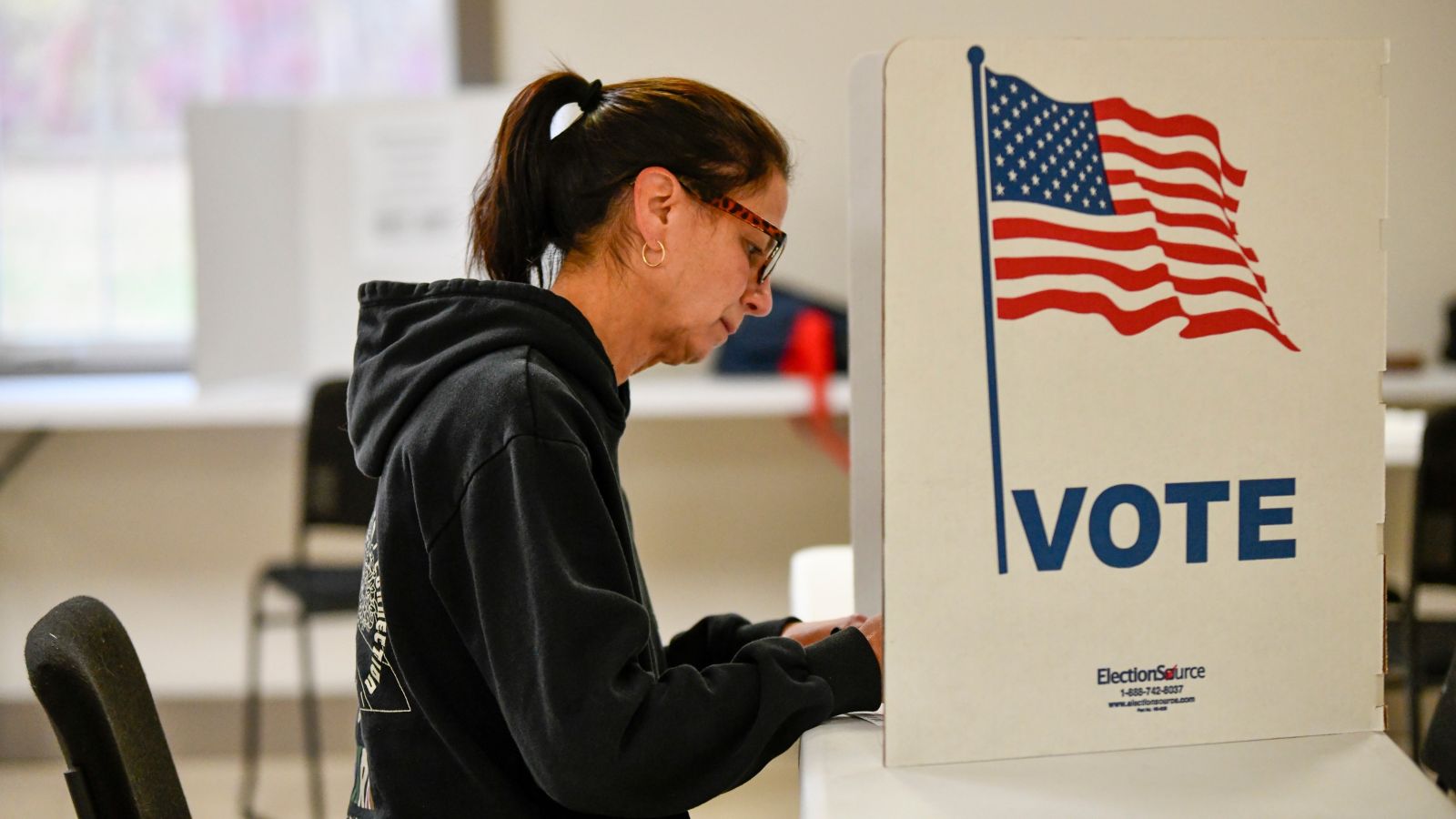
Every two years, cable news networks and major digital outlets dust off the exact same playbook. They launch a breathless live blog, slap a dramatic headline on the homepage about Americans delivering a sweeping national verdict on the sitting president and Congress, and spend forty-eight hours treating local precinct returns like a unified moral referendum.
It is lazy journalism. Worse, it is analytically backwards.
If you are glued to an election night live tracker waiting to find out what "America thinks" about Donald Trump or the current Congress, you are measuring the wrong thing with a broken ruler. A midterm election is not a national referendum. It is a fragmented, low-turnout, hyper-structural sorting mechanism where the outcome is largely baked in before a single ballot is cast.
I have spent over fifteen years inside political data rooms, campaign war rooms, and media strategy sessions watching analysts blow millions of dollars chasing phantom "national mood" narratives. Every cycle, pundits try to reverse-engineer a coherent ideological story out of 435 completely separate House races and roughly three dozen Senate contests. They mistake structural inevitability for voter passion, and they confuse turnout differentials with persuasion.
Here is what is actually happening when those precinct numbers roll in, why the mainstream live-blog framing gets the mechanics of American democracy wrong, and how to read election results without falling for the media's favorite fairy tale.
The Myth of the National Verdict
To have a "verdict," you need a unified jury weighing the same evidence under the same rules. The United States does not hold national elections. It holds thousands of localized elections simultaneously.
When a headline claims voters are casting a verdict on the White House, it implies that a voter in a suburban district outside Philadelphia is participating in the same psychological exercise as a voter in a rural county in Iowa or an urban district in Phoenix. They are not. In modern American politics, nationalization has changed how people brand themselves, not why midterms swing.
Why Presidential Midterm Losses Are Structural Gravity
Look at the historical ledger. Since the Civil War, the president’s party has lost House seats in almost every single midterm election. The rare exceptions—1934, 1998, and 2002—required extraordinary, once-in-a-generation anomalies: the immediate aftermath of the New Deal realignment, a historic backlash against an unpopular impeachment effort during a booming economy, and the immediate post-9/11 rally-around-the-flag effect.
Outside of those three outliers, the pattern holds regardless of who sits in the Oval Office, regardless of whether unemployment is at four percent or nine percent, and regardless of how charismatic the president is.
Political scientists like James Campbell and Robert Erikson have documented this phenomenon for decades through concepts like surge and decline and presidential penalty models. The mechanics are brutally simple:
- The Winner’s Coalition Fractures: A winning presidential coalition is an unnatural alliance of ideological purists, reluctant pragmatists, and low-propensity voters who showed up for a charismatic top-of-the-ticket figure. Once that figure takes office, governing requires compromises that alienate the purists while failing to excite the casual voters.
- Thermostatic Public Opinion: Political scientist Christopher Wlezien coined the "thermostatic model" of public opinion. When the government moves policy to the right, the public thermostat clicks left. When the government moves left, the public clicks right. Voters do not want ideological purity; they instinctively reach for a brake pedal whenever one party holds the wheel.
- Asymmetric Anger: Loss aversion is the strongest force in human psychology. Voters who are furious about the party in power show up at vastly higher rates in non-presidential years than voters who are mildly content with how things are going.
Calling a midterm swing a "verdict on the president" is like watching an apple fall off a tree and writing a breaking news alert about the apple's personal vendetta against the branches. It is just gravity.
How Redistricting Killed the Swing District
The second flaw in the "voters are deciding" narrative is the assumption that the playing field is actually open for persuasion. It is not.
Over the last three decades, a combination of geographic self-sorting—documented extensively by Bill Bishop in The Big Sort—and surgical, data-driven gerrymandering has turned the vast majority of House districts into ideological fortresses.
Consider the math of a modern congressional map. Out of 435 seats in the House of Representatives, fewer than forty are genuinely competitive in any given cycle. In over eighty-five percent of the country, the general election is a formality. The real election happened months earlier in a low-turnout party primary where the most uncompromising base voters selected the nominee.
When a live blog updates you on the "battle for Congress," you are not watching the American electorate wrestle with competing visions for the country. You are watching a tiny sliver of swing voters in roughly thirty suburban districts decide the fate of a legislative body representing 330 million people.
The Fallacy of the Persuaded Voter
Campaign consultants love to talk about "persuasion" because persuasion requires expensive television ads, focus groups, and fat agency retainers. Turnout operations are tedious, unglamorous, and hard to bill at a fifteen percent media commission.
Yet the data from modern voter files tells a starkly different story. True swing voters—people who voted for one party in the last cycle and genuinely agonize over voting for the other party this time—make up a microscopic fraction of the electorate.
What looks like a massive shift in public opinion on election night is almost always a composition shift, not a conversion shift.
Imagine a scenario where District X has 100,000 registered Democrats and 100,000 registered Republicans. In a presidential year, 75,000 of each show up, and a tiny pool of independents decides the winner by two points. Two years later, in the midterm, 62,000 of the out-party's voters show up because they are furious at the president, while only 48,000 of the in-party's voters bother to cast a ballot because their guy isn't on the ticket.
The out-party wins in a fourteen-point landslide. The next morning, pundits declare a historic ideological realignment. Nobody changed their mind. One side simply stayed home.
Why Election Night Live Coverage Is Designed to Mislead You
If the structural reality is so clear, why do major news outlets frame election night as a cliffhanger referendum? Because uncertainty sells advertising inventory, and linear storytelling is easier than statistical modeling.
Live election blogs suffer from three fatal structural biases that distort your understanding of what is happening in real time:
- The Mirage of Early Returns: Depending on state laws regarding mail-in ballots versus election-day machine tabulations, the first two hours of returns almost always create an artificial lead for one party—often dubbed the "red mirage" or "blue shift." Live blogs breathlessly report these early margins as if they represent actual momentum, setting up false narratives that evaporate by midnight.
- The Horserace Obsession: Tracking raw vote totals without weighting for where those votes are coming from is worse than useless. A candidate leading by 50,000 votes means nothing if all the outstanding ballots are sitting in a densely populated urban county that breaks eighty percent for their opponent.
- False Attribution: Pundits need a "why" before the "what" is even finished counting. Before the final precinct closes, commentators are already attributing the outcome to inflation, immigration, abortion, foreign policy, or a specific gaffe from three weeks prior. Exit polls, which are notoriously unreliable due to non-response bias and retrospective rationalization by voters, are treated as gospel truth to validate whatever narrative the network prefers.
Dismantling the Questions Voters Actually Ask
When people search for midterm election results, they are usually trying to figure out what the numbers mean for their wallets, their rights, and the next two years of governance. Most coverage answers those questions poorly because it buys into political theater.
Does the party that wins the midterms actually fix what voters are mad about?
No. In fact, a divided government almost guarantees the opposite.
When the opposition party takes control of the House or Senate in a midterm, they do not gain the power to enact their agenda. The president still holds the veto pen, and neither party ever wins enough seats in a modern midterm to override a presidential veto.
What the winning party actually gains is subpoena power and appropriations leverage. The two years following a midterm wave are rarely spent passing sweeping legislative solutions to inflation, healthcare, or border security. They are spent holding televised oversight hearings, launching investigations into the administration, and manufacturing high-stakes brinkmanship over debt ceiling hikes and government shutdowns. Voters hire the opposition party to act as a wrecking ball, then express shock two years later when nothing got built.
Do midterm results predict who will win the next presidential election?
This is the single biggest trap in political analysis. They do not.
History is littered with presidents who suffered catastrophic midterm wipeouts only to cruise to re-election two years later:
- Ronald Reagan (1982): Republicans lost twenty-six House seats during a brutal recession. Two years later, Reagan won forty-nine states.
- Bill Clinton (1994): Democrats lost fifty-four House seats and control of both chambers for the first time in forty years. Two years later, Clinton won re-election easily.
- Barack Obama (2010): Democrats took a historic "shellacking," losing sixty-three House seats. Two years later, Obama defeated Mitt Romney by nearly five million votes.
A midterm loss actually helps an incumbent president prepare for re-election. It forces a sluggish White House to clean house, purge underperforming staff, pivot toward the political center, and run against a "do-nothing" opposition Congress for the next twenty-four months. Losing the midterms often saves a presidency.
Is high midterm turnout good for one specific party?
For decades, the conventional wisdom in Washington was simple: high turnout helps Democrats, low turnout helps Republicans.
That rule is dead.
Over the last decade, the educational polarization of the American electorate has completely inverted turnout dynamics. College-educated, affluent suburban voters—who now lean heavily Democratic—are the highest-propensity voters in the country. They vote in every school board election, every municipal primary, and every midterm. Meanwhile, non-college-educated working-class voters—who have swung sharply toward the Republican coalition—are much lower-propensity voters who frequently skip elections when a charismatic populist figure is not at the top of the ballot.
High turnout in a modern midterm is no longer an automatic lifeline for the left, and low turnout is no longer a guaranteed shield for the right. Any analyst still repeating the old turnout orthodoxy is operating on twenty-year-old demographic maps.
The Honest Downsides of Structural Cynicism
Admitting that midterms are largely driven by structural gravity, gerrymandering, and turnout differentials comes with an uncomfortable catch: it makes individual agency look trivial.
If the macro-environment dictates eighty percent of the outcome, it is easy to conclude that candidate quality, campaign strategy, and grassroots organizing do not matter at all. That is false, and over-indexing on structural determinism is how campaigns lose winnable races.
In those thirty to forty genuinely competitive districts, and in statewide Senate races where gerrymandering does not exist, candidate quality is the ultimate tie-breaker. When the national wave is modest, a deeply flawed nominee with extremist baggage or personal scandals can easily underperform the structural baseline by five to eight points—more than enough to blow a Senate majority. Conversely, a disciplined, hyper-local candidate who relentlessly hammers kitchen-table issues can outrun a hostile national environment.
Structure sets the tide, but bad captains still sink ships in calm water.
How to Actually Read Election Night Data
If you want to understand what is happening on election night without getting played by cable news theatrics, ignore the national popular vote ticker, close the breathless live blogs, and track three specific metrics instead:
- Suburban County Margins vs. Four Years Ago: Ignore raw vote totals and look strictly at percentage margins in bellwether suburban counties—places like Chester County in Pennsylvania, Waukesha County in Wisconsin, or Maricopa County in Arizona. Compare the candidate's margin directly against the previous presidential and midterm benchmarks. If the in-party is bleeding five points in educated suburbs, the wave is real.
- The Ticket-Splitting Rate: Look at states holding both a Senate race and a gubernatorial race on the same ballot. If voters are backing a Republican for governor by eight points while backing a Democrat for Senate by two points, the electorate is rejecting national party branding in favor of individual candidate quality. If the margins are identical within a point or two, straight-ticket tribalism has locked the state down.
- Down-Ballot Judicial and Ballot Measure Results: Politicians lie, and voters rationalize. Ballot measures do not. When a state elects conservative candidates while simultaneously passing progressive ballot initiatives on minimum wage, healthcare expansion, or reproductive rights—or vice versa—you are seeing the true ideological tension that partisan horse-race coverage completely misses.
Turn off the live-blog sirens, stop waiting for thirty-second pundit soundbites to explain the soul of the nation, and look at the precinct math.


