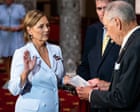
The national press corps is currently drowning in a warm bath of sentimentality. Following the sudden passing of Senator Lindsey Graham, the media has decided to suspend its critical faculties to applaud a touching family drama. Donald Trump and South Carolina Governor Henry McMaster have orchestrated the appointment of Darline Graham Nordone, the late senator's sister, to fill his seat in the upper chamber. We are told this is a beautiful tribute. We are told it honors a lifetime of service.
It is actually a profound insult to the voters of South Carolina and a textbook example of the intellectual decay of American political institutions.
A seat in the United States Senate is not a grandfather clock. It is not a family signet ring to be passed down to the next of kin because they share the same DNA and a poignant backstory. It is one-hundredth of the most powerful legislative body on earth. Treating it like a condolence card cheapens the republic and exposes the absolute cynicism of the political elite who orchestrated this transition.
I have spent decades watching political establishments protect their own, but this latest maneuver sets a new, worrying benchmark. Behind the damp-eyed press releases lies a cold, calculated strategy of raw political preservation. The public is being fed a Hallmark channel script so they do not look at the machinery behind the curtain.
The Sentimental Smoke Screen
The narrative being peddled is undeniably cinematic. We are reminded that Lindsey Graham practically raised his younger sister after their parents died when she was a teenager. We are shown clips of her standing by his side during his long career. When McMaster announced the appointment, he declared it his honor to ask Graham's sister to "finish his work".
This is emotional manipulation masquerading as governance.
Governing a nation of over 330 million people requires skills that are not inherited through bloodlines. Darline Graham Nordone has spent her career in state administration. Her work with the South Carolina Commission for the Blind is honorable, standard bureaucratic labor. It does not, by any stretch of the imagination, prepare someone to negotiate complex federal budgets, vote on international treaties, or handle classified intelligence briefings during a period of intense global instability.
When we accept the premise that a sibling is qualified to inherit a federal office simply by virtue of relationship, we are accepting the logic of monarchy. We are agreeing that the Senate is a house of lords where seats belong to estates, not the electorate. The fact that the media is largely playing along with this hereditary handoff shows how deeply we have internalized the dynastic nature of modern American politics.
The Realpolitik of the Placeholder
Let us strip away the grief and look at the cold math of South Carolina Republican politics. This appointment was not made to honor Lindsey Graham. It was made to freeze a bloodbath.
The South Carolina Republican party is a pressure cooker of competing ambitions. The state is packed with high-profile figures who have spent years waiting for Graham to vacate his seat so they could mount a campaign. Figures like Representative Nancy Mace, Attorney General Alan Wilson, and Representative Ralph Norman have been eyeing higher office for a generation.
If Governor McMaster had appointed any one of these active politicians to fill the vacancy, he would have instantly shattered the delicate peace within the state party.
- The Incumbency Trap: Appointing a real contender would have handed them an immense advantage in the upcoming August 11 special primary.
- The Fractured Coalition: Elevating one faction would have alienated the others, triggering an immediate civil war in the middle of an election year.
- The Trump Mandate: Donald Trump needed a reliable, quiet vote in the Senate who would not bring any independent personal ambition or legislative agenda to the table.
By pushing for Darline Graham Nordone, Trump and McMaster found the perfect escape hatch.
She is the ultimate placeholder. She has zero legislative record, which means she has no controversial votes to defend. She has no long-term political ambition of her own, ensuring she will not use the seat to build a personal empire. She has already pledged complete loyalty to Trump’s agenda.
Best of all, her appointment is wrapped in the armor of tragedy. Anyone who dares to criticize her lack of qualifications or point out the absurdity of the arrangement can instantly be smeared as heartless, disrespectful to the memory of a dead senator. It is a brilliant, deeply cynical shield. It allows the Republican establishment to keep the seat completely warm and compliant while the ambitious sharks fight it out in the August primary without any incumbent interference.
Dismantling the "Placeholder" Myth
Defenders of this move will argue that interim appointments are always placeholders, so what does it matter? They will say that since she is only serving for a few months until the special election is settled, we should not hold her to the standards of a full-term senator.
This defense is incredibly lazy.
The world does not pause its geopolitical crises because South Carolina is mourning. During the months that Nordone will sit in that chamber, critical votes will occur. National security decisions will be made. Federal judges will be confirmed.
To suggest that a vote cast by an unelected sibling with no foreign policy or federal legislative experience is "just a placeholder" is to admit that we no longer believe the Senate requires expertise. It is an admission that we view senators as mere biological button-pushers whose only job is to vote the party line when told to do so.
If a Senate seat can be held by anyone with the right last name and a clean record, then we have admitted that the institution itself is hollow. We have declared that the office does not require deep knowledge of constitutional law, economic theory, or military strategy. We are saying that a senator is just an actor in a play, and any understudy who looks the part can step in to read the lines.
The Dangerous Precedent of Hereditary Succession
We have seen this movie before, and it always ends with the degradation of public trust. The practice of appointing spouses, children, or siblings to vacant congressional seats is a archaic relic of a bygone era that we should have abandoned a century ago.
When a family member is appointed, they are placed in a position where they cannot be easily challenged. They are shielded by the public's natural inclination to avoid speaking ill of the dead or attacking a grieving relative. This creates an artificial political vacuum where real debate is stifled.
Furthermore, it creates a terrible incentive structure. It teaches the public that access to the highest levels of power is not earned through rigorous debate, community organization, or policy expertise. Instead, it is earned through proximity to power. It solidifies the public's suspicion that the political system is a closed loop, an exclusive club where the rules of merit do not apply.
Imagine a scenario where a major corporation’s CEO dies, and the board of directors immediately appoints the CEO’s sibling—who has spent their life running a small regional nonprofit—to run the entire multinational conglomerate, simply because "it is what the late CEO would have wanted." The shareholders would revolt. The stock would plummet. The board would be sued for a breach of fiduciary duty.
Yet, when it comes to the governance of the wealthiest and most powerful nation on earth, we are expected to applaud this exact behavior as a beautiful, tear-jerking tribute.
The Real Cost to South Carolina
South Carolina deserves actual representation, not a sentimental proxy. Lindsey Graham was a heavyweight in Washington. Love him or hate him, he possessed immense institutional knowledge, chaired major committees, and wielded massive influence over foreign policy and judicial nominations.
Replacing that level of influence with an administrative placeholder who has openly admitted she is only there to "support the president" and carry out her brother's memory is a massive downgrade for the citizens of the state. For the next six months, South Carolina will effectively have only one active, functioning senator in Washington. The state’s voice on major national issues will be diluted to a mere echo of party-line compliance.
The true tragedy here is not just the death of a senator. It is the death of the expectation that our leaders should be chosen based on their readiness to lead. By turning a Senate appointment into an act of family therapy, the political class has shown us exactly what they think of the office, the constitution, and the voters.
They do not see the Senate as a sacred trust. They see it as a family asset. And as long as the public continues to mistake this blatant nepotism for a heartwarming tribute, they will continue to treat it as such.


