Every summer, the internet resurrects the same brain-dead clickbait. Lazy travel writers and local news outlets dust off sensationalized lists of the most "snake-infested" waters in South Carolina, targeting the Savannah River, the ACE Basin, and Lake Murray. They paint these iconic waterways as writhing pits of venomous doom, practically begging suburban kayakers to buy tactical boots or avoid the water entirely.
It is a massive, scientifically bankrupt lie.
There is no such thing as a "snake-infested" natural water body in South Carolina. There are only healthy, biodiverse ecosystems functioning exactly as they should. The term "infested" is reserved for pests, parasites, and invasive species ruining a habitat. Applying it to native reptiles—species that have kept these aquatic systems clean and balanced for millennia—is a triumph of human arrogance over basic biology.
As someone who has spent decades wading through the blackwater swamps of the Lowcountry and tracking herpetofauna in the Savannah River Site, I have seen the real-world damage this sensationalism causes. It does not keep people safe. Instead, it breeds irrational fear, fuels the senseless slaughter of harmless animals, and completely obscures the actual, measurable dangers of South Carolina's waterways.
The Nerodia Illusion: Why You Can't Identify a Cottonmouth
The absolute core of this manufactured panic is human ignorance. Walk up to any casual paddler on the Edisto River or Lake Hartwell and they will swear on their life they just narrowly escaped a deadly cottonmouth (Agkistrodon piscivorus).
They did not.
In ninety-five percent of these encounters, what they actually saw was a completely harmless, non-venomous watersnake of the genus Nerodia. South Carolina is home to several highly visible water-dwelling species, including the Brown Watersnake (Nerodia taxispilota), the Banded Watersnake (Nerodia fasciata), and the Red-bellied Watersnake (Nerodia erythrogaster). These snakes are incredibly common, highly active during the day, and completely lack venom.
The problem is that evolution is highly effective, and humans are easily fooled.
When a harmless Nerodia feels threatened by a giant plastic kayak floating toward it, it deploys a classic defensive bluff. It flattens its head. By splaying its jaw bones outward, a round-headed watersnake creates a distinct triangular shape that perfectly mimics the blocky, venomous head of a cottonmouth. To the untrained eye of a weekend tourist, this bluff is a green light to panic.
But the physical mechanics of how these snakes navigate the water tell a completely different story. If you want to stop being fooled, you need to understand the physics of snake flotation:
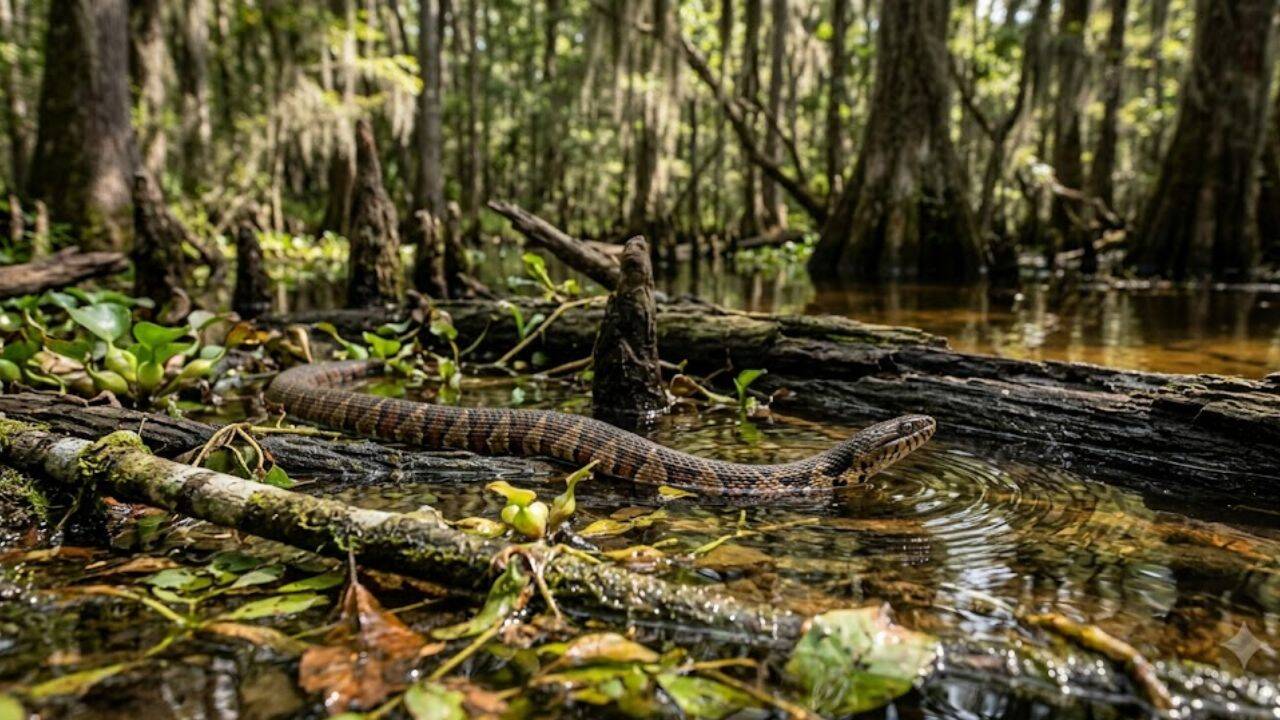
- The Cottonmouth (Agkistrodon piscivorus): These are heavy-bodied pit vipers. When they swim, they inflate their single lung to act as a buoyancy aid. Because of this, their entire body floats high on top of the water like a dry cork. You can clearly see their back, their head, and their tail cutting across the surface.
- The Watersnake (Nerodia species): These snakes lack that specific buoyancy behavior. When they swim, their entire body remains submerged below the surface of the water, with only their head poking up like a tiny periscope.
If you see a snake swimming with its body draped across the surface of the water like a thick pool noodle, it might be a cottonmouth. If you see only a head cutting through the water with the body trailing below, it is almost certainly a harmless watersnake.
By failing to make this basic distinction, listicles lump every swimming reptile into a single category of terror. They treat a harmless, frog-eating Banded Watersnake with the same alarmist dread as a defensive pit viper. It is the ecological equivalent of calling a golden retriever a timber wolf just because they both have teeth.
The Savannah River and Lake Murray: What "Infested" Actually Means
To understand why these waters are so rich with reptilian life, we have to look at the legendary research conducted by the Savannah River Ecology Laboratory (SREL) at the University of Georgia. For over seven decades, SREL scientists have studied the herpetofauna of the Savannah River basin, building one of the most comprehensive ecological datasets on earth.
Their findings do not point to a horror movie. They point to a gold standard of ecological health.
Consider Lake Murray, a massive 48,000-acre reservoir. Clickbait articles love to warn swimmers about the "swarms" of snakes nesting on the lake's islands. Let us look at the actual mechanics of why snakes are there.
Lake Murray is dotted with isolated, uninhabited islands. These islands are free from terrestrial predators like feral hogs, coyotes, and domestic dogs. They are also packed with nesting waterbirds, which drop eggs, hatchlings, and fish scraps. For an Eastern Kingsnake (Lampropeltis getula) or a Southern Black Racer (Coluber constrictor), these islands are not a military base for invading the mainland; they are a vital sanctuary.
More importantly, these snakes are the natural middle management of the lake.
Imagine a scenario where we successfully purged Lake Murray of its snake population to satisfy the anxieties of tourists. Without Kingsnakes and Racers patrolling those islands, rodent populations would explode exponentially. Rats would overrun bird nesting sites, decimating the local avian populations. Diseases carried by ticks and rodents would spike.
Furthermore, Eastern Kingsnakes are famous for being ophiophagous—meaning they eat other snakes, including venomous ones. By maintaining a healthy population of non-venomous kingsnakes, Lake Murray naturally keeps the population of venomous copperheads and cottonmouths in check.
When you call Lake Murray "snake-filled," you are looking at a highly efficient, self-regulating biological filtration system and calling it a nuisance.
The ACE Basin: A Conservation Miracle, Not a Pit of Vipers
Perhaps the most egregious target of sensationalized fearmongering is the ACE Basin. Comprising the Ashepoo, Combahee, and Edisto rivers, this 1.6-million-acre watershed is widely celebrated as one of the largest undeveloped wetland ecosystems on the entire Atlantic coast.
It is a globally recognized conservation triumph. Yet, listicles highlight it as a place where "Eastern diamondback rattlesnakes swim in saltwater between barrier islands," as if you are going to get ambushed by a swimming viper while sunbathing.
Let us inject some reality into this narrative.
Yes, Eastern Diamondback Rattlesnakes (Crotalus adamanteus) can swim. Yes, they occasionally move between barrier islands in the ACE Basin. But these animals are highly secretive, critically threatened by habitat loss, and exceptionally rare to encounter. They are not cruising the beaches looking for tourists to bite. They are attempting to navigate a fragmented coastal habitat that humans have systematically destroyed with luxury beachfront developments and golf courses.
The freshwater marshes of the ACE Basin do feature healthy populations of Brown Watersnakes and Cottonmouths. But here is the hard truth about the swamp: if you do not want to see snakes, do not go to a swamp.
Swamps are defined by saturated soils, slow-moving water, and dense canopy cover—the exact biological blueprint required for ectothermic (cold-blooded) reptiles to thermoregulate, hunt, and reproduce. Expecting the ACE Basin to be free of snakes is like booking a flight to Antarctica and complaining about the snow. The presence of these predators is proof that the ACE Basin is still wild, undeveloped, and ecologically viable. The moment those snakes disappear is the moment the entire Lowcountry food web collapses.
The Real Threats We Ignore While Panicking Over Serpents
The absolute absurdity of snake panic becomes glaringly obvious when you look at actual public safety data.
Every year, millions of people visit South Carolina's lakes and rivers. And every year, people die in these waters. But they are not dying from snakebites.
Let us look at the real hazards of South Carolina's water bodies:
| Hazard | Annual SC Casualties / Incidents | Scientific Reality |
|---|---|---|
| Drowning | Dozens of deaths annually | Often linked to failure to wear personal flotation devices (PFDs) and swimming in strong currents. |
| Boating & Jet Ski Accidents | Hundreds of injuries, multiple fatalities | Driven by alcohol consumption, reckless operation, and crowded channels on lakes like Murray and Hartwell. |
| Submerged Hazards | Numerous severe injuries | Jumping from cliffs or bridges into murky water with hidden logs, rocks, or old dock pilings. |
| Venomous Snakebite Deaths | Nearly Zero | On average, fewer than 5-6 people die from venomous snakebites nationwide each year. In SC, a fatal bite is an extreme anomaly. |
If you are paddling down the Broad River or boating on Lake Hartwell, your biggest threat is not a copperhead hiding in the brush. It is the drunk driver operating a pontoon boat at thirty miles per hour, or your own refusal to wear a life jacket.
Yet, we do not see viral articles titled "The 6 Most Drunk-Boater-Infested Waters in South Carolina." That would require addressing human behavior, which is uncomfortable. It is much easier to blame a mute, legless reptile basking on a log for making the water "unsafe."
Stop Reacting to Fear and Start Showing Competence
The current status quo of "snake safety" advice is useless. It tells you to "watch your step" and "be careful where you put your hands." While technically true, this advice does nothing to dismantle the underlying panic that leads to ecological destruction.
If you actually want to be a competent, responsible outdoorsman in the American Southeast, you need to throw out the listicles and adopt a completely different mindset.
Stop Killing Snakes with Paddles
The single most common way people get bitten by snakes in South Carolina is by trying to kill or move them. When you corner a cottonmouth and start swinging a canoe paddle or throwing rocks, you force the animal into a defensive fight-or-flight response. Left alone, a snake will almost always choose flight. They do not want to waste their highly energetically taxing venom on a giant biped they cannot swallow. If you see a snake, back up three feet. You have just solved one hundred percent of the danger.
Learn to Identify the "Big Three"
You do not need to be a professional herpetologist to navigate South Carolina waters safely. You only need to learn to identify the three venomous species that actually frequent aquatic or semi-aquatic habitats in the state:
- The Eastern Cottonmouth (Agkistrodon piscivorus): Heavy body, dark brown/black coloration, pixelated pixel-like banding, and a dark "Zorro" mask stripe running across the eye.
- The Copperhead (Agkistrodon contortrix): Hourglass-shaped bands that are thin on top of the back and wide on the sides. They prefer damp woods near water rather than swimming open lakes.
- The Timber Rattlesnake (Crotalus horridus): Chevron-shaped bands and a distinct rattle. Highly terrestrial, though they can swim when necessary.
If the snake swimming next to your kayak does not match these exact descriptions, congratulations: it is a harmless watersnake doing you a favor by eating diseased fish and keeping the shoreline clean.
The next time some viral travel article warns you about the terrifying, snake-filled waters of South Carolina, look at the ecosystem instead of the headline. Those snakes are not an invasion. They are the keepers of the wild. If you cannot handle sharing a river with them, do not blame the water. Stay in the swimming pool.