Washington political reporters treat Cabinet turnover like a fantasy football draft. Every six months, the Beltway rumor mill churns out the exact same lazy script. A high-profile official looks tired during a press briefing, a rival leaks a whisper to a friendly columnist, and suddenly the headlines scream that an imminent resignation is on the table.
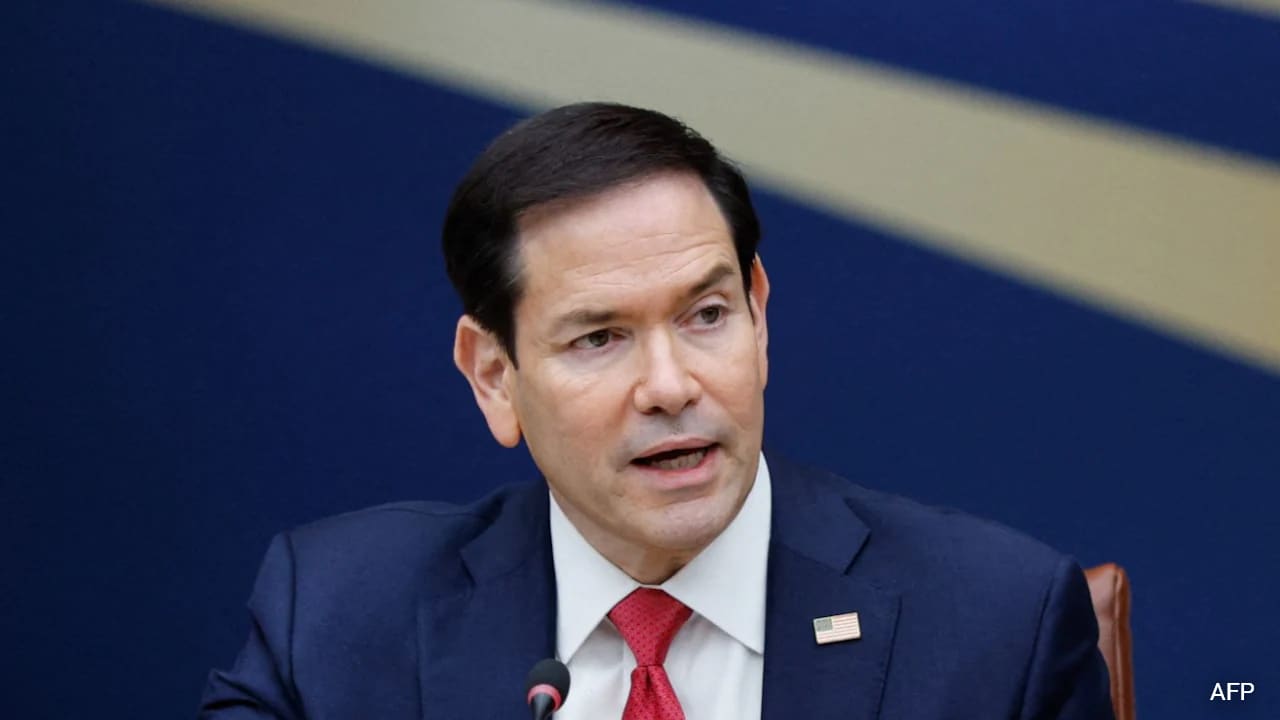
When Marco Rubio stepped up to a microphone and stated that remaining in his post had "always been my plan," the mainstream media coverage immediately framed the moment as standard political damage control. Pundits dissected his body language. They analyzed the phrasing. They treated his denial as a temporary stay of execution rather than a calculated assertion of institutional dominance.
That reading is completely backward.
If you have spent any real time watching how executive branch power actually operates behind closed doors, you know that rumor-mongering about a Secretary of State or senior foreign policy principal leaving early is rarely about the official wanting out. It is almost always a proxy war waged by bureaucratic rivals trying to kneecap that official's authority with foreign counterparts. By buying into the "will he or won't he" horse race, standard political journalism misses the actual chess match happening on the board.
The Anatomy of a Washington Leak
To understand why the exit rumors around Rubio gained traction—and why his flat dismissal matters—you have to understand the mechanics of Beltway whisper campaigns.
In any administration, foreign policy is turf. You have the State Department, the National Security Council, the Pentagon, the intelligence community, and an army of special envoys all competing for the President's ear and control over the diplomatic cable traffic. When one principal consolidates too much influence, the quickest way for internal rivals to undercut them is to plant a story that they are "one foot out the door."
Think about the immediate effect of a resignation rumor on diplomacy. If a foreign minister in Tokyo, Warsaw, or Riyadh reads in the morning press that the top American diplomat is planning to resign within the year, that foreign minister stops making concessions. Why negotiate a painful trade-off with someone who will be clearing out their desk by autumn? You stall. You wait for the successor. You treat the current officeholder as a lame duck.
I have watched senior officials lose half their operational bandwidth overnight because they failed to kill a resignation story fast enough. Once the "short-timer" label sticks in Washington, career bureaucrats slow-walk your directives, allies hedge their bets, and adversaries test your red lines just to see if anyone is actually home.
Rubio’s response—framing his tenure as a settled, long-term plan rather than engaging in defensive parsing—was not a PR flub or a nervous dodge. It was a signal aimed directly at foreign capitals and internal agency heads. The message was blunt: I am not going anywhere, so do not bother waiting me out.
Why Leaving Early Is Career Suicide for an Institutionalist
The lazy consensus assumes that high-profile politicians view Cabinet posts as miserable, thankless grinds that they want to escape as quickly as possible so they can cash in on corporate boards or launch another presidential campaign.
That logic applies to mid-level agency heads and political appointees who came from the private sector. It fails completely when applied to someone with Rubio’s specific political trajectory.
Before stepping into the executive branch, Rubio spent over a decade on the Senate Foreign Relations Committee and the Senate Select Committee on Intelligence. He did not arrive in Foggy Bottom as a political tourist looking for a resume bullet. He arrived as a career foreign policy hawk who spent years critiquing executive branch execution from the legislative sidelines.
Leaving a top diplomatic or national security post after a brief stint carries a brutal political penalty. Consider the historical precedent:
- The Cyrus Vance Trap: Resigning early—whether over policy friction or personal exhaustion—brands a statesman as someone who lacked the stamina to see a doctrine through to execution.
- The Presidential Audition Reality: Voters and party donors do not reward candidates who bail out of tough executive jobs when the headlines get choppy. If a politician has ambitions for higher office later in the decade, the only currency that matters is a completed, multi-year record of tangible geopolitical outcomes. You cannot negotiate a durable security framework, reorient supply chains, or manage great-power competition in twelve months.
- The Senate Exile: Unlike a private-sector CEO who can return to a lucrative firm, a former Senator who leaves an executive post early has nowhere to go. You cannot simply walk back into your old Senate seat. Leaving means trading the most powerful diplomatic megaphone on earth for a cable news contributor contract.
When Rubio says staying was always the plan, the math backs him up. Walking away early offers zero upside and catastrophic downside.
The Media's Addiction to Palace Intrigue
Why did the competitor coverage focus so heavily on the speculation rather than the strategic reality? Because palace intrigue is cheap to write and easy to sell.
Covering actual foreign policy execution is hard. Analyzing the granular details of bilateral defense agreements, sanctions enforcement, tariff negotiations, and diplomatic staffing takes deep subject-matter expertise. By contrast, writing a 600-word piece speculating on whether a Cabinet official is frustrated with the West Wing requires three anonymous phone calls and a thesaurus.
This creates a massive blind spot for readers trying to understand where American policy is actually heading. When the press frames every press conference around personnel survival, it obscures the structural shifts taking place underneath.
Let us look at what actually determines whether a top official stays or goes in a high-pressure administration:
- Direct Access to the Principal: Does the official still have regular, unmediated face time with the President? As long as the President picks up the phone and includes the official in the small-group decision room, rumors from lower-level staffers are irrelevant noise.
- Control Over Key Appointments: Can the official place their own trusted lieutenants into deputy and assistant roles? If an official is winning personnel battles inside their own building, they are digging in for a multi-year run, not packing boxes.
- Ownership of the Portfolio: Is the official flying on the critical trips and leading the highest-stakes negotiations, or are special envoys cutting them out of the loop?
If you track those three metrics, you will never be blindsided by a resignation—and you will never be fooled by a planted hit piece.
Dismantling the "Friction" Myth
Another major flaw in the standard reporting around Rubio’s tenure is the assumption that any policy disagreement between a Cabinet secretary and the White House signals an impending breakup.
In reality, friction is the baseline operating condition of every effective national security team in modern American history.
Look at the historic pairings that actually produced major geopolitical results. Richard Nixon and Henry Kissinger clashed constantly over tactics and credit. Ronald Reagan and George Shultz had fierce internal battles with Caspar Weinberger and the NSC staff over how to approach the Soviet Union—battles so intense that Shultz repeatedly threatened to quit in private while projecting absolute continuity in public. George H.W. Bush and James Baker argued fiercely behind closed doors before presenting a unified front to the world.
Amateur observers mistake internal policy debate for terminal dysfunction. Seasoned operators know that an administration without friction is an administration suffering from groupthink.
When a reporter asks a top official about reports that they might leave, the reporter is hoping the official will take the bait and complain about the internal process. By refusing to validate the premise and stating flatly that staying was always the plan, the official starves the narrative of oxygen. They deny their bureaucratic rivals the satisfaction of seeing them sweat on camera.
The Downside of Digging In
Of course, committing publicly to a long-term stay carries its own set of sharp risks. There is no free lunch in executive branch politics, and pretending otherwise would be dishonest.
When a senior official plants their flag and declares that they are in it for the long haul, they surrender a vital piece of internal leverage: the credible threat of resignation.
In high-stakes governance, the only real check a Cabinet member has against a policy decision they view as catastrophic is the willingness to walk out the door. If the White House knows with 100 percent certainty that you will never resign—because your political future depends on sticking it out—they can force you to swallow unpalatable compromises. You end up defending policies at the podium that you argued against in the Situation Room, absorbing public blame for decisions you did not make.
Furthermore, longevity in a top foreign policy role guarantees that you will own the unintended consequences of every crisis that erupts on your watch. Early departures get to write memoirs blaming the people who came after them. Long-serving principals inherit the blowback. By locking himself into the post, Rubio accepts full ownership of whatever geopolitical storms hit over the next several years.
How to Read Political Denials Like an Insider
If you want to stop getting jerked around by breathless breaking-news alerts about imminent Cabinet shakeups, you need a better filter. The next time a story drops claiming a major official is preparing to exit, ignore the headline and run the story through three cold tests:
- Who benefits from the leak? If the story cites "people familiar with the matter" without naming a single ally of the official, it is an opposition hit job. Someone wants that official weakened before an upcoming summit, budget fight, or policy rollout.
- What is the official's next viable move? Politicians rarely jump from high-altitude power into a vacuum. Unless there is an open Senate seat, a gubernatorial race, or a massive private-equity fund waiting with a signed contract, the official is staying put.
- Watch the calendar, not the quotes. Real departures happen around natural inflection points—after midterm elections, following the passage of a major legislative package, or at the two-year mark when ethics rules and vesting schedules reset. Rumors that pop up randomly in the middle of a legislative session are almost always political theater.
Stop Watching the Exit Door
The obsession with whether Marco Rubio—or any other senior principal—is plotting an exit misses the entire point of how power is exercised in Washington.
In a city full of people desperate to survive the next news cycle, the person who projects permanence holds the high ground. Foreign leaders respect durability. Career bureaucrats obey authority that looks permanent. Rivals back down when they realize their whisper campaigns failed to rattle the target.
Rubio did not give that quote because he was trying to convince the press corps. He gave it because he knows that in diplomacy, perception is leverage, and the appearance of staying power is half the battle. Stop reading the tea leaves for a resignation letter that is not coming, and start paying attention to what he is actually building while everyone else is watching the door.


