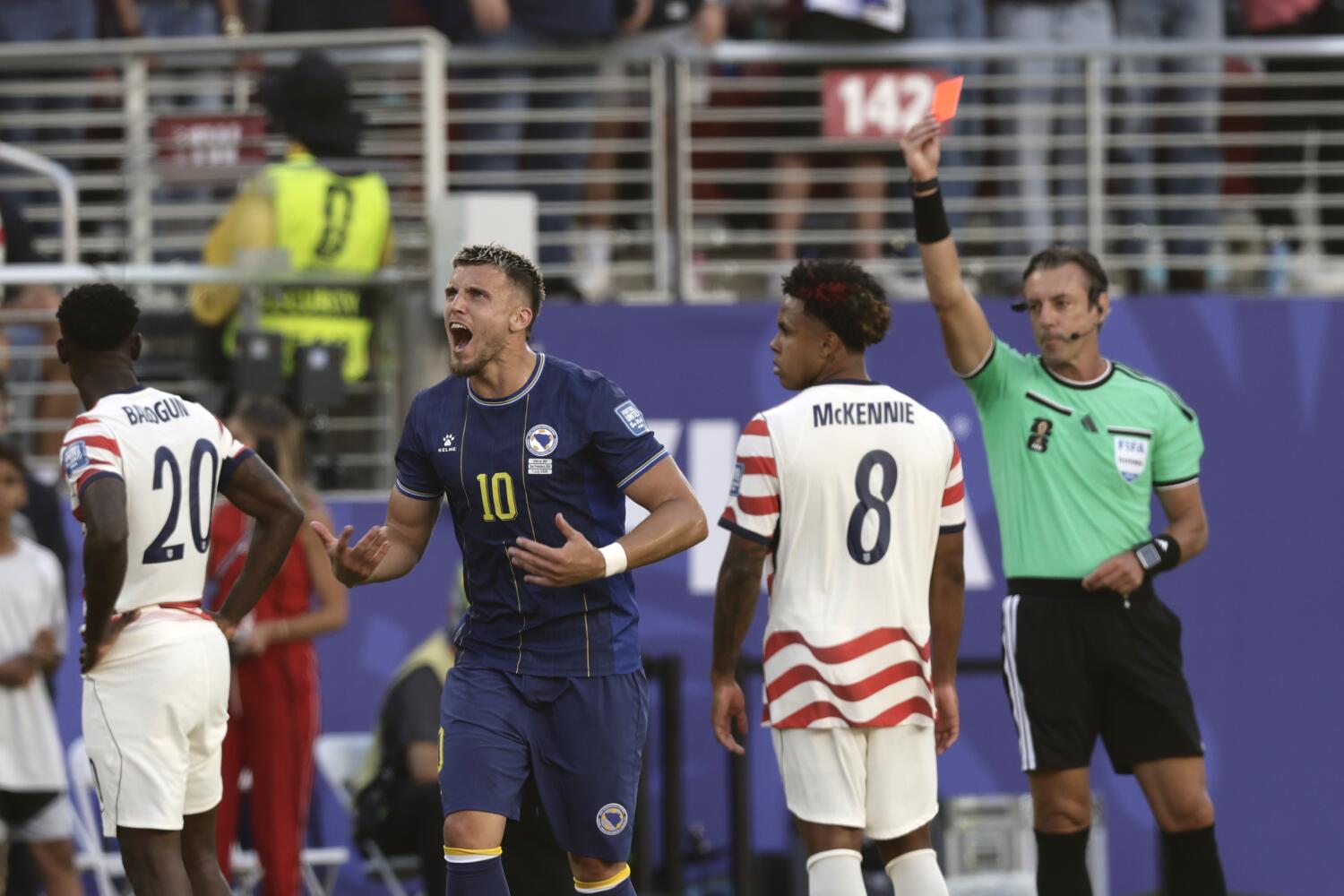
The collective weeping heard across American sports media after Wednesday's 2-0 World Cup victory over Bosnia and Herzegovina is embarrassing. Mirjam Swanson calls it a "tragedy." Mauricio Pochettino calls it "accidental." Thierry Henry went on television to lecture the world about the physics of jumping, claiming a human being "has to land somewhere."
They are all wrong.
Folarin Balogun did not get cheated by a broken system or a rogue Brazilian referee named Raphael Claus. He got caught. The narrative that the United States Men’s National Team is the victim of a tech-driven heist in Santa Clara is a comfortable lie designed to shield a star striker from his own technical recklessness.
Let's stop pretending that intent matters under modern refereeing guidelines. It does not. The moment Balogun left his studs planted firmly into the ankle of Tarik Muharemovic, he invited the red card. The system worked exactly the way it was designed to work. It caught a dangerous, reckless action that the human eye missed in real-time.
The Myth of the Accidental Landing
The primary defense mounted by the USMNT media apparatus relies on a fundamental misunderstanding of the Laws of the Game. The argument goes like this: Balogun scored the opening goal, he was having a brilliant World Cup with three goals in two games, and he was simply contesting a loose ball in the 64th minute. His foot happened to land on Muharemovic's leg during the natural progression of his stride.
I have spent decades watching forwards use "momentum" as a license to commit assault. I have seen players deliberately leave a little extra on a defender, knowing they can look at the ref with wide eyes and say, "Where else was my foot supposed to go?"
The International Football Association Board (IFAB) Law 12 is explicit regarding serious foul play. A tackle or challenge that endangers the safety of an opponent or uses excessive force or brutality must be sanctioned as serious foul play. Nowhere in that text does the word "intent" appear.
When you leave your foot extended with studs exposed at that height, you are gambling with the opponent’s career. Muharemovic's ankle flexed at an angle that should make any viewer wince. If that challenge occurs anywhere else on the pitch, or if a defender makes that exact same challenge on Christian Pulisic, American fans would be demanding a multi-match ban and a public apology. The hypocrisy is staggering.
The Slow-Motion Replay Delusion
A major point of contention raised by tactical purists and former refs turned analysts is that VAR breached protocol by showing Claus slow-motion replays and still frames. They cite the guideline stating that normal speed should be used to judge the "intensity" of an offense, while slow motion should only establish the point of contact.
This is a distinction without a difference in this specific scenario.
Imagine a scenario where a player fires a projectile at a target. Slowing down the tape does not change the fact that the projectile hit the bullseye. The still frame established a definitive fact: Balogun's studs made direct, high-pressure contact with an opponent’s lower leg well above the boot line.
Once the point of contact is established as a direct stomp onto an ankle, the intensity is self-evident due to the biomechanics of the human body. You do not need to watch it at full speed to know that a 150-pound elite athlete landing all his weight onto a fixed joint constitutes excessive force. Claus looked at the monitor, saw the reality of the damage being inflicted, and made the only decision a competent referee could make.
The argument that the referee missed it live so it should not be called is a regressive mindset that belongs in the 1980s. The game is too fast for the naked eye. Referees miss leg-breakers constantly because they are tracking the ball or adjusting their positioning. VAR exists specifically to act as the safety net for these exact moments.
Tactical Ignorance and the Media Shield
The outrage surrounding this incident exposes a deeper flaw in how soccer is analyzed in North America. The media treats the sport like football or basketball, where a foul is judged by whether it disrupted the flow of an offensive play or how "hard" the hit looked to a casual observer.
Soccer is a game of microscopic margins. The red card was not a punishment for Balogun's character; it was a consequence of poor technical execution. Balogun was fatigued. He had been chasing long balls all night against a physical Bosnian backline. When fatigue sets in, tracking details get sloppy. He arrived late to the challenge because his mind was moving faster than his legs.
Pochettino’s post-match defense of his player is predictable management strategy. He has to preserve Balogun's confidence ahead of the knockout stages, assuming the team survives without him. But the tactical reality is that Balogun let his team down. The USMNT was forced to play down a man for nearly thirty minutes in a crucial elimination match. They were saved by an 82nd-minute piece of magic from Malik Tillman, not by their own defensive resilience or tactical brilliance.
The narrative should not be about "justice for Balogun." The narrative should be about the terrifying lack of discipline that continues to plague this generation of American players on the world stage. We saw it with Timothy Weah at the Copa América, and we are seeing the same mental lapses now.
The Cost of the Victim Mentality
By focusing the conversation on the referee and the video technology, the USMNT is building an escape hatch for failure. They face Belgium next on Monday. Belgium’s central defenders do not care about IFAB protocols or whether Thierry Henry thinks Balogun had a place to land. They will look at a U.S. squad missing its most lethal attacker and they will exploit that space ruthlessly.
If the U.S. crashes out in the Round of 16 because they lack a clinical finisher up front, the media will blame Raphael Claus. They will point back to the 64th minute in Santa Clara as the moment the tournament was stolen from them.
That is a loser's mentality.
The elite teams—the Argentinas, the Frances, the Spains—do not spend three days crying about a clear-contact red card. They review the tape, recognize the technical error, adjust their tactical shape, and move on. They accept that if you leave your feet and compromise an opponent's safety, you are at the mercy of the rulebook.
Stop asking if it was a red card. It was. Start asking why a world-class striker under the tutelage of Mauricio Pochettino is still making amateur challenges in the defensive third of the pitch. That is the question that matters, and it is the only one the American soccer community refuses to answer.
Folarin Balogun Red Card Incident Analysis
This video shows the exact sequence of play and the multiple angles evaluated during the video review that led to the ejection.