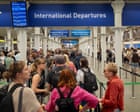
The media is currently hyperventilating over another delay in the EU’s Entry/Exit System (EES). They call it a logistical nightmare. They blame bureaucratic incompetence in Brussels. They mourn the "lost efficiency" of a seamless border.
They are all wrong.
The delay isn't the problem. The premise is. We are being sold a fantasy that facial recognition and fingerprinting will magically fix a structural capacity crisis at Dover and St Pancras. It won't. I have watched government departments sink hundreds of millions into "smart border" solutions that ignore the basic laws of physics. If you have 500 people and four narrow lanes, it doesn't matter if they are scanning their retinas or showing a paper passport—the bottleneck is the physical space.
The EES delay is actually a mercy killing for a system that is fundamentally broken before it even launches.
The Myth of the Five Second Scan
The "lazy consensus" among travel journalists is that biometric checks take seconds. This is a lie born from lab conditions. In the real world, lighting is poor. Children don't stand still. Elderly passengers have worn fingerprints.
When the UK's Port of Dover conducted internal modeling on the impact of EES, the results were grim. A single car with four passengers requires each individual to exit the vehicle (in a cramped lane), provide four fingerprints, and have a facial scan.
The math is brutal:
- Current manual check: 45 to 60 seconds per car.
- EES biometric enrollment: 6 to 10 minutes per car.
This isn't a "glitch." It is a fundamental increase in processing time of roughly 900%. No amount of software "optimization" fixes the fact that a family of five cannot move faster than biological reality allows. The delay isn't about the app not being ready; it's about the fact that if they turned it on tomorrow, the M20 would become the world's longest car park within three hours.
Digital Borders are Just Prettier Walls
We are told that digitizing the border makes it more secure. This is security theater at its most expensive. The EES is designed to track overstayers—people who stay longer than the 90 days permitted in the Schengen zone.
But here is what the industry won't admit: the people who intend to overstay or work illegally are not the ones who will be deterred by a facial scan at a legal crossing. They are the ones who will continue to circumvent the system entirely. We are building a high-tech dragnet that only catches the most law-abiding tourists who simply forgot to count their days correctly.
We are sacrificing the fluidity of Western European trade and tourism for a database that offers marginal gains in actual security. I’ve consulted on enough infrastructure projects to know when a "solution" is actually a vanity project for tech vendors. The biometric industry is currently the biggest lobbyist in Brussels, and they are selling a dream of "frictionless travel" that their own hardware cannot deliver.
The App is a Red Herring
The latest delay is being blamed on the failure to deliver a functional mobile app that would allow travelers to register their data at home. This is a classic bait-and-switch.
Even if the app worked perfectly, the EU’s own regulations require the first registration to be done in the presence of a border official to verify that the person in the photo is the person standing there. You cannot "app" your way out of the initial enrollment.
The industry keeps asking "When will the app be ready?" when they should be asking "Why are we building a system that requires a border officer to watch a tourist struggle with an iPad for six minutes?"
If you want to solve the cross-Channel crisis, you don't need more servers. You need more tarmac. You need more booths. But tarmac is expensive and politically unpopular. Software is easy to sell to voters because it sounds like progress.
The Inevitable Death of the Weekend Trip
If you think the current delays are bad, wait until the EES actually goes live. The "quick weekend in Paris" or the "day trip to the Christmas markets" is about to become a relic of the past for anyone traveling by car or coach.
Logistics experts at the Eurotunnel have already pointed out that their terminals were designed in the 1980s. They do not have the "buffer" space to hold thousands of cars waiting for biometric enrollment. When the queues hit the terminal entrance, the entire flow of freight stops.
This isn't just about frustrated tourists. This is about the supply chain. Every minute a truck spends stuck behind a family of four trying to get a three-year-old to look at a camera is a minute of lost economic productivity. We are prioritizing a database of tourist faces over the movement of fresh produce and industrial parts.
Why the Status Quo is Actually Better
The contrarian truth that no politician dares say: the old-fashioned, manual passport stamp was more efficient.
- Human Intuition: A trained border guard can spot a nervous traveler in three seconds. A camera just sees pixels.
- Resilience: If the power goes out or the server in Strasbourg crashes, a stamp still works. If the EES goes down, the border closes. Period.
- Speed: Flipping to a page and hitting it with ink is objectively faster than capturing 10 high-resolution fingerprints and cross-referencing them against a central EU database in real-time.
We have been blinded by the "tech-is-always-better" dogma. We are replacing a system that worked—albeit imperfectly—with a system that is guaranteed to fail during peak periods.
Stop Asking for the Date
The media needs to stop asking for the "new launch date." Every time a date is set, the industry spends millions preparing for it, only for it to be pushed back when the reality of the physics sets in.
Instead of demanding a launch date, we should be demanding a total redesign of the EES requirements.
- Eliminate the fingerprint requirement for short-term tourists.
- Move the "enrollment" away from the physical border and into designated centers in major cities (similar to the US Global Entry model, but for everyone).
- Admit that the 100% capture rate is a pipe dream that will destroy the travel industry.
The delay isn't a failure of the IT department. It is the last line of defense against a logistical catastrophe. If you are a traveler, you should be praying for more delays. The moment this system "works" is the moment your travel freedom dies in a six-hour queue at Dover.
The border of the future isn't a high-speed facial scan. It's a stationary car on a motorway, with a driver staring at a "System Offline" sign while their vacation time ticks away.
Fix the physics, or don't turn on the power.