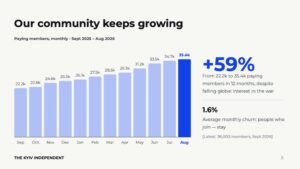
Media executives love a fairy tale. Right now, their favorite bedtime story comes out of Ukraine.
Every publishing conference from London to New York is buzzing about how The Kyiv Independent allegedly cracked the code on modern journalism. They bypassed the broken ad-tech ecosystem, tapped into a global wave of moral urgency, and built a thriving, reader-funded newsroom in the middle of an existential war. The industry press calls it "data-informed, mission-driven" publishing. They frame it as a blueprint for saving democracy and monetization at the exact same time.
They are wrong. And if you try to copy their playbook, you will bankrupt your newsroom before the fiscal year ends.
The lazy consensus in media circles treats The Kyiv Independent as a repeatable business model. It is not. It is a black swan event fueled by a historic geopolitical catastrophe, a uniquely photogenic underdog narrative, and a massive injection of Western guilt. Confusing a wartime emergency response with a sustainable commercial strategy is the exact kind of delusional thinking that has killed thousands of legacy outlets over the last two decades.
I have watched digital media founders burn through tens of millions in venture capital trying to replicate lightning-in-a-bottle journalism models. They see a spike in direct-to-consumer memberships during a crisis, mistake an emotional donation for a recurring commercial habit, and scale their fixed overhead to match a temporary surge. When the headlines fade, the churn hits like a freight train.
Let us strip away the halo effect and look at the cold, hard unit economics of selling "editorial integrity" during a crisis.
The Myth of "Monetising Editorial Integrity"
First, let us correct a fundamental piece of industry jargon. You cannot monetize editorial integrity. Integrity is a baseline operational cost, not a value proposition. Telling readers to pay you because you tell the truth is like a restaurant advertising that their kitchen is free of rat poison. It is the bare minimum required to enter the market.
When a publication like The Kyiv Independent surges to tens of thousands of paying members, readers are not buying journalism. They are buying moral alignment. They are purchasing a psychological release valve for their own helplessness while watching tanks roll across a sovereign border on their television screens.
In behavioral economics, this is known as warm-glow giving. People contribute money not because they calculate the utility of the product—in this case, daily dispatches from the Donbas—but because the act of paying makes them feel virtuous.
Here is the fatal flaw in building a business on warm-glow giving: virtue is subject to rapid diminishing returns.
A subscription business relies on habitual utility. Look at the heavy hitters that actually survive the brutal realities of digital publishing: The New York Times, The Financial Times, and The Wall Street Journal. Nobody subscribes to the FT out of charity. You pay their exorbitant fees because if you do not read it, you look stupid in your 9:00 AM board meeting, or you lose money in the markets. That is utility.
The Kyiv Independent is selling an emotional stake in a foreign war. When you sell emotion instead of utility, your churn rate is tethered entirely to the global news cycle—a variable over which you have zero control.
War Fatigue Is Not a Marketing Problem
The standard industry analysis praises The Kyiv Independent for using "data-informed" tactics to combat "war fatigue." They point to slick newsletter funnels, segmented donor appeals, and smart A/B testing on landing pages.
This is like trying to stop a tsunami with a bucket.
War fatigue is not a messaging failure. You cannot optimize your way out of human psychology with better email subject lines. Cognitive empathy has a hard biological ceiling. When an audience is bombarded with years of attritional trench warfare, casualty figures, and geopolitical stalemate, their brains naturally numb out as a self-defense mechanism.
Imagine a scenario where a regional US newspaper tries to apply this exact "mission-driven" framework to local investigative reporting. They expose municipal corruption, rally the community around a moral crusade to "save local democracy," and spike their subscriptions by 300% in three months. Fast forward eighteen months. The corrupt mayor is in jail, the immediate crisis is over, and the newsroom is now covering zoning board meetings and sewer maintenance.
What happens to those "mission-driven" subscribers? They vanish. Because the mission was accomplished—or worse, the mission became boring.
The Kyiv Independent faces an even darker version of this trap. Their entire commercial engine is structurally dependent on the continuation of a horrific conflict. If the war freezes into an endless, low-intensity stalemate—which is the reality of most modern conflicts—global attention will inevitably drift toward the next flashpoint in the Taiwan Strait or the Middle East. No amount of "data-informed" audience segmentation will convince a subscriber in Chicago to keep paying $10 a month for updates on a frontline that has not moved three kilometers in two years.
Why "Data-Informed" Usually Means Audience Capture
Let us talk about the other half of that glowing headline: being "data-informed."
In modern digital newsrooms, "data-informed" is almost always a polite euphemism for audience capture.
When your revenue comes directly from passionate, mission-aligned members rather than broad-based advertisers, your analytics dashboard becomes a tyranny. You see precisely which stories drive conversions and which stories cause cancellations. Very quickly, your editorial judgment bends to the financial incentives of keeping your tribe happy.
Let us be brutally honest about how this plays out in wartime journalism:
- Nuance dies first. Stories about Ukrainian resilience, Western weapon deliveries, and Russian incompetence will convert readers at a massive rate. Stories about domestic Ukrainian corruption, forced conscription backlash, or strategic blunders by Kyiv's high command will trigger immediate subscription cancellations.
- The echo chamber hardens. Even if the journalists have the purest intentions, the data creates a subconscious gravitational pull. Editors start greenlighting stories that validate the donor base's worldview and quietly shelving investigations that complicate the narrative.
- The brand becomes a monoculture. By tying your entire financial existence to a single geopolitical event, you destroy your ability to pivot. You are no longer a news organization; you are a single-issue advocacy vertical wearing a press pass.
To their credit, The Kyiv Independent has published tough investigative pieces on Ukrainian defense procurement and government missteps. They deserve immense respect for doing that under fire. But doing it once or twice does not exempt them from the structural gravity of membership models. Ask any editor at The Intercept, The Daily Wire, or The Guardian how hard it is to publish a story that infuriates their paying base. When the audience signs your paychecks directly, editorial independence is a constant knife fight against your own balance sheet.
The Hidden Subsidy Nobody Mentions
If you want to understand why you cannot replicate The Kyiv Independent’s success, look at the cost side of their ledger, not just their revenue.
Western media analysts love to gush over the conversion rates of Ukrainian outlets while conveniently ignoring the massive geopolitical arbitrage keeping them afloat. Operating a newsroom in Kyiv means paying Eastern European labor costs while collecting subscription revenue in US dollars, Euros, and British pounds.
Furthermore, the ecosystem around wartime Ukrainian media is heavily subsidized by Western NGOs, diplomatic grants, and emergency journalism funds. When an outlet can pair high-margin Western currency subscriptions with low-cost local overhead and philanthropic grants, the math looks magical.
Try running that exact same "mission-driven" playbook out of London, Toronto, or San Francisco, where a mid-level reporter costs $95,000 a year plus benefits, office space is a fortune, and nobody is handing you emergency democracy grants. The unit economics collapse instantly.
Answering the Questions Media Executives Are Too Scared to Ask
When publishers look at the Ukrainian media miracle, they ask the wrong questions. They ask how to build better membership funnels or how to craft a more compelling mission statement. Here is the reality behind the questions they should actually be asking.
Can a newsroom survive solely on reader revenue without a massive crisis?
Almost never at scale. Outside of a tiny handful of global financial and prestige brands, pure reader-revenue models hit a hard ceiling very quickly. If you are not selling actionable financial data, elite lifestyle status, or hyper-local utility (like school ratings and real estate trends), relying 100% on consumer subscriptions is a slow march toward irrelevance.
Does high trust actually translate into higher willingness to pay?
No. This is one of the most persistent lies in media research. The Reuters Institute Digital News Report shows year after year that some of the most trusted news brands in the world—like the BBC or NPR—struggle immensely when placed in direct-pay environments, while hyper-partisan, low-trust outlets print money. People do not pay for trust; they pay for validation, utility, or entertainment.
How do you actually combat audience fatigue on a long-running story?
You stop covering the story as a daily breaking news feed and pivot to deep, high-value intelligence. You raise your prices, shrink your target audience, and sell specialized geopolitical risk analysis to institutional buyers—hedge funds, defense contractors, supply chain executives, and policymakers. You trade 50,000 fickle $5 retail donors for 500 corporate clients paying $5,000 a year.
The Downside of the Contrarian Play
Of course, abandoning the mass-market "mission" model for cold-blooded institutional utility comes with a massive trade-off. You lose cultural relevance.
When you pivot from selling moral urgency to selling high-priced intelligence or hard utility, you stop being a movement. You will not get invited to speak on panels about saving democracy. You will not go viral on social media. Your audience becomes smaller, quieter, and infinitely more demanding. If your data is wrong or your analysis is lazy, a corporate subscriber will fire you immediately—no warm-glow feelings will save you.
It is much less glamorous than riding a wave of global sympathy. It requires building proprietary data sets, hiring deeply specialized analysts instead of general assignment reporters, and obsessing over customer retention rather than viral reach.
Stop Copying Wartime Economics
The Kyiv Independent is a remarkable journalistic achievement born out of extraordinary courage. The reporters on the ground risking their lives to document a brutal invasion deserve every dollar they raise and every award they win.
But courage is not a scalable SaaS metric.
Media executives need to stop treating wartime survival mechanisms as a masterclass in digital publishing strategy. If you build your newsroom around moral urgency, you are building a house on a fault line. The crisis will eventually fade, the donors will move on to the next trending tragedy, and your "mission" will leave you with a bloated payroll and an empty bank account.
Stop asking readers to pay you to save the world. Start building something so useful they cannot afford to cancel.


