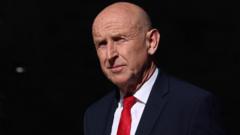
The political commentary machine loves a dramatic resurrection story. When Andy Burnham handed John Healey the keys to No 11 Downing Street, the media consensus formed within minutes: a principled defense secretary who walked away from Keir Starmer over military funding had executed a masterclass in political leverage. The story sounds clean, dramatic, and completely wrong.
What the mainstream pundits mistake for tactical genius is actually an unmitigated disaster for British fiscal sanity. By rewarding a minister who resigned over an unbudgeted £5bn spending shortfall with the top financial post in government, the Burnham administration has handed the Treasury's keys to an institutional hawk. Far from signaling economic stability, Healey's appointment guarantees a brutal reckoning between defense hawks and fiscal reality.
The Myth of the Treasury "Safe Pair of Hands"
The establishment loves calling Healey a "safe pair of hands". They point to his years as a junior minister under Gordon Brown and his steady, low-drama demeanor. They treat his Treasury return as a comforting nod to orthodoxy.
This narrative ignores basic arithmetic.
Healey quit the Cabinet because he demanded a hard deadline to scale military spending to 3% of GDP by 2030. In plain English, that commitment requires tens of billions in additional annual borrowing or tax hikes at a time when gilt markets are already throwing tantrums over UK sovereign debt. Minutes after Healey's appointment, 10-year gilt prices wobbled precisely because traders understand what lobby journalists refuse to acknowledge: you cannot put a spending hawk in charge of the cash register without inflating the deficit.
"Fiscal control is the first duty of any chancellor," Healey declared on his first night on the job.
That statement is fundamentally incompatible with his own resignation letter from a month prior. You do not blow up a Cabinet over a refusal to spend more money and then claim to be the champion of fiscal restraint.
Defense Bonds Are a Dangerous Gimmick
To bridge this gap, Treasury insiders have floated the idea of issuing dedicated "defense bonds" to finance military hardware off the main balance sheet. It sounds like a clever workaround. It is actually financial engineering at its worst.
Here is how the defense bond scheme actually works under the hood:
- The Illusion of Separation: The Treasury issues specialized debt designated strictly for military hardware and equipment recapitalization.
- The Debt Reality: Bond markets do not care what name you slap on a sovereign debt instrument. Debt is debt. Higher issuance pushes up borrowing costs across the entire yield curve.
- The Crowding-Out Effect: Capital diverted into low-yield government defense bonds is capital pulled away from private sector fixed investment and infrastructure.
Imagine a household claiming they have balanced their monthly budget simply because they put their new car purchase on a second credit card with "Auto" written on the plastic in sharpie. That is the exact logic behind defense bonds. Capital markets will see straight through it.
The Unspoken Cabinet Conflict
The standard media line paints Burnham's Cabinet as a broad-church compromise. Look past the press releases, and you find an irreconcilable ideological collision course.
Burnham won the leadership on promises to end rough sleeping, rebuild public services, and invest heavily in regional growth. At the same time, Ed Miliband has taken the Foreign Office with an aggressive internationalist agenda. Meanwhile, Healey occupies the Treasury, bound by his own public ultimatum to direct GDP percentages toward defense.
The math simply does not work.
| Cabinet Mandate | Economic Reality | Conflict Point |
|---|---|---|
| 3% GDP on Defense | Requires £15bn+ annually in extra funding | Forces deep cuts in domestic department spending |
| Burnham's Social Plan | Demands massive upfront capital expenditure | Directly competes for the same tax receipts |
| Gilt Market Stability | Restricts new unbacked borrowing | Punishes any government trying to do both simultaneously |
I have watched successive administrations try to paper over these exact structural contradictions. It always ends the same way: either the tax rates skyrocket, public investment collapses, or the currency takes the hit.
The High Cost of Principle
Admirers praise Healey for standing up for his sector. They argue that quitting Starmer's government showed rare political courage.
Courage in a spending department is easy. Demanding more resources for your own portfolio requires zero economic discipline. True authority in government comes from making hard trade-offs, not walking out when you fail to get your way and then accepting the Treasury top job weeks later.
By promoting a minister who resigned over spending caps, Burnham has set a dangerous precedent for his own government. Every cabinet secretary now knows that public defiance is not a career-ending move—it is a promotion strategy.
When the new Chancellor presents his first Budget, he will not face a sympathetic room of defense advocates. He will face bond traders, global markets, and taxpayers who are entirely unpersuaded by accounting tricks. Putting a spending champion in charge of restraint is not a masterstroke. It is a high-stakes gamble that Britain can ill afford.