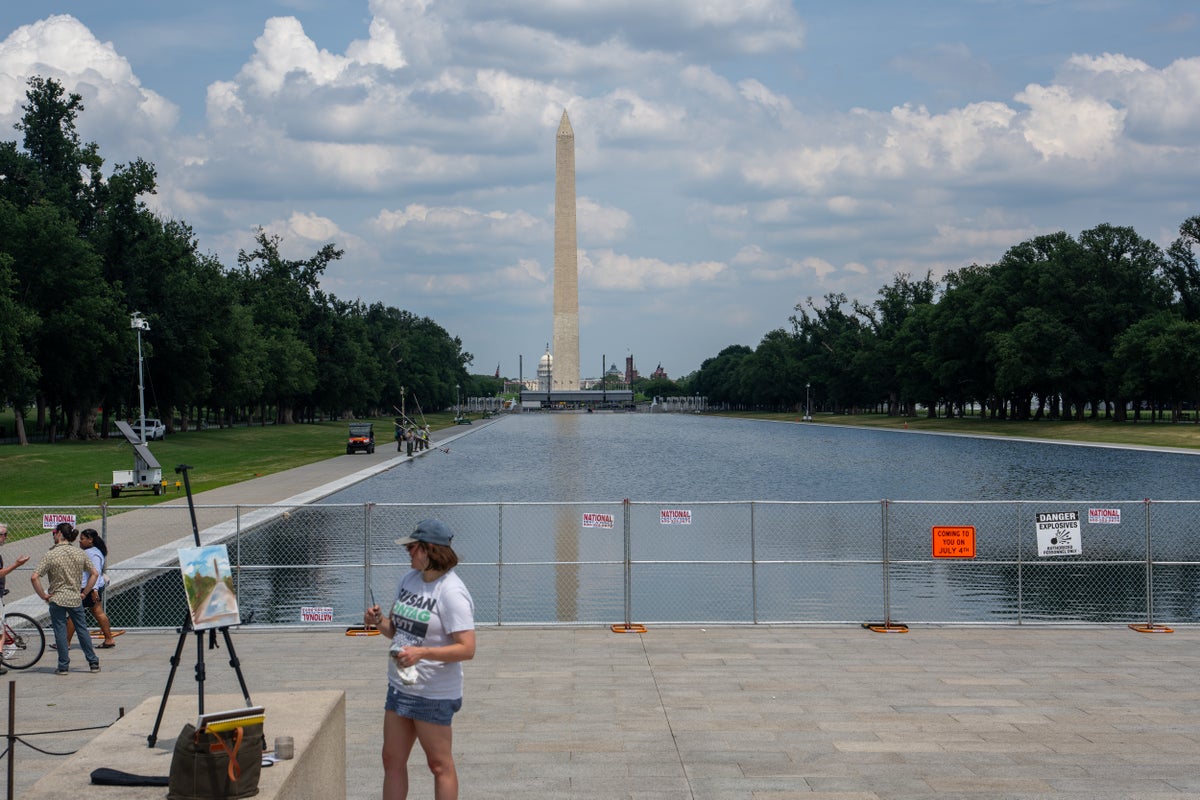
The mainstream media wants you to focus on the political theater of the White House arguing with its own Justice Department over a pool liner.
They are missing the real story.
The lazy consensus says this is a simple tale of political embarrassment: prosecutors dropped charges against a former Olympian accused of tearing up the Lincoln Memorial Reflecting Pool, admitting the damage was actually a botched contractor job. Headlines treat this as a rare moment of bureaucratic rebellion against executive fiat.
That framing is dangerously naive.
Focusing on the turf war between the White House and U.S. Attorney Jeanine Pirro masks a far more systemic institutional failure. We are watching a multi-million-dollar government procurement apparatus crash directly into the laws of physics, and nobody is holding the actual mechanics of federal contracting accountable.
The Anatomy of a $14.7 Million Shortcut
Let us look at the verifiable mechanics of what actually happened at the National Mall.
Virginia-based Atlantic Industrial Coatings secured a 14.7 million dollar no-bid contract to repaint and waterproof the concrete floor of the Lincoln Memorial Reflecting Pool with an American flag blue finish ahead of the nation's 250th anniversary celebrations.
That timeline was an engineering impossibility from day one.
When you rush a polymer coating application on massive outdoor concrete structures under tight political deadlines, chemistry does not care about your ribbon-cutting ceremony. Court filings and internal memos reveal the stark reality:
- Rain and high winds repeatedly delayed sealing expansion joints.
- Sealant products arrived late at the worksite.
- Contractors applied coats over damp surfaces and rushed curing times to beat the clock.
Any commercial contractor who has ever laid industrial waterproof liners on multi-acre concrete basins will tell you the exact same thing. When you apply a coating without proper substrate preparation, delamination is not a risk; it is a mathematical certainty. The material lifts because moisture trapped underneath expands under solar thermal radiation.
Yet, when the blue liner began peeling in sheets within days of completion, the initial reflex from official channels was not to check the moisture meters. It was to call the police.
The Criminalization of Construction Failure
The most disturbing element of the Reflecting Pool saga is how quickly a civil warranty dispute transformed into a criminal prosecution.
The Department of the Interior pointed fingers at citizens, leading to grand jury indictments and arrests for malicious destruction of property. Former Olympic canoeist David Hearn and several others found themselves slapped with federal charges because officials preferred to blame phantom vandals with box cutters rather than admit their own procurement timeline was unworkable.
Imagine a scenario where a commercial real estate developer botches a parking garage membrane, watches it bubble and crack under heavy traffic, and then calls the FBI to arrest tenants for walking on it.
That is essentially what happened in Washington. Prosecutors spent weeks boasting about "tremendous evidence" before a basic visual inspection of the middle of the pool—where no sensible vandal could possibly reach without a boat—revealed widespread, systemic peeling from the bottom up.
When the Department of Justice finally moved to dismiss the charges, they cited withheld documents and flawed installation. But the damage to individuals' reputations and careers was already done. Justin Carreno, a government contractor swept up in the dragnet, reportedly lost his job over an accusation built on administrative deflection.
The Real Procurement Disease
This is not just about a blue pool liner in the District of Columbia. It is a symptom of how large-scale public infrastructure projects operate across the board.
When political entities demand impossible speed for high-profile public milestones, risk management goes out the window. No-bid emergency contracts bypass the rigorous competitive vetting that usually weeds out incapable vendors. When those vendors fail to deliver, the machinery of the state twists itself into knots to protect institutional pride instead of owning up to a bad pour.
We have seen this playbook before. Agencies prioritize optics over engineering standards, hand out massive lump sums without stringent milestones, and then scapegoat the public when the physical reality catches up with the PR campaign.
The Department of the Interior tried to pin structural delamination on a razor blade. The Justice Department eventually blinked because physical evidence in the middle of a drained basin is stubborn and difficult to argue away in front of a judge.
Stop looking at this as a clash of personalities between the Oval Office and federal prosecutors. Start looking at it as an indictment of a procurement system that values speed over specs, and ego over engineering.
The pool liner peeled because the math didn't work. No amount of spin can glue it back down.