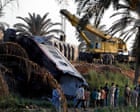
Every time two trains collide in Egypt, the script writes itself before the dust even settles.
Breaking news flashes across screens. A tragic body count—seven dead, dozens injured. Within hours, local authorities announce an urgent investigation. By nightfall, a low-level train driver or a signalman sits in handcuffs, charged with gross negligence. Don't miss our recent article on this related article.
And the media? They eat it up. They frame these disasters as isolated failures of human error or "aging infrastructure" that simply needs a fresh coat of paint and a few billion dollars in shiny new locomotives.
That consensus is lazy, predictable, and dead wrong. To read more about the background here, NPR offers an in-depth summary.
Blaming a driver for a rear-end collision on the Nile Delta line—or anywhere else on the Egyptian National Railways (ENR) network—is like blaming a blindfolded sprinter for running into a brick wall. When you strip away the superficial breaking-news cycle and examine the actual mechanics of railway safety, a brutal truth emerges: you cannot buy your way out of an organizational failure with new rolling stock.
The Fallacy of the "Human Error" Scapegoat
In modern safety engineering, "human error" is rarely a root cause. It is a symptom.
Ask any veteran rail operations director or read the foundational work of safety theorist James Reason on the "Swiss Cheese Model." Accidents in high-risk transport do not happen because one operator had a bad day. They happen when multiple layers of defense—signaling, automated braking, dispatch protocols, maintenance schedules, and management oversight—all fail simultaneously, lining up the holes so a single mistake turns fatal.
Yet, when news outlets report on a collision in Minya, Sohag, or Qalyubia, they treat the crash as a freak aberration caused by a reckless individual.
Look at the mechanics of what actually happens on the tracks. In a functional rail network, a train driver cannot simply plow into the back of a stationary train because they missed a red flag or misread a manual logbook. Modern railways rely on interlocking systems and Positive Train Control (PTC) or European Train Control System (ETCS) standards. If a driver misses a signal, the track communicates directly with the locomotive's onboard computer and slams on the emergency brakes automatically.
When a network operates on manual block signaling—where stationmasters literally call each other on telephones or write down track clearances in paper ledgers—disaster isn't a bug. It is baked into the architecture. Arresting the operator after the metal twists into scrap does nothing to fix the underlying single-point-of-failure design. It merely serves as political theater to appease public outrage until the next crash occurs six months later.
The Shiny Object Syndrome of Infrastructure Spending
The second pillar of the mainstream media's narrative is equally flawed: the idea that throwing massive capital expenditure at new trains solves the crisis.
Over the past decade, Egypt has poured billions of dollars into its transport sector. High-speed rail deals with Siemens, sleek new passenger coaches from Russia and Hungary, and massive monorail projects in Cairo dominate the headlines. Journalists point to these mega-projects as proof that the problem is being solved.
I have watched transport ministries across developing economies make this exact mistake for twenty years. They fall in love with ribbon-cutting ceremonies for gleaming new trains while starving the unglamorous, invisible backbone of the network: track-circuit signaling, axle counters, and institutional safety culture.
Putting a brand-new, high-torque locomotive onto a track governed by 1950s mechanical signaling and poorly maintained switches doesn't make the railway safer. It makes the collisions faster and deadlier.
Consider the physics. Kinetic energy scales with the square of velocity ($E_k = \frac{1}{2}mv^2$). When you upgrade engines to pull heavier loads at higher speeds without simultaneously upgrading the braking distance telemetry and automated signaling blocks, you multiply the destructive force of every single operational slip-up. You aren't modernizing; you are handing a teenager the keys to a Ferrari on a gravel road with no guardrails.
Why "Just Privatize It" Is a Dangerous Myth
Whenever state-run railways suffer repeated casualties, armchair economists immediately jump in with their favorite silver bullet: Privatize the whole thing.
Let's dismantle that premise right now.
Privatization is not a synonym for safety. Ask British commuters about the aftermath of the Railtrack privatization in the late 1990s, which culminated in the horrific Ladbroke Grove and Hatfield rail crashes. When you take a natural monopoly like rail infrastructure and chop it up into profit-driven concessions without ironclad, independent regulatory oversight, maintenance is the first thing cut to boost quarterly margins.
In Egypt, the ENR carries hundreds of millions of passengers annually at heavily subsidized ticket prices. Millions of working-class citizens depend on those dirt-cheap fares to survive. If you hand that network over to private equity without a massive, transparent state subsidy mechanism, one of two things happens:
- Ticket prices skyrocket, pricing out the exact population the railway exists to serve and forcing millions onto overcrowded, equally lethal microbuses on the highways.
- Private operators slash maintenance budgets to squeeze a profit out of low fares, accelerating the physical decay of the tracks.
Neither outcome saves lives.
What People Actually Need to Ask
When a headline reads "Collision of two trains in Egypt kills at least seven," readers naturally search for simple answers: Is it safe to take the train in Egypt? Why do trains keep crashing there?
If you are looking for a comforting lie, look elsewhere. Taking regional commuter lines in Egypt carries a measurably higher risk than taking a high-speed train in Western Europe or Japan. The Express sleeper trains running between Cairo and Aswan generally receive priority dispatching and better maintenance, making them significantly safer than the congested, third-class commuter routes in the Delta.
As for why they keep crashing, stop looking at the tracks and start looking at the reporting structure.
In a safe aviation or rail system, safety investigators operate with total independence from the ministry that runs the trains. Look at the National Transportation Safety Board (NTSB) in the United States or the Rail Accident Investigation Branch (RAIB) in the UK. Their sole mandate is to find out what broke in the system—not to put someone in jail. In fact, they protect whistleblowers and operators who admit mistakes so the agency can fix the flaw before people die.
When the entity investigating the crash reports to the exact same political apparatus that manages the railway—and when admitting a mistake guarantees a prison sentence—every single employee on the line has a massive incentive to hide problems, falsify maintenance logs, and cover their tracks. You destroy the feedback loop required to keep a complex machine running safely.
The Only Fix That Actually Matters
If you want to stop the body count on Egyptian railways, stop building flashy megaprojects for five minutes and execute three brutal, unglamorous reforms:
- Decouple Safety from Criminal Prosecution: Establish a legally independent transport safety board with zero ties to the Ministry of Transport. Grant immunity to rail workers who self-report near-misses and equipment failures. Until a signalman feels safer reporting a broken switch than ignoring it, the crashes will continue.
- Freeze New Rolling Stock Purchases: Redirect every available dollar into completing automated electronic signaling (ETCS Level 1 or 2) across the entire legacy network—especially the high-density Delta commuter lines. Do not buy another passenger coach until every kilometer of active track has automated train protection that overrides human error.
- Enforce Hard Capacity Caps: Overcrowding isn't just uncomfortable; it destroys suspension geometry, extends braking distances beyond engineered limits, and turns survivable derailments into mass-casualty events. Automated turnstiles and strict capacity enforcement must replace the chaotic, open-door boarding culture on regional lines.
The downside to this approach? It wins zero political points. Nobody holds a press conference to celebrate replacing underground copper wiring or rewriting whistleblower protection statutes. It takes years of quiet, tedious bureaucratic warfare, and the results don't look good on a billboard.
But the alternative is already playing out on the evening news. You can keep arresting drivers, keep buying shiny new trains, and keep writing the exact same obituary every few months.


