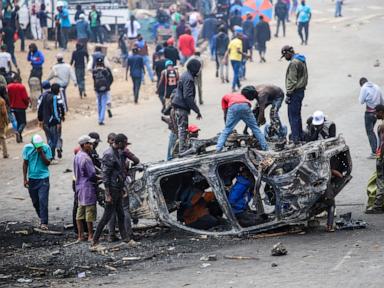
The media is serving up a collective yawn of a narrative regarding the recent two-day transport strike in Kenya. The standard copy-paste reporting sounds identical across major newsrooms: global oil shocks triggered by Middle Eastern instability, a government handcuffed by ballooning national debt, a predictable tragic clash leaving four people dead, and an eventual, uneasy truce called to "allow for consultations."
It is lazy. It is neat. It is entirely wrong.
The mainstream press wants you to believe this is a straightforward story of a helpless developing economy getting crushed by external macro forces. They look at the Energy and Petroleum Regulatory Authority (EPRA) bumping super petrol to KSh 214.25 and diesel to KSh 242.92 per litre and shrug their shoulders. "What can the Ruto administration do?" they ask, echoing Treasury Cabinet Secretary John Mbadi’s defense that this is a global crisis Kenya didn't cause.
I have spent years analyzing emerging market fiscal policies, and I can tell you that blaming external supply shocks or strict IMF austerity mandates is a convenient smoke screen. The explosive rage boiling over on the streets of Nairobi, Nakuru, and Kakamega isn't a reaction to the war in the Middle East. It is a direct response to a protectionist, state-engineered monopoly that has broken the back of Kenya’s most vital economic artery: the transport sector.
The Government-to-Government Farce
Let’s dismantle the premise that Kenya is simply at the mercy of global spot prices. The Transport Sector Alliance explicitly demanded an end to the current government-to-government (G2G) fuel procurement mechanism. Why? Because the G2G deal, sold to the public as a brilliant strategy to lock in stable prices and ease pressure on US dollar reserves, has morphed into a highly inefficient, anti-competitive weight around the neck of the economy.
When you replace a competitive, open-tender free-market system with centralized state procurement, you lose the ability to pivot. Private oil marketers in East Africa have their hands tied while neighboring landlocked nations—who historically relied on Kenya's logistics corridor—manage to maintain lower prices at the pump by sourcing smarter and reacting faster.
The state didn't cushion the blow; the state built the boxing ring. By abandoning an open fuel procurement framework, the government insulated a handful of politically connected entities from true market competition. The 23.5% surge in diesel prices that grounded the matatus and boda bodas wasn’t just an act of God or an act of war; it was the bill coming due for a flawed, state-backed monopoly.
The Math the Treasury Doesn't Want You to Do
The government claims its hands are tied because it needs fuel tax revenue to service its massive sovereign debt. This is the classic "fiscal responsibility" defense. But it relies on a fundamental misunderstanding of economic elasticity.
Economist XN Iraki noted that a single day of total transport paralysis costs the Kenyan economy roughly KSh 50 billion ($390 million).
Take a look at how the math actually breaks down when a government over-taxes a primary input like diesel:
| Economic Metric | The State's Theoretical Model | The Real-World Friction |
|---|---|---|
| Tax Rate on Fuel | Maximized to hit IMF deficit targets. | Reaches a tipping point of negative returns. |
| Transport Sector Activity | Assumed to be inelastic (people always need to travel). | Complete shutdown; matatus park, commerce freezes. |
| Daily GDP Impact | Negligible short-term friction. | KSh 50 Billion loss per day in broader economic velocity. |
| Net Fiscal Position | Increased tax revenue collected per litre. | Massive net loss in VAT, business taxes, and productivity. |
Choking out the transport sector to collect an extra silver coin at the pump is a losing strategy. The public transport system in Kenya isn't a luxury; it is the infrastructure. When the government treats diesel as a cash cow rather than a foundational economic utility, it directly cannibalizes its own tax base. The country loses more in aggregate economic activity in a 48-hour shutdown than it could ever hope to claw back through inflated petroleum levies.
Dismantling the Agitator Narrative
Interior Minister Kipchumba Murkomen was quick to deploy the standard political playbook: blame the violence on "criminal elements" and claim the protests were "hijacked by political actors for political ends."
This is an insult to the intelligence of the business owners and transport operators who backed this shutdown. The Transport Sector Alliance comprises passenger operators, cargo logistics firms, ride-hailing drivers, and driving schools. These are not professional political agitators. These are the literal gears of the Kenyan economy.
When a matatu driver refuses to turn the key because the cost of diesel makes the route a net-negative venture, that isn't a political stunt. It's basic accounting. The consensus narrative tries to frame the suspension of the strike after two days as a victory for state diplomacy. It isn't. It is a temporary pause because the formal and informal business sectors cannot survive a prolonged cardiac arrest.
The Real Cost of "Cushioning"
The energy regulator proudly pointed out that the government spent $38.5 million to cushion consumers from even higher prices in the latest review. We need to stop calling these state interventions "subsidies" or "cushions." They are market-distorting band-aids paid for by the very taxpayers they claim to protect.
A true counter-intuitive approach to fixing Kenya's recurring energy crises doesn't involve more state funds thrown at temporary relief or suspending fuel quality standards as authorities did last month—a move that risks destroying vehicle engines and driving up maintenance costs for operators.
Instead, the solution requires a brutal unwinding of state involvement:
- Abolish the G2G procurement monopoly immediately and return to an aggressive, transparent, open-tender market.
- Decouple the fuel pricing formula from fixed, arbitrary domestic tax targets that ignore localized economic realities.
- Acknowledge that the transport network is a productivity multiplier, not an extraction zone for a cash-strapped Treasury.
The suspension of this strike is a countdown timer, not a solution. Until the underlying structural protectionism is dismantled, the next global tremor will instantly trigger the exact same chaos on the streets of Nairobi.