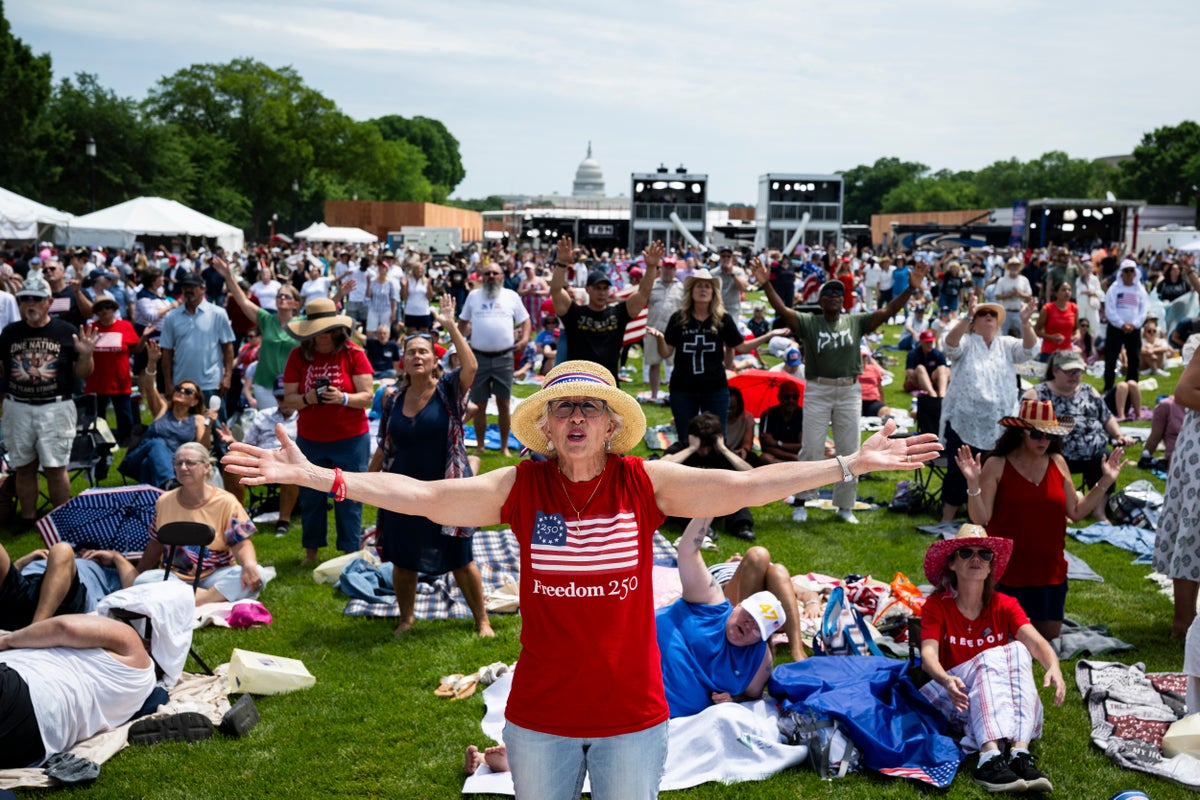
The internet loves a cheap coincidence. When news broke that several high-profile musical acts backed out of the "Freedom 250" concert series—a planned celebration of America’s 250th anniversary backed by Donald Trump—the media didn't focus on the structural decay of live entertainment branding. Instead, they hyper-fixated on a name. The veteran talent recruiter booking the talent happens to be named Jeff Epstein, co-owner of Universal Attractions Agency.
Predictably, the tabloids and low-effort commentators pounced on the name alignment, treating it like a cosmic joke or some dark, conspiratorial punchline. The consensus narrative became lazy and predictable: a trainwreck concert event associated with a divisive political figure, helmed by an agent cursed with the most unfortunate name in modern history, inevitably collapses under the weight of its own bad optics. In related developments, read about: Why Oasis Overtaking The Beatles is a Meaningless Streaming Illusion.
This coverage is completely missing the point. Jeff Epstein of Universal Attractions Agency is a highly respected, multi-decade music industry executive who co-created the massive "I Love the '90s" tour and has repped legends from James Brown to MC Hammer. His name is an accidental distraction. The collapse of the Freedom 250 concert series isn't a failure of talent recruitment, nor is it a simple byproduct of internet mockery.
The real breakdown reveals a fundamental rule of live entertainment that modern event organizers continue to ignore at their own peril: you cannot sell a purely political rally disguised as a non-partisan cultural celebration, and you cannot expect mainstream artists to protect your brand when their own fanbases are fragmented. Deadline has also covered this critical subject in great detail.
The Myth of the Neutral Mega-Event
The standard post-mortem on the Freedom 250 collapse claims that performers like Bret Michaels and Martina McBride suddenly realized the event was "too divisive" and pulled out to protect their integrity. This assumes a level of naive surprise that simply does not exist in professional talent management.
Let's dismantle how these bookings actually work. Agents don't sign contracts worth hundreds of thousands of dollars in a vacuum. I have seen booking teams spend months vetting the capital structure, corporate sponsors, and political alignment of major festival offers before a single pen touches paper.
The idea that these artists were "misled" into thinking a Trump-backed anniversary event on the National Mall would be a quiet, bipartisan flag-waving affair is absurd. What actually changed wasn't the nature of the event; it was the realization that the event's PR strategy offered zero cover for the talent.
When a public-private entity books legacy acts, the unspoken contract is that the corporate framework will insulate the artist from political fallout. The moment Donald Trump took to social media to call for replacing the "overpriced singers" with a massive political rally headlined by himself, he didn't just kill the concert series—he proved that the event's structural insulation was nonexistent.
The Fragility of the Legacy Act Economy
To understand why the talent fled the National Mall line-up, you have to look closely at the mechanics of the legacy artist economy. Mainstream media mocked the remaining roster—featuring names like Vanilla Ice and C+C Music Factory—as a relic of decades past. But there is a precise economic reality governing these choices.
Legacy artists rely entirely on a delicate, multi-generational nostalgia loop. Unlike contemporary pop stars who command fiercely loyal, highly mobilized fanbases willing to defend their political choices online, older heritage acts survive on general goodwill and casual ticket buyers.
- Contemporary Stars: Can weather a political storm because their core audience views the artist's identity as part of their own.
- Legacy Acts: Cannot risk alienation. A country icon or an 80s rock frontman cannot lose 30% of their touring demographic over a single festival booking because they do not have the streaming volume to replace that live ticket revenue.
When an event becomes radioactive, the calculated financial downside of performing far outweighs the guarantee check. Jeff Epstein did his job perfectly: he secured recognizable, cross-demographic talent capable of filling a massive outdoor space. The failure occurred because the event organizers broke the cardinal rule of experiential branding: never force your talent to choose between their payout and their permanent fan base.
The Illusion of Audience Aggregation
The broader structural lesson here is that the era of the monocultural mega-concert is dead. The premise behind Freedom 250 was that you could aggregate a massive, ideologically diverse crowd using a generic patriotic hook and a roster of nostalgia acts.
"Imagine a scenario where a brand attempts to launch a massive national festival celebrating a major milestone, using legacy music as the primary draw, only to realize that the cultural landscape is so balkanized that the event itself becomes a proxy war for the audience's identity."
That is exactly what played out in Washington. In the modern live entertainment ecosystem, audiences do not aggregate around passive concepts like a national birthday anymore. They aggregate around shared cultural identities, specific subgenres, and curated communities.
When the festival identity is completely undefined or violently shifting from a non-partisan celebration to a political rally, the audience matrix shatters. The artists didn't catch "the yips," as the public statements claimed. They executed a rational, risk-mitigating corporate retreat from an unstable platform.
Stop Asking the Wrong Questions About Booking Failures
When industry observers ask, "How did the booking team let this happen?" they are operating under a flawed premise. They think a talent agency's job is to ensure the political harmony of a festival line-up. It isn't. An agency's job is to secure the highest possible guarantees for its roster under terms that are executable at the time of signing.
Universal Attractions Agency executed its mandate. The collapse of the concert series lies squarely on the operational chaos of the event's leadership, which valued a polarizing public narrative over the structural stability of the production. When a client actively undercuts the viability of their own talent roster by labeling them "Third Rate 'Artists'" on public forums, the contract is effectively dead before the legal teams even exchange breach notices.
The real takeaway from the Freedom 250 debacle has nothing to do with internet name coincidences or celebrity cold feet. It is a stark reminder that in the modern live events space, corporate and political organizers can no longer use musical talent as a shield for their lack of a cohesive, stable brand strategy. If you build an unstable stage, do not be surprised when the performers refuse to stand on it.