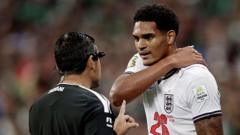
The Football Association is currently engaged in one of the most embarrassing displays of bureaucratic whimpering in modern sporting history. Following Jarell Quansah’s straight red card in England's chaotic 3-2 victory over Mexico at the Estadio Azteca, the FA is reportedly "evaluating options" to appeal the automatic one-match ban. British politicians have even crawled out of the woodwork, writing letters to Gianni Infantino demanding that England receive the same disciplinary reprieve handed to US striker Folarin Balogun.
This entire campaign is a pathetic, logically bankrupt deflection. It completely misreads the laws of the game, demonstrates a toxic reliance on backroom political favors, and threatens to derail Thomas Tuchel’s World Cup campaign by focusing on courtroom optics instead of pitch-side reality.
I have spent decades watching football associations burn millions on desperate legal appeals, and the script never changes. Executives panic, point fingers at administrative anomalies, and try to escape the consequences of their own systemic failures. The lazy consensus dominating the back pages right now is simple: "The US got away with it via political meddling, so England must demand equal treatment."
That logic is a disease. The reality is that Jarell Quansah committed a textbook, dangerous foul that deserved a red card, and trying to leverage a corrupt political precedent to save him is an insult to the sport.
The Myth of the Clean Tackle
Let’s dismantle the absolute fiction that Quansah was hard done by. The immediate reaction from partisan pundits followed a tired, archaic playbook: "He played the ball first."
In the modern game, playing the ball is completely irrelevant if your follow-through plants six metal studs directly into an opponent’s shin. During the 54th minute in Mexico City, Quansah lunged into a sliding challenge on Jesus Gallardo. While his foot did make initial contact with the ball, his momentum carried his leg over the top, catching the Mexican full-back in a manner that endangered his safety.
Former match officials like Darren Cann immediately pointed out that under law 12, this is a clear-cut case of serious foul play. The Video Assistant Referee did exactly what it was designed to do: it removed the emotion of a roaring Azteca crowd, presented referee Alireza Faghani with the cold, hard physics of the impact, and forced a correct dismissal.
To appeal this decision is to argue that the rules of gravity and player safety should be suspended because England has an injury crisis at right-back. It is an argument built on pure entitlement.
The Trump Precedent is a Toxic Mirage
The driving force behind the FA’s sudden legal bravery isn't a belief in Quansah’s innocence; it is pure envy over the Folarin Balogun situation. The US striker was dismissed against Bosnia and Herzegovina, yet had his suspension mysteriously "deferred" under Article 27 of the FIFA disciplinary code after a direct phone call between Donald Trump and Gianni Infantino.
Thomas Tuchel was entirely correct when he asked where this line is drawn. If political leaders can simply call the head of FIFA to erase sporting bans, the entire competitive integrity of international football collapses.
But the FA’s response to this corruption is mind-bogglingly hypocritical. Instead of condemning the weaponization of political influence in football, the British establishment is actively trying to copy it. Labour MPs Noah Law and Melanie Onn writing formal letters to FIFA begging for a mirroring reprieve is secondary-school playground logic. "They cheated the system, so we should get to cheat it too" is not a legal strategy. It is a confession of moral bankruptcy.
Imagine a scenario where every single nation in the quarter-finals commands their prime ministers and presidents to lobby FIFA for amnesty before a match. The tournament ceases to be a football competition and turns into a geopolitical G20 summit masquerading as a sporting event. By participating in this circus, the FA is legitimizing the very backroom corruption they usually love to self-righteously criticize from their offices in Wembley.
The High Cost of Legal Distraction
Even if we look at this through a purely cynical, pragmatic lens, the FA's legal maneuvers are an active detriment to Thomas Tuchel’s tactical preparations. England is preparing to face a lethal Norway team in Miami, spearheaded by a rested Erling Haaland. Every minute spent by the coaching staff reviewing legal briefs and drafting appeals is a minute lost to solving the actual crisis on the field.
Quansah was only playing right-back because Tuchel’s squad has been hollowed out by defensive injuries. He is a natural center-back playing out of position. The red card didn't just cost England a player for the final half-hour in Mexico; it exposed the sheer vulnerability of England's defensive depth.
Trying to force Quansah back into the lineup via a bureaucratic loophole is short-sighted. If the FA somehow succeeds in delaying the ban under Article 27, they don't erase the suspension; they merely kick the can down the road. A deferred ban means Quansah would remain eligible for the quarter-final but would be a ticking disciplinary time bomb, potentially missing a semi-final or the World Cup final itself.
The downside to accepting the ban is simple: Ezri Konsa or John Stones has to play out of position at right-back against Norway. It is a difficult tactical puzzle, but it is an honest one. Tuchel is paid millions to engineer defensive masterclasses under pressure, just as he did when dropping Stones into the backline immediately after the red card to secure the 3-2 win. Trust the manager's tactical acumen instead of relying on FIFA’s compromised judicial bodies.
Dismantling the Premier League Entitlement
The underlying issue here is a deep-seated cultural arrogance within English football. The domestic media and the national setup have become so accustomed to dominating the financial and cultural discussion that they expect international rules to bend to their narrative.
When a decision goes against an English player on the world stage, the default assumption is never that the player made a reckless error. The assumption is always that there is a conspiracy, a flawed VAR protocol, or an administrative injustice that needs to be corrected by suit-wearing executives.
Look at the brutal honesty required to win tournaments. True champions do not spend the 48 hours following a grueling knockout victory crying to FIFA about consistency. They adapt. They look at the footage, acknowledge that a young defender made a rash decision in a high-intensity environment, and they fix the tactical shape for the next opponent.
The Actionable Order for Wembley
The FA needs to rip up the letters, cancel the meetings with FIFA lawyers, and issue a public statement backing the integrity of the refereeing decision.
Stop looking at Washington and FIFA headquarters for permission to compete on a level playing field. The US Soccer federation's backroom deal for Balogun will remain a permanent stain on this tournament. Compounding that stain by demanding an equally greasy favor for Quansah does not create fairness; it codifies corruption as the standard operating procedure for the knockout rounds.
The premise of the question facing English football right now is entirely wrong. The FA shouldn't be asking, "How do we get Quansah off the hook?" They should be asking, "Why are we so terrified of playing Norway without a temporary right-back that we are willing to compromise our institutional integrity?"
Beat Norway on the pitch, with eleven men who earned their right to be there, or go home. Those are the only options an elite football nation should ever consider. Anything else is just cowardice disguised as administration.


