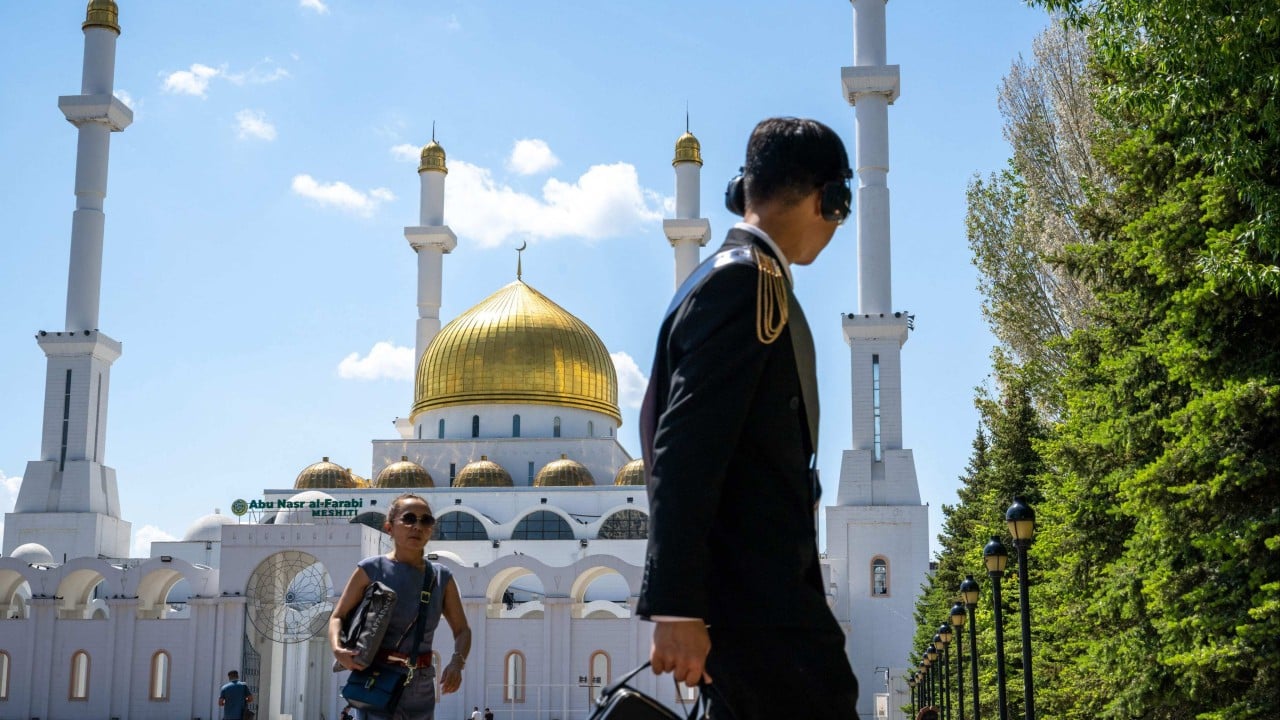
The wind in Astana does not care about geopolitics. It blows fierce and cold straight from the Siberian plains, cutting through the gaps between futuristic skyscrapers that look like they were dropped into the Kazakh grassland by an alien civilization.
For centuries, men sitting in comfortable offices in London, Moscow, and Washington looked at a map of this region and saw a giant, empty void. They called it the "Heartland." They called it the "Pivot of History." Most famously, they called it the Grand Chessboard. In this sweeping narrative, the millions of people living between the Caspian Sea and the borders of China were reduced to mere wooden pieces, moved at the whim of foreign emperors.
But if you sit in a bustling café in Tashkent or walk the neon-lit avenues of Almaty today, you quickly realize something profound.
The pieces are moving themselves.
The Ghost of the Great Game
Consider a hypothetical merchant named Alisher. He is thirty-five, speaks fluent Uzbek, Russian, and English, and runs a logistics firm out of Samarkand. For generations, Alisher’s ancestors had to look north for permission to breathe. During the Tsarist and Soviet eras, the train tracks, the pipelines, and the highways all pointed toward Moscow. If Central Asia wanted to talk to the world, it had to route the conversation through a Russian switchboard.
That was the old reality. Cold. Hard. Inflexible.
When the Soviet Union collapsed in 1991, five new nations emerged blinked into the sunlight of independence: Kazakhstan, Uzbekistan, Turkmenistan, Kyrgyzstan, and Tajikistan. The world expected them to fracture. Pundits predicted ethnic chaos, economic ruin, or immediate re-absorption into a neighboring empire.
Instead, a quiet revolution took place.
It did not happen overnight with a dramatic tearing down of statues. It happened dollar by dollar, track by track, and diplomatic summit by summit. The strategic isolation that once made these countries vulnerable became their greatest asset. They sit precisely where the global economy needs to flow.
Multi-Vectoring the Future
Western analysts often look at Central Asia and ask a binary question: Is this region under Russia's thumb, or is it falling into China's wallet?
This question is fundamentally wrong. It misses the entire strategy of modern Central Asian statecraft, a concept diplomats call "multi-vector foreign policy."
To understand how this works in real life, look at how Kazakhstan handles its energy exports. Under the old system, Europe bought Kazakh oil, but Russia controlled the pipes. When geopolitical tensions spiked, those pipes mysteriously required "technical maintenance."
So, what did the region do? They did not start a war. They simply built other options.
Today, Chinese capital funds highways stretching east. European green energy initiatives plant massive wind farms across the plains. Meanwhile, regional leaders are actively opening up the Trans-Caspian International Transport Route—the Middle Corridor. This network of ships, rails, and roads bypasses sanctioned territories entirely, linking the factories of Asia directly to the markets of Europe.
It is a masterclass in playing giants off against one another. If one neighbor closes a door, Central Asia opens a window to the south, an avenue to the east, and a shipping lane to the west.
The View from the Street
This is not just about pipelines and billionaire state funds. The real shift is cultural, generational, and deeply human.
Over sixty percent of the population in Central Asia is under the age of thirty. This youth bulge represents a massive demographic shift. These young people do not remember the Soviet Union. They do not view Moscow as the default center of the universe, nor do they look at Beijing with wide-eyed reverence.
Step into a co-working space in Bishkek. The teenagers there are coding apps for German tech firms while drinking Turkish coffee and listening to K-pop. They are hyper-connected, fiercely patriotic, and intensely pragmatic.
The language dynamics tell the story beautifully. While Russian remains a useful tool for commerce across borders, the usage of local state languages like Kazakh and Uzbek is surging. Simultaneously, the demand for English instruction has skyrocketed. It is not an ideological shift; it is a practical one. English is the language of the global market, and these societies want direct access to that market without a middleman.
The old empires used to think they could control the region by controlling its elites. But you cannot control a population that sees the entire globe as their potential audience.
Breaking the Landlocked Curse
Geography used to be destiny. Being landlocked was considered an economic death sentence, a structural flaw that kept nations poor and dependent on coastal neighbors. Uzbekistan faces an even steeper challenge: it is one of only two doubly landlocked countries in the world, meaning its citizens must cross at least two independent states just to reach an ocean.
But the definition of distance is changing.
In a world disrupted by maritime chokepoints, supply chain vulnerabilities, and shifting geopolitical alliances, overland connectivity has become incredibly valuable. Central Asia is transforming itself from a landlocked barrier into a land-linked bridge.
The infrastructure cutting through these mountains and deserts is staggering. Freight trains that used to take a month to travel from coastal China to Central Europe now make the journey across the Eurasian steppes in less than two weeks.
The stakes are invisible but immense. Every time a new rail line is laid, a layer of old colonial dependence peels away. Every time a regional trade agreement is signed between Tashkent and Astana without an external superpower in the room, the old narrative of the "Great Game" loses its power.
The New Architecture of Cooperation
For a long time, the biggest critique of Central Asia was that the republics did not get along with each other. Border disputes left over from poorly drawn Soviet maps caused friction. Water rights in the fertile Fergana Valley sparked localized conflicts. Superpowers exploited these divisions, keeping the region fragmented to maintain influence.
That strategy is failing.
A profound internal alignment is occurring. Leaders across the five nations are meeting regularly, solving their own border issues, and creating regional trade zones. They have realized that their strength lies in collective bargaining. When a single Central Asian nation speaks to Washington, Brussels, or Beijing, it can be ignored. When a unified bloc of eighty million people speaks, the world listens.
This is not to say the path forward is smooth. The challenges are real and heavy. Climate change is shrinking the glaciers of the Tien Shan mountains, threatening the region's water supply. Transitioning away from authoritarian legacies toward more open governance is a slow, halting process. The shadow of powerful neighbors will always loom large over their borders.
Yet, the fundamental trajectory has shifted. The days of treating Central Asia as a passive prize to be won or a buffer zone to be managed are over.
Watch a sunset over the Registan in Samarkand, where the ancient blue tiles have witnessed the rise and fall of countless conquering armies. The conquerors always leave. The people of the steppe remain, writing their own rules, trading on their own terms, and steering their own destiny into a new century.