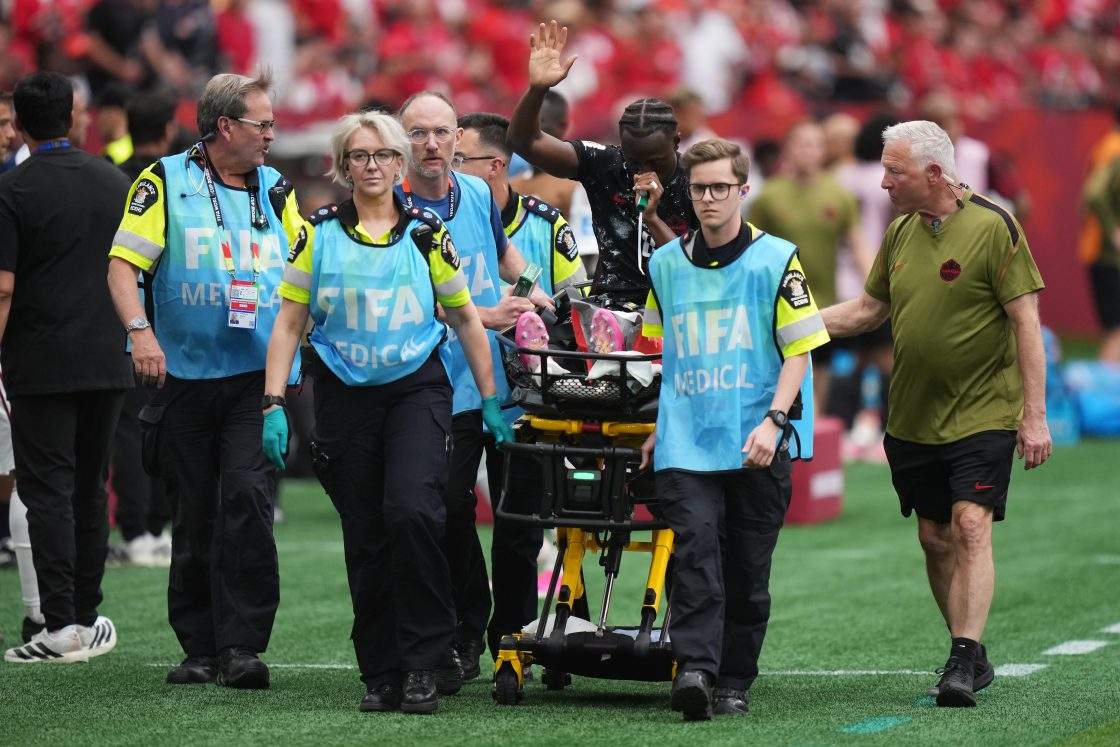
The media fell in love with a plastic tube during the 2026 FIFA World Cup. When Canadian midfielder Ismaël Koné went down with a horrific tibia and fibula fracture following a brutal challenge from Qatar's Assim Madibo, the narrative shifted instantly from the tragedy of a ruined tournament to a shiny medical novelty. Cameras zoomed in on Koné sucking on a bright green device on his stretcher.
The internet did what it always does: it obsessed over the gadget. "What is the green whistle?" headlined every major sports and news outlet. Out came the standard, lazy medical explainers. Journalists copy-pasted medical brochures, breathlessly celebrating Penthrox—the brand name for inhaled methoxyflurane—as a miracle of modern sports medicine. They called it a "game-changer" without realizing they were falling hook, line, and sinker for a half-century-old chemical rebrand.
I have spent over a decade working alongside sports medicine personnel and elite training staffs. I have seen teams spend millions trying to optimize recovery and pain management. The consensus surrounding the green whistle is deeply flawed. The public is being fed a romanticized version of on-field trauma care that ignores medical history, downplays severe physiological trade-offs, and misunderstands why the device is actually used.
The green whistle did not save Ismaël Koné. It did what a simple shot or an ice pack couldn't do logistically, but treating it like a revolutionary medical breakthrough is a symptom of historical amnesia.
The Illusion of Modern Innovation
The biggest lie circulating about the green whistle is that it represents the cutting edge of sports science. It does not.
Methoxyflurane was first synthesized in the late 1940s and introduced as a general anesthetic in the United States in the 1960s. It was not a sports medicine miracle; it was a heavy-duty surgical knock-out gas. By the 1970s, the medical establishment largely abandoned it for full anesthesia because high doses were linked to severe nephrotoxicity—otherwise known as kidney failure.
While the United States pulled it from wide distribution due to these toxicity concerns, medical teams in Australia and New Zealand realized that at incredibly low, self-administered doses, it worked as a highly effective pain reliever without knocking the patient unconscious.
When you watch a footballer inhale from that green tube, they are breathing in a diluted version of a drug that the American Food and Drug Administration kept banned for decades. It only achieved approval from Health Canada in 2022. Calling this a "new" innovation is like calling a record player a breakthrough in audio engineering. It is an old, toxic anesthetic repackaged in an ergonomic plastic pipe.
The Real Reason It Is on the Pitch
The mainstream media asserts that sports teams use the green whistle because it provides superior pain relief to traditional methods. This is fundamentally incorrect.
If supreme pain eradication were the goal, an intravenous line of a strong opioid or a fast-acting synthetic sedative would win every single time. The green whistle is not used because it is the most effective painkiller; it is used because elite sporting environments are a logistical nightmare.
Imagine a scenario where a player snaps his leg in front of 50,000 screaming fans. The pitch is an open arena, not a sterile hospital room. Setting up an intravenous line to administer heavy narcotics requires:
- Finding a vein on a severely dehydrated, shock-addled athlete.
- Lugging around sterile IV kits, sharps containers, and controlled substance lockboxes.
- Immediate, continuous monitoring of blood pressure and respiratory depression.
The green whistle bypasses every single operational hurdle. It is a disposable, lightweight piece of plastic. A doctor pours 3 ml of liquid methoxyflurane into the chamber, hooks up a carbon filter to catch the exhaled gas so the medical staff doesn't accidentally get high, and hands it to the player.
The magic of the device is not chemical; it is behavioral. It is a self-titrating system. Because the patient must actively hold the whistle to their mouth and breathe in to get the drug, they cannot overdose. If they become too drowsy or slip out of consciousness, their hand drops, the whistle falls away, and the drug delivery stops.
It is a tool born of medical laziness and logistical convenience, not clinical superiority. It buys the medical staff 20 minutes of compliance so they can load a screaming, 180-pound athlete onto a cart without him thrashing around and worsening a compound fracture.
The Hidden Physiological Cost
The media paints Penthrox as a harmless puff of "laughing gas" that makes players giggly and relaxed. This casual dismissal of its chemical profile is dangerous. Methoxyflurane does not just turn off pain signals in the brain; it heavily taxes the internal organs.
The liver and kidneys bear the brunt of metabolizing the drug. While the 3 ml dose inside a standard sports inhaler is generally below the threshold for acute organ damage, it is far from harmless—especially to an elite athlete who has just spent an hour running at maximum intensity.
During a high-stakes match, a player like Koné is operating in a state of acute physical stress:
- High core body temperature.
- Severe dehydration.
- Reduced blood flow to visceral organs as the body prioritizes the skeletal muscles.
Introducing a nephrotoxic agent to kidneys that are already struggling with low blood volume is a massive gamble. There is a reason medical guidelines strictly forbid using the green whistle on anyone with pre-existing renal or hepatic issues, or anyone who has received the drug within the last 48 hours. It is a calculated risk, a messy compromise where sports doctors decide that the immediate benefit of calming a panicked player outweighs the subtle, toxic strain placed on their filtration systems.
Dismantling the Fan Culture
The sudden viral fame of the green whistle has sparked a deeply flawed perspective among fans and amateur athletes who now openly ask why they cannot buy these devices at a local pharmacy or keep them in a standard first-aid kit.
The premise of the question is entirely broken. The green whistle belongs strictly in the hands of trained emergency personnel. Without proper scavenging filters and clinical oversight, the exhaled gas poses an immediate secondhand hazard to anyone standing nearby. Furthermore, treating severe trauma pain by simply masking it with an inhaled anesthetic without diagnosing the underlying structural damage—like Koné's fractured tibia—can lead to catastrophic secondary injuries if a patient attempts to bear weight.
The sports world does not need more gimmicks, and it does not need to romanticize a vintage anesthetic disguised as a high-tech tool. The green whistle is a crude, effective, logistically convenient stopgap. Nothing more, nothing less. Stop treating it like a miracle.