Public fascination with political spouses often eclipses substantive policy debates. When a former president stands before the United Nations General Assembly and singles out his wife seated quietly in the audience, the reaction reveals more about the mechanics of modern media than international diplomacy. Cameras instantly pivot. Pundits dissect a wave, a smile, or the lack thereof. This phenomenon is not accidental. It is the result of carefully managed public choreography designed to capture attention in an era saturated with noise.
The United Nations Stage and the Anatomy of Public Visibility
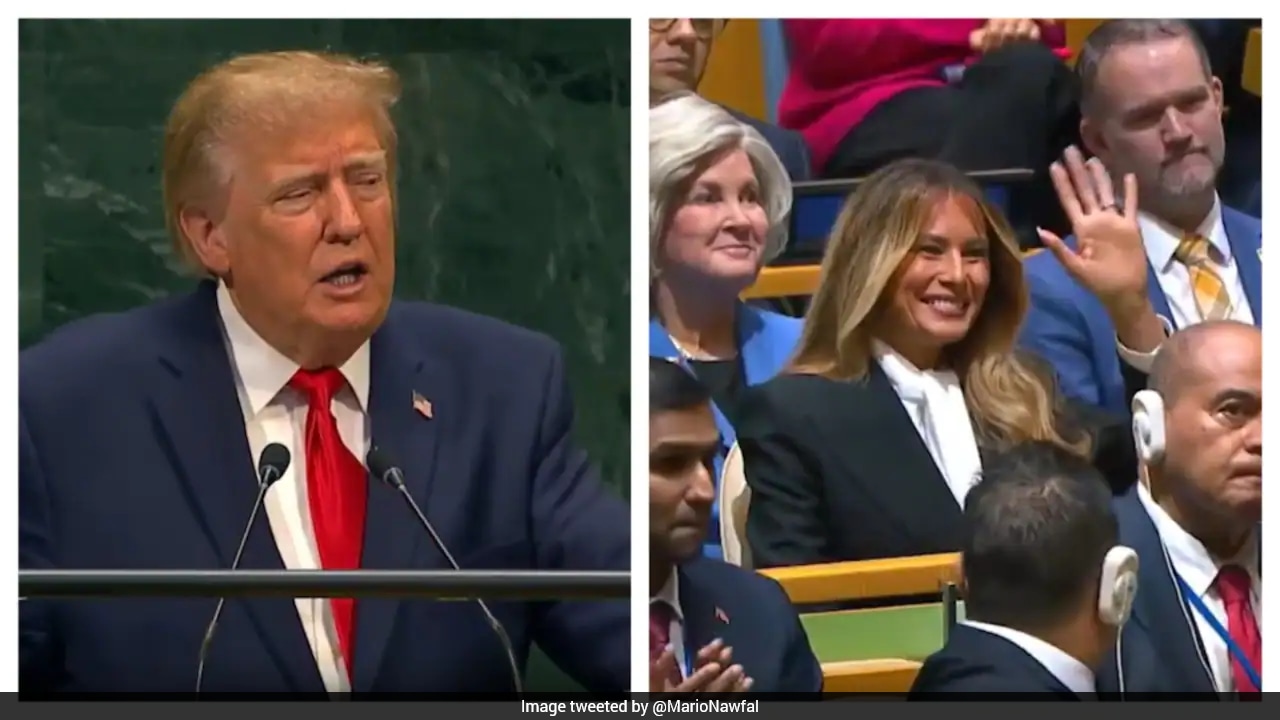
The United Nations headquarters in New York represents a unique theater of power. Leaders from across the globe gather under one roof to deliver carefully calibrated messages to domestic and international audiences. Every gesture carries weight. Every empty seat sparks speculation. When Donald Trump paused his address to acknowledge Melania Trump, the auditorium shifted from formal diplomatic solemnity to a familiar spectacle of celebrity politics. The audience responded with polite recognition, but the real audience was millions of viewers watching through screens across the globe.
Media outlets scrambled to frame the moment. Headlines questioned her whereabouts prior to the event, treating a private citizen's schedule like a national security puzzle. This routine interrogation highlights an enduring obsession with political spouses. Observers demand constant visibility, interpreting every absence as a sign of marital strain or political dissent. Yet, maintaining distance can also function as a deliberate strategy. By controlling exposure, a public figure preserves an aura of mystery in a media environment that typically demands total transparency.
Political spouses occupy an ambiguous space. They are neither elected officials nor ordinary citizens, yet they are subjected to intense public scrutiny. Historically, the role of the spouse involved hosting receptions, championing soft-policy initiatives, and standing dutifully behind the podium during campaign announcements. Over recent decades, this template has fractured. Some partners embrace aggressive advocacy campaigns, while others retreat entirely from public view, choosing discretion over constant campaign exposure.
Crafting Absence as a Political Statement
Melania Trump redefined the boundaries of the role during her time in the White House and continues to navigate public appearances on her own terms. Her approach challenges traditional expectations of political spouses. Traditional norms dictate constant smiling, relentless handshaking, and enthusiastic endorsement of every political maneuver. Deviation from this script triggers endless speculation from commentators seeking hidden meanings in neutral expressions.
Consider the mechanics of the modern news cycle. Networks require continuous narrative hooks to hold viewer attention. A prominent figure sitting silently in an auditorium provides a blank canvas for projected anxieties and political narratives. If she smiles, analysts claim she endorses the rhetoric. If she maintains a neutral expression, critics declare it a sign of silent protest. Every interpretation says more about the observer than the observed. This projection engine thrives on ambiguity, turning ordinary human behavior into high-stakes psychodrama.
Diplomatic settings amplify this effect. The General Assembly hall is a chamber built for grand rhetoric and symbolic posturing. Heads of state project strength, urgency, and moral authority to domestic voters just as much as foreign peers. A spouse seated in the gallery serves a dual purpose. On one hand, it humanizes the speaker, projecting a traditional image of family stability. On the other hand, it acts as a visual anchor, drawing the viewer's eye away from potentially controversial policy statements toward a comforting domestic tableau.
Analyzing the reactions to such moments reveals deep divisions in political culture. Supporters view selective visibility as a sign of independence, praising a spouse who refuses to play the traditional political theater game. Detractors view the same behavior as aloofness or calculated detachment, arguing that public figures owe complete transparency to the electorate. Both perspectives miss the underlying reality. Modern political figures operate within a hyper-mediated environment where every public appearance is weighed against potential electoral advantage.
The Mechanics of Modern Political Marriages under Media Lenses
The transition from official duties to private life does not end media curiosity. Former leaders and their families remain permanent fixtures in the public consciousness, subject to the same relentless scrutiny as active officeholders. When an appearance happens at a high-profile international venue, the old machinery spins back into motion instantly. Photographers jostle for position. Reporters count seconds of eye contact. Editors craft headlines designed to provoke maximum engagement on social media platforms.
Understanding this dynamic requires looking past the surface performance. The interaction between a speaker on a podium and a spouse in the audience is a well-tested ritual of American politics. It borrows from the playbook of celebrity culture, where personal lives are endlessly merchandised for public consumption. Even when a figure attempts to step back from the spotlight, the cultural machinery pulls them back into the narrative frame whenever convenience dictates.
The insistence on constant access to private lives stems from a broader cultural shift. Audiences no longer accept the boundary between public office and private existence. Every public figure is expected to perform authenticity 24 hours a day. When someone resists this demand by offering sparse public appearances or carefully guarded silence, the reaction is often disproportionate hostility or obsessive inquiry.
Examining the coverage of these events exposes the fragile nature of political reporting. Substance frequently takes a backseat to symbolism. While world leaders debate climate change, trade agreements, and regional conflicts, headline space is dedicated to analyzing a wave from the gallery. This imbalance reflects what audiences consume most eagerly. Drama outsells diplomacy in a crowded media marketplace.
Public Spectacle versus Private Strategy
The strategy of controlled scarcity remains effective precisely because people crave what they cannot easily access. By limiting public remarks and infrequent appearances, a figure maintains control over their own narrative. Every rare sighting becomes an event, commanding disproportionate attention compared to constant, overexposed media campaigns. This creates a distinct power dynamic between the subject and the press corps. The press demands access, while the subject withholds it, driving up the perceived value of any interaction.
Critics often underestimate the discipline required to maintain this posture over years of intense public life. Sustaining a neutral, unreadable public persona in front of international cameras requires immense focus. Every movement is scrutinized by thousands of analysts armed with slow-motion playback tools. Under such conditions, standard human reactions are treated as encrypted political signals.
This environment alters how political families interact with public institutions. Instead of viewing public appearances as civic obligations, they become calculated risks. Every outing is weighed against the certainty of media distortion. Consequently, protective measures increase, access narrows, and the distance between the public and public figures widens further.
The ripple effects extend across the entire political ecosystem. Campaign strategists now factor spouse visibility into polling models. Focus groups evaluate how public perceptions of a spouse influence undecided voters. The personal becomes thoroughly professionalized, stripped of spontaneity and converted into a tactical asset.
The Unspoken Rules of Diplomatic Pageantry
Reflecting on these dynamics sheds light on why political theater remains endlessly compelling despite its predictability. Viewers tune in not for the policy declarations, which are often recycled from previous speeches, but for the unscripted moments of human interaction or the perceived tensions beneath the surface. The wave from the audience at the United Nations is a microcosm of this reality. It is a fleeting gesture loaded with decades of cultural baggage, media incentives, and public projection.
As the political environment continues to evolve through shifting digital platforms and fragmented media consumption, the tools of visibility will change, but the core human appetite for drama will remain constant. Whether standing at a podium or waving from a balcony, public figures know that every gesture is part of an ongoing negotiation for attention. The silence surrounding these moments is never truly empty. It is filled entirely by the expectations of the millions watching from the other side of the glass.
The historical trajectory of political spouses shows a steady move away from compliance toward distinct autonomy. Early twentieth-century figures maintained strict adherence to decorum, rarely stepping outside prescribed charitable frameworks. Mid-century partners began carving out policy niches, addressing literacy, drug abuse, or historic preservation. Today, autonomy can manifest as selective silence or total withdrawal from the campaign trail. This evolution creates friction with traditional media institutions that still expect compliance with outdated behavioral scripts.
When a public figure chooses non-compliance, the media apparatus attempts to force conformity through relentless framing. Headlines construct narratives of absence, transforming a personal schedule into a constitutional crisis or a marital breakdown. This strategy relies on the public's appetite for personal drama over institutional analysis. By reducing complex human beings to caricatures of compliance or rebellion, media outlets generate the engagement metrics necessary to sustain their business models.
Yet, public appetite for this melodrama shows signs of fatigue. Audiences increasingly recognize the artifice behind manufactured political theater. When a camera lingers on a spouse in an auditorium, viewers understand the calculated nature of the broadcast. This awareness changes the power dynamic. It transforms a simple wave into an exercise in mutual performance, where both the subject and the observer acknowledge the unwritten rules of the game.
Ultimately, the attention given to Melania Trump's presence at the United Nations underscores a enduring truth about modern political communication. Symbolism frequently outweighs substance because symbols are easier to consume and debate in a fractured media ecosystem. Until audiences and media organizations demand deeper engagement with policy rather than performative gestures, the balcony and the podium will remain the primary stages upon which political power is visibly enacted and contested.