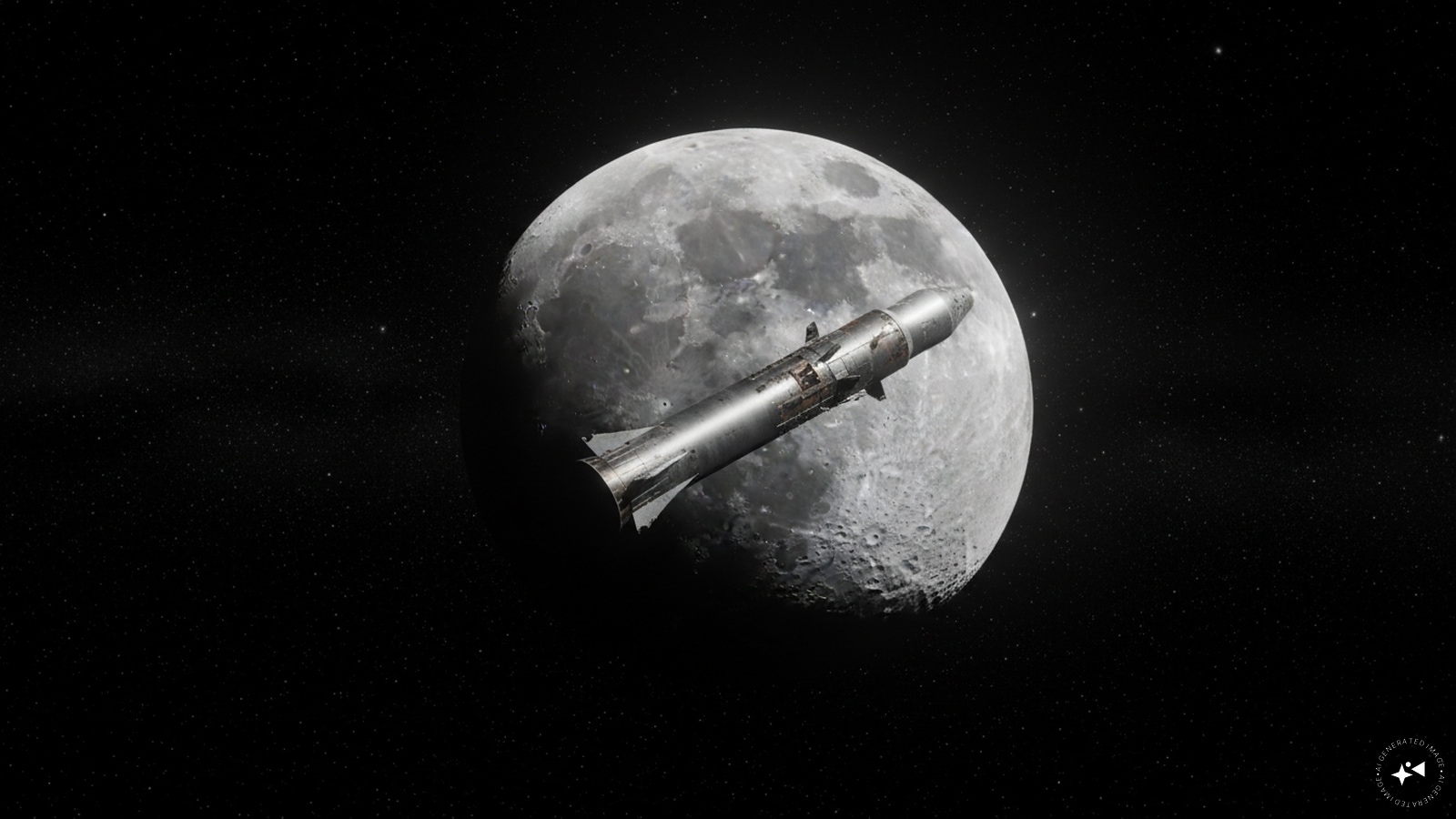
An eight-thousand-pound chunk of aluminum hardware just slammed into the lunar surface at over five thousand miles per hour.
The object was the discarded upper stage of a SpaceX Falcon 9 rocket. It launched back in January 2025 to send commercial lunar landers on their way, finished its job, and then spent eighteen months drifting through a chaotic high-Earth orbit. Gravity and solar radiation slowly nudged it onto a collision course with the Moon.
People love to panic about space junk, but this impact won't destroy the Earth or wreck future missions. Instead, it offers a rare, real-world laboratory for planetary scientists. We rarely get to watch a controlled or semi-controlled high-speed impact of a known human-made object on another celestial body.
What Happens When a Rocket Hits the Moon
When an object hits the lunar surface at 5,400 mph, physics gets violent instantly. The kinetic energy converts into an explosion equivalent to roughly three tons of TNT.
Scientists estimated this crash carved out a crater roughly twenty to thirty meters wide and up to sixteen feet deep. Because the Moon lacks an atmosphere or wind to sweep things clean, the debris field behaves differently than it would on Earth. Spectroscopy data captured by facilities like the Very Large Telescope in Chile detected plumes containing lithium and sodium. The sodium kicked up from the lunar soil itself, while the lithium likely originated from the spent rocket hardware.
Observing these chemical signatures gives researchers a unique way to verify remote sensing data. It lets them test seismic listening equipment on the lunar surface and check how well their impact models match reality.
The Tracking Blind Spot Nobody Talks About
Independent astrodynamicist Bill Gray spotted this trajectory using software originally designed to track near-Earth asteroids. That is the real issue here. We don't have a dedicated government radar network constantly watching high-altitude space debris.
Most military and commercial tracking networks focus heavily on low-Earth orbit, where operational satellites and the International Space Station live. Deep space objects like this Falcon 9 upper stage are usually found by accident when asteroid-hunting telescopes cross paths with them.
SpaceX defended its operational record, noting that they followed standard disposal guidelines. High-energy missions to the Moon require massive amounts of fuel, leaving upper stages in high-altitude orbits where standard immediate deorbiting into Earth's atmosphere isn't always mathematically or physically possible.
As NASA's Artemis program and international competitors ramp up lunar exploration, traffic around the Earth-Moon system is getting crowded. Ignoring high-altitude junk because it is out of sight is a lazy strategy. Space agencies and commercial operators need better tracking protocols before lunar congestion becomes a permanent headache. Keep an eye on how upcoming orbital cleanup initiatives handle deep-space debris in the next few years.