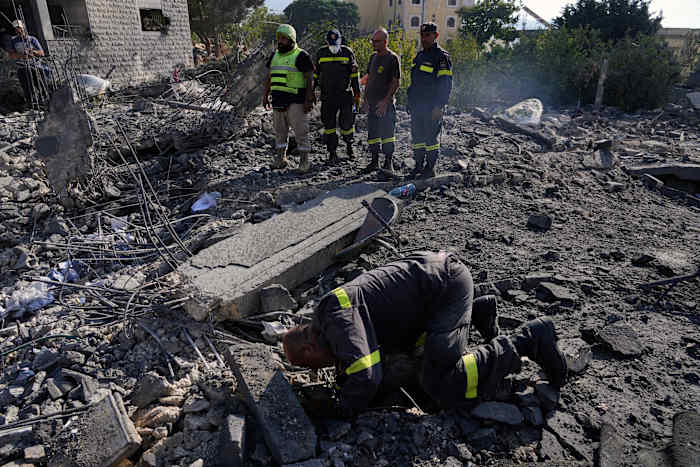
Every standard news report covering casualties in southern Lebanon follows a rigid, exhausted script. Count the bodies, assign immediate moral culpability to the kinetic strike, and act as though the event dropped out of a clear blue sky. This shallow framing treats geopolitical flashpoints like sudden weather phenomena rather than the gruesome, predictable accounting of an ongoing, structural strategy. When an airstrike flattens a village and kills nine people while wounding thirteen, the immediate mainstream reflex is to freeze-frame the tragedy, strip away the surrounding architecture of deterrence, and demand your emotional compliance.
That approach is intellectually lazy. Worse, it is professionally dishonest.
I have spent years analyzing operational military doctrine and strategic deterrence models in the Eastern Mediterranean. I have watched analysts treat asymmetric warfare like a spectator sport, cheering for tactical flashpoints while ignoring the operational gravity pulling the entire region toward the abyss. If you want to understand why southern Lebanon keeps bleeding, you have to stop looking at the individual craters and start looking at the doctrine of controlled escalation that built them.
The Myth of the Accidental Escalation
The mainstream narrative relies on a comforting fiction. It tells us that every engagement is a deviation from peace, a tragic accident born of momentary miscalculation or sudden fury.
That is wrong.
In modern security architecture, what looks like an escalation is frequently just the routine maintenance of a status quo. Deterrence theory, pioneered by thinkers like Thomas Schelling, teaches us that actors in protracted conflicts do not operate in a moral vacuum. They operate in a continuous loop of signaling, threshold testing, and cost imposition. When a village in southern Lebanon absorbs a strike, it is rarely an isolated tactical decision. It is a data point in a brutal calculus of deterrence where both sides test how much kinetic punishment the civilian geography can absorb before the political threshold for total war is breached.
Treating these events as isolated moral outrages misses the structural reality. The villages along the Litani and further south are not civilian spaces existing outside the conflict zone; they are deeply integrated logistical and political nodes in a heavily fortified theater. Pretending otherwise protects a comfortable illusion at the expense of analytical clarity.
The Information Trap and the Casualty Count
Consider how casualty figures are deployed. Nine dead. Thirteen wounded. These numbers are blasted across tickers to manufacture instant moral consensus.
I am not minimizing the human cost. Every life extinguished in this theater is a tragedy. But let us look at how the information pipeline uses those numbers. The raw data of human suffering is weaponized to bypass critical analysis. The moment a headline drops with high casualty numbers, analytical rigor goes out the window. You are expected to feel, not think. You are expected to accept a binary morality play where one side is pure victim and the other is pure monster.
Real analysis requires discomfort. It requires asking structural questions that the standard reporting refuses to touch:
- What tactical assets were co-located near the strike zone?
- How does population density function as a deliberate doctrinal shield in asymmetric defense?
- What message was the striking force trying to send to regional command networks by hitting this specific coordinate?
When you refuse to ask these questions, you become an accessory to propaganda. You become a stenographer for tactical communications disguised as journalism.
The Downside of Contrarian Realism
Let me be entirely transparent about the weakness of this perspective. Stripping away the emotional framing to analyze cold mechanics risks clinical detachment. It can sound callous, as if human lives are merely pawns on a grand chessboard.
That is the inherent danger of geopolitical analysis. The moment you zoom out to examine the macro-strategy, you risk losing sight of the blood on the ground. But the alternative—drowning in perpetual outrage while failing to understand the underlying mechanics that cause the bloodshed in the first place—is infinitely more dangerous. Outrage does not stop missiles. Understanding operational logic, deterrence failures, and asymmetric doctrine gives you a fighting chance at grasping reality.
The villages of southern Lebanon will continue to absorb strikes as long as the underlying strategic equation remains unbalanced. As long as non-state actors operate embedded within civilian infrastructure, and as long as state militaries rely on overwhelming kinetic force to enforce deterrence boundaries, the casualty counts will tick upward in predictable, agonizing cycles.
Stop waiting for a moral awakening in a theater governed entirely by cold, calculated survival. Look at the architecture. Read the operational logic. Stop falling for the headline.