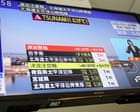
The coffee in the ceramic mug didn't just ripple. It shuddered.
For anyone living along the jagged, beautiful coastline of northern Japan, that specific vibration carries a genetic memory. It is a frequency that bypasses the ears and goes straight to the marrow. On a Tuesday that felt like any other—gray skies, the scent of salt air, the mundane rhythm of the morning commute—the earth beneath the Tohoku region reminded fifty million people that they live on a restless giant. Don't forget to check out our earlier post on this related article.
A magnitude 7.2 earthquake is not a mere statistic when you are standing on a floor that has suddenly turned into liquid. It is a physical assault. The initial jolt is often sharp, a vertical crack that suggests something deep in the crust has finally snapped. Then comes the swaying. This is the long, nauseating roll of the S-waves, traveling through the bedrock and making high-rise buildings in Sendai dance like reeds in a river.
The Ghost in the Water
The shaking is the warning. The silence that follows is the threat. If you want more about the history of this, NBC News provides an informative breakdown.
Minutes after the tectonic plates adjusted their weight miles beneath the Pacific floor, the Japan Meteorological Agency (JMA) issued the words that trigger a very specific kind of clock: Tsunami Advisory. For those watching the digital tickers on their phones or listening to the sirens beginning their mournful wail across the coastal towns, the focus shifted instantly from the land to the horizon.
Consider a hypothetical shopkeeper in a town like Minamisanriku. Let's call him Hiro. Hiro knows that a tsunami is not a single wave. It is not the curling, cinematic crest of a surfer’s dream. It is the entire ocean rising. It is a displacement of volume so massive that the sea appears to simply forget where the shore is supposed to end.
The science is brutal in its simplicity. When the seafloor is shoved upward by a fault line, it displaces the entire column of water above it. This energy moves outward at the speed of a jet airliner. In the deep ocean, you wouldn't even feel it pass under your boat. But as that energy hits the shallow shelf of the coast, it slows down and piles up. It becomes a wall.
A Culture Defined by the Watch
Japan is perhaps the most prepared nation on the planet for this specific brand of catastrophe. This isn't accidental. It is a discipline forged in the fires of 2011 and a dozen other scars across the centuries.
When the alert goes out, the response is a choreographed symphony of survival. Bullet trains, the Shinkansen, are programmed to stop automatically at the first hint of a primary wave. Nuclear reactors enter a state of cold shutdown. In coastal schools, children don’t scream; they grab their protective headgear and move toward higher ground with a practiced, haunting efficiency.
But the emotional weight of an "alert" is something no drill can fully simulate. It is the frantic phone call to an elderly parent who refuses to leave their garden. It is the sight of fishing boats racing away from the harbor, heading for the safety of deep water before the tide turns against them. The stakes are invisible until they are absolute.
We often talk about "resilience" as if it’s a static trait. It isn't. It is a weary, constant vigilance. The Japanese people do not "overcome" the threat of the Pacific; they negotiate with it every single day.
The Physics of Fear
The advisory today specified waves of up to one meter. To a casual observer, a one-meter wave sounds like a weekend at the beach. That is a dangerous misunderstanding of fluid dynamics.
A one-meter tsunami carries the weight of a freight train. Unlike a wind-driven wave that breaks and retreats in seconds, a tsunami is a "bore." It keeps coming. It pushes. It carries with it everything it has picked up along the way—cars, timber, debris, the jagged remnants of the world we built. Even a knee-high surge can sweep a grown man off his feet and pin him against a structure with enough force to crush bone.
The JMA uses a sophisticated network of ocean-bottom sensors called S-net. These are the tripwires of the deep. They detect the pressure changes of the passing wave long before it reaches the cameras on the shore. This data buys the most precious commodity in the world: time.
Three minutes. Ten minutes. Thirty.
In those windows of time, lives are saved or lost. The "follow latest" updates on news feeds aren't just headlines; they are the pulses of a nation holding its breath.
The Weight of the Wait
There is a psychological toll to the "near miss." When the waves finally arrive and they are smaller than feared—perhaps only thirty centimeters, a mere swelling of the tide—there is a collective exhale. But beneath that relief lies a jagged edge of anxiety.
The earth is a closed system. One massive adjustment in the North Pacific can increase the stress on a fault line further south. Geologists watch the "seismic gap," the areas that haven't moved in a long time, with the intensity of a hawk. They know that every minor alert is a reminder of the "Big One" that remains a statistical certainty for the Nankai Trough or the Tokyo Bay area.
We live on a crust that is barely thicker than the skin of an apple, floating on a sea of molten rock. We build cities of glass and steel on top of it and hope the foundations hold. In Japan, the architecture reflects this humility. Base-isolation systems allow buildings to slide on Teflon pads or giant rubber bearings. They are built to fail gracefully, to sway rather than snap.
The Human Signal
Technology provides the data, but humans provide the meaning.
During the height of the alert, the digital world becomes a lifeline. Social media maps light up with crowdsourced reports of water levels. Translators work frantically to ensure that the millions of tourists—often unaware of the gravity of a siren—understand exactly where to run.
The "human-centric" reality of a tsunami alert is found in the hands. The hand of a mother gripping her child’s sleeve as they walk up a concrete evacuation stairway. The hand of a technician in a windowless room in Tokyo, staring at a jagged line on a monitor, knowing that his next keystroke will determine whether a city goes into lockdown. The hand of a survivor from 2011, trembling slightly as the old sirens bring back the ghosts of a decade ago.
The news cycle will eventually move on. The "Tsunami Alert" will be downgraded to a "Tsunami Forecast," and then it will vanish from the headlines entirely. Life will return to the rhythm of the gray skies and the salt air.
But the coffee in the mug stays on the table. The people stay near the stairs. They know the sea is never truly quiet; it is merely waiting for its next turn to speak.
The ocean looked flat and silver as the sun began to dip. From a distance, it appeared infinite and peaceful. But on the shore, the wet sand revealed where the water had pushed just a few inches higher than it should have, a tiny, dark line marking the boundary between a normal Tuesday and the day the world almost broke again.