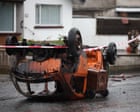
The smell of burning rubber travels fast through the narrow, brick-lined streets of Belfast. It creeps through the gaps in window frames, settles into the fabric of living room curtains, and wakes you up before the sirens even start. If you have lived here long enough, your brain categorizes that smell instantly. It is not a backyard bonfire. It is a bus, or a car, or a barricade of wooden pallets doused in petrol.
Then comes the sound. It begins as a low, collective roar from the end of the block—the acoustic footprint of an angry crowd. Next is the sharp, metallic clink-clink-clink of stones bouncing off the reinforced tarmac of a police Land Rover. And finally, the definitive smash of a petrol bomb hitting its target.
To the outside world watching on a screen, it looks like a sudden, chaotic explosion of violence. The news anchors use words like "regression" and "sectarian flare-up." They talk about the politics, the protocols, and the borders drawn on maps. But on the ground, the reality is much smaller, much more intimate, and far more terrifying. It is the story of teenagers weaponizing their boredom, of mothers standing on doorsteps trying to spot their sons in a sea of identical tracksuits, and of a peace that always feels a little too fragile.
The Geography of the Flashpoint
To understand why a street corner can turn into a war zone overnight, you have to understand the architecture of the city.
Consider a hypothetical teenager named Callum. He is seventeen, born years after the 1998 Good Friday Agreement. He has never known the worst of the Troubles, yet his daily life is entirely shaped by them. He lives in a neighborhood defined by a "peace wall"—a massive structure of concrete, iron, and mesh that towers over the houses. In some places, these walls are higher than the Berlin Wall ever was. They were built as temporary measures decades ago. Today, they are still standing, slicing through the urban fabric, separating working-class Protestant communities from working-class Catholic communities.
During the day, the gates in these walls are open. People walk through them to go to the grocery store or catch a bus. But when political tensions rise at the executive level in Stormont, the atmosphere on the streets changes like a drop in barometric pressure.
The gates close early.
When those heavy iron structures slam shut, it signals to everyone on both sides that the space has changed. It is no longer a thoroughfare. It is a perimeter. For young people like Callum, who face high unemployment rates and a distinct lack of community funding, the closed gate becomes a stage. On one side, loyalist youths gather; on the other, nationalist youths assemble. The space between them becomes a vacuum waiting to be filled with violence.
The Mechanics of the Riot
Rioting is rarely a spontaneous eruption of pure emotion. It has a rhythm, a economy, and a terrifyingly organized structure.
It often begins in the late afternoon. Word spreads not through secret political networks, but through social media apps. A video on TikTok or a message in a WhatsApp group chat is all it takes to coordinate a gathering. By the time the sun goes down, the crowds have formed.
The front lines are almost exclusively populated by kids. Some of them are as young as twelve or thirteen. They wear hoodies pulled tight and scarves wrapped over their faces, leaving only their eyes visible. To a casual observer, they look like seasoned militants. In reality, they are children imitating the ghosts of their neighborhoods' pasts.
Behind them are the older men. They rarely throw the stones themselves. Instead, they stand in the shadows of alleyways, orchestrating the supply line. They are the ones who bring the crates of empty beer bottles. They are the ones who show the younger boys how to stuff a rag into the neck of a bottle filled with petrol and sugar—the sugar makes the burning liquid stick to the police windscreens.
When the police arrive in their heavily armored gray vehicles, the choreography begins. The police do not immediately charge; they form a barrier, a wall of plastic shields and reinforced steel. They absorb the impact of the bricks and the fireworks. It is a grueling game of endurance. The air grows thick with the acrid smoke of burning plastic bins and the blinding glare of flares.
If you stand close enough, you can hear the strange, mismatched soundtrack of the event. There is the violent crash of the rioting, but underneath it, you can hear the normal sounds of a residential neighborhood. A dog barking in a backyard. A television blaring through an open window just thirty yards from a burning car. A microwave beeping in a kitchen. The extraordinary and the mundane exist side by side, separated by nothing more than a row of brick terraced houses.
The Invisible Costs
The morning after a riot is arguably more haunting than the night itself. The smoke clears, leaving a gray, overcast Belfast sky. The tarmac is scorched black, scarred by the melted rubber of tires. The street is littered with the debris of the night before: shattered glass that crunches under the boots of commuters, spent fireworks, and the heavy smell of stale petrol.
But the deepest scars are the ones that do not show up on the morning news broadcasts.
Consider the local shopkeeper who has to sweep up the glass from his shattered storefront for the third time in a year. He does not care about the geopolitical arguments surrounding trade borders or political agreements. He cares about his insurance premiums, which are now so high that his business is no longer viable. He cares about the fact that his elderly neighbors are too terrified to walk down the street to buy milk.
Consider the mothers. In the wake of a riot, the conversation shifts from the macro-politics of Northern Ireland to the micro-tragedies of individual families. Mothers stand at the school gates, speaking in hushed tones about who was spotted on the livestreamed videos the night before. They know that a single criminal record for rioting can ruin a young person's future, stripping away their chances of university, employment, or travel before their lives have even truly begun.
There is a profound sense of exhaustion that settles over the communities that live along the peace lines. It is a psychological fatigue born from the knowledge that decades of political progress can be overshadowed in a single evening by a handful of petrol bombs. The residents of these areas are caught in a pincer movement between political paralysis above them and social deprivation around them.
The real tragedy of the Belfast riots is not that they represent a return to the past. It is that they reveal how little the present has managed to heal the underlying fractures. The peace process brought an end to the bombs in city centers and the daily military patrols, which was an monumental achievement. But it often failed to deliver a peace dividend to the working-class areas that suffered the most during the conflict. When young people feel they have no stake in the future, the past becomes a dangerous form of entertainment.
A police Land Rover slowly drives down the street, its engine humming a low, steady vibration against the pavement. A woman in a dressing gown steps out onto her front porch, a mug of tea in her hand, and watches the vehicle pass. She looks at the scorched circle on the road where a car burned just eight hours ago. Then, without a word, she raises her broom and begins to sweep the shattered glass into a neat little pile against the curb.