The sky above South Lebanon does not belong to the clouds. For those who live beneath it, the air is a heavy, living thing, charged with a tension that dictates when you sleep, where you stand, and how tightly you hold your children.
On an ordinary morning, the silence here is never truly silent. It is a fragile truce between the earth and the horizon. When that truce breaks, it does not happen with a polite warning. It happens with a roar that shakes the marrow in your bones.
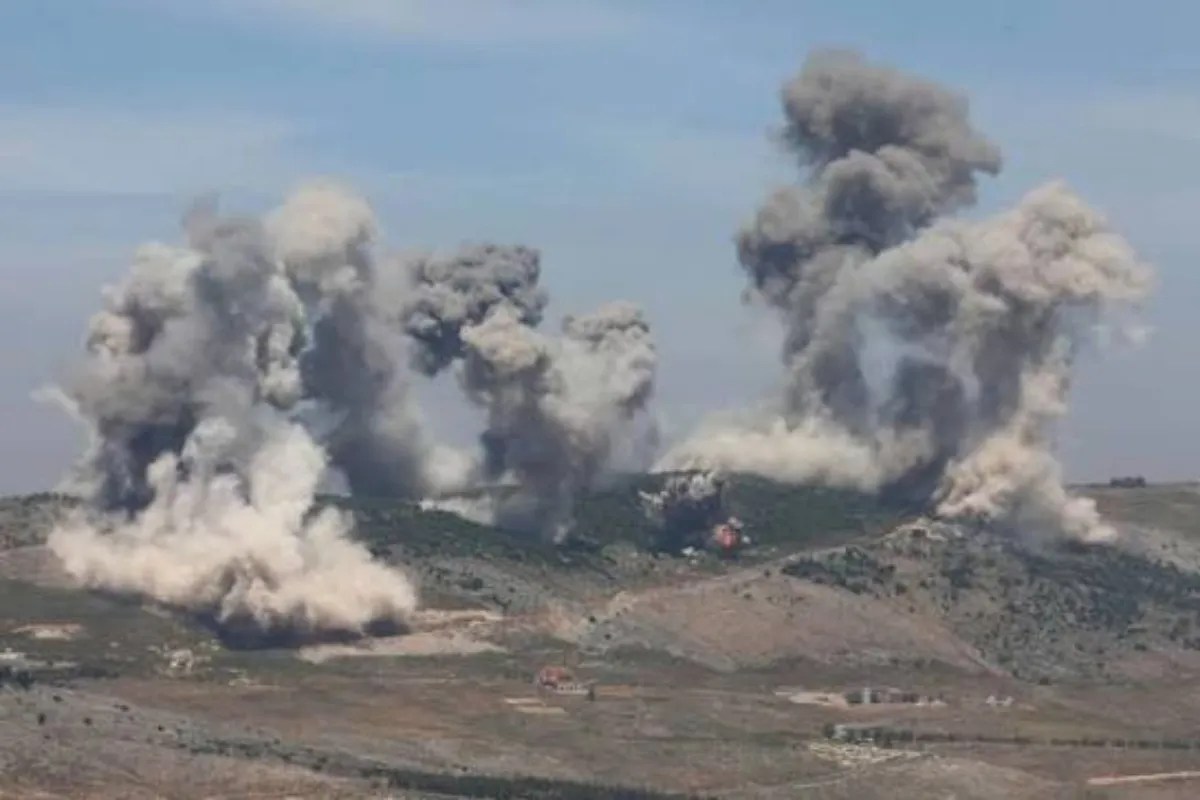
The standard news reports will tell you the clinical facts. They will report that the Israeli military launched targeted airstrikes across multiple sectors of South Lebanon. They will counter that line by stating Hezbollah fired a barrage of ten rockets in retaliation. The wires will frame it as a mathematical equation of kinetic warfare. Action. Reaction. Ten rockets here. A dozen payloads there.
But numbers are a coward's way of looking at a warzone. They flatten the jagged edges of human terror into neat, digestible data points. They erase the smell of cordite and the sound of a teacup rattling against its saucer on a kitchen table in Khiam or Kfar Kila. To understand what happened, you have to look past the tally sheets.
The Architecture of an Alert
Imagine a morning routine stripped of all certainty. A mother, let us call her Layla, is heating flatbread. This is not a dramatic exercise; it is the mundane reality of survival. Her ears are trained to differentiate between the low, rhythmic thrum of a reconnaissance drone—the background hum of her entire adult life—and the sudden, sharp tear of a jet engine cutting through the atmosphere.
When the Israeli jets arrive, the sound precedes the impact by only a heartbeat. The Israeli Defense Forces state these strikes target specific infrastructure, weapon caches, and launch sites hidden within the rugged terrain. From a military command center in Tel Aviv, these are coordinates on a digital map, verified by intelligence and executed with precision.
From the ground, it is an earthquake that falls from the sky.
The earth erupts. Concrete turns back into dust. The shockwave travels through the soles of your feet before the sound even hits your ears. In those seconds, the geopolitical grandstanding of empires and proxy groups fades into absolute irrelevance. There is only the primal instinct to shrink, to become as small as humanly possible beneath whatever shelter is within arm's reach.
The news anchors rarely mention the dust. It stays in the air for hours after the fighter jets have cleared the airspace. It coats the olive trees. It gets into the back of your throat, a chalky reminder that someone’s home or livelihood just became part of the landscape's ledger of loss.
Ten Responses in the Dark
Then comes the counterweight. The report notes ten rockets fired by Hezbollah toward northern Israel.
To understand the mechanics of this escalation, one must realize that these are not grand, coordinated set-piece battles from the history books. This is a war of visibility versus invisibility. Hezbollah operates from the shadows of the hills, utilizing mobile launchers and deeply entrenched positions. The firing of ten rockets is an act of defiance, a message wrapped in steel and propellant meant to signal that despite the heavy bombardment from the air, the capability to strike back remains intact.
Consider the receiving end of those ten rockets. In the towns of northern Israel, the sirens wail with a terrifying predictability. The residents there have seconds to reach fortified rooms or bomb shelters. It is a mirror image of anxiety. The iron dome interceptors rise to meet the incoming threats, drawing white streaks across the blue sky. Most are blown to fragments mid-air, a spectacular display of defensive technology that leaves behind a rain of hot shrapnel.
But some get through. Or the debris falls on a road, a field, a home.
The physical damage from ten rockets might be contained, but the psychological toll is cumulative. It is a slow, grinding erosion of normalcy. A child in Kiryat Shmona flinches at the sound of a motorcycle backfiring. A farmer in South Lebanon refuses to harvest his crops because the fields offer no cover from the drones overhead. This is the invisible calculus of the conflict. The strikes and counterstrikes do not just destroy buildings; they dismantle the psychological infrastructure of everyday life.
The Mirage of Deterrence
For decades, the prevailing logic governing this border has been the doctrine of deterrence. The theory is simple: make the cost of aggression so prohibitively high that neither side dares to cross the line.
But deterrence is a volatile currency. What one side views as a measured, defensive response to a threat, the other sees as an intolerable provocation demanding an immediate answer. The line between a controlled escalation and an all-out regional conflagration is terrifyingly thin.
The recent exchange of fire illustrates this precarious balance. By targeting South Lebanon, the Israeli military aims to push Hezbollah’s assets away from the border, creating a buffer zone of safety for its northern citizens. Conversely, by launching rockets, Hezbollah seeks to enforce its own red lines, demonstrating that any violation of Lebanese sovereignty will carry a domestic cost for Israel.
It is a dance performed on a tightrope over an abyss. Both sides operate with intense calculation, yet both are subject to the fog of war. A single missile miscalculating its target, a single airstrike hitting a high-casualty civilian structure instead of an empty launch site, and the carefully calibrated theater of deterrence collapses into an uncontainable spiral.
The View from the Rubble
When the smoke clears and the late afternoon sun casts long shadows over the hills of South Lebanon, the true cost reveals itself. It is found in the old men who sit on plastic chairs outside damaged storefronts, sweeping away shattered glass with methodical, tired strokes. They have seen this cycle before. They saw it in 1996, in 2006, and they are seeing it again now.
The world watches these events through a lens of desensitization. A headline about ten rockets and a series of airstrikes barely registers on the international ticker. It is treated as the permanent weather pattern of the Middle East—unchanging, tragic, but ultimately distant.
Yet there is nothing permanent about the suffering of those caught in the crossfire. The tragedy lies in the adaptability of the human spirit, which learns to accept the unacceptable as the baseline of existence. We read the cold facts of the military communiqués and forget that every explosion rewrites the future of a family, leaves an indelible scar on a child's memory, and pushes the prospect of a lasting peace further into the realm of impossibility.
The sky over South Lebanon eventually clears, turning that brilliant, deceptive shade of Mediterranean blue. But the silence that follows is never peaceful. It is merely the indrawn breath of a region waiting for the next roar.