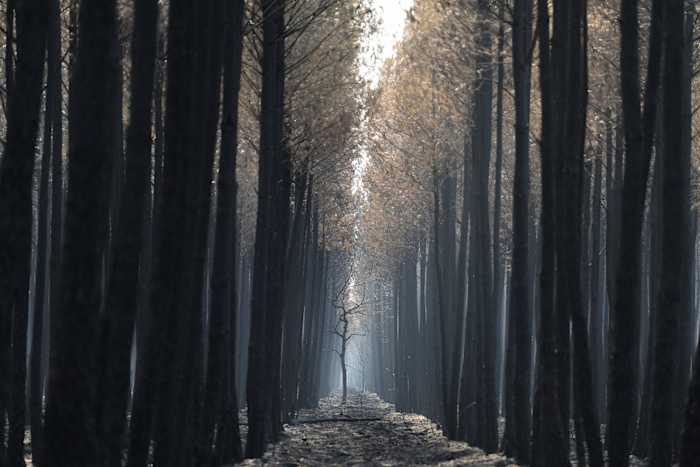
The air in the western foothills tasted like cold ash for weeks. I remember watching the olive trees turn a ghost-white as the fine, greasy particulate settled on every leaf, turning an ancient Mediterranean landscape into a monochrome photograph. Then, almost overnight, the sirens stopped wailing in the valleys of Spain and Portugal. The Atlantic winds shifted, pushing the heat dome eastward, offering a fragile, collective exhale to communities that had spent half the summer staring at the horizon.
We wanted to believe the crisis had passed.
That is the comforting illusion of fire. It moves like a living thing, hunting fuel, abandoning a scorched ruin only to strike where the ground is still thick with dry pine and untouched brush. While the western edge of Europe began cleaning the soot from their window sills, the atmospheric pressure sealed a new fate across the Aegean.
Greece was waiting.
To understand what happened next, you have to look at the ground. Imagine standing on a parched olive terrace in the Peloponnese during a July afternoon. The soil beneath your boots is cracked open, begging for moisture that hasn't arrived since spring. The thermometer reads forty-two degrees Celsius, but the humidity sits stubbornly in the single digits. Every blade of grass is a wick. Every pine needle is a match head.
Meteorologists call this a persistent blocking high. It is a wall of high pressure that parks itself over a region, baking the earth and baking out whatever humidity remains in the vegetation. When the western fires subsided, this atmospheric wall simply shifted its weight, locking its sights squarely onto the Greek mainland and its emerald islands.
Suddenly, the maps changed. The emergency broadcasts stopped coming from Andalusia and started pulsing from Rhodes, Evia, and the outskirts of Athens.
Fire does not care about national borders, but it respects geography with ruthless precision. Western Europe had spent years hardening its defenses. Portugal restructured its forestry management, clearing underbrush and creating firebreaks after the devastating losses of previous decades. Spain deployed advanced early-detection thermal cameras. They fought the fire with science, with money, and with hard-won muscle memory.
Greece found itself caught in a different kind of trap. Its terrain is steep, rugged, and heavily forested with resinous pines that burn like kerosene. A wind shifts by ten degrees, and a manageable ground fire leaps into the crown of the trees, transforming into an unstoppable wall of flame that outruns the fastest evacuation order.
Consider a hypothetical olive farmer named Nikos, whose family has worked the same hillside near Olympia for four generations. Nikos knows every contour of the valley. He knows which wind brings rain and which wind brings ruin. When the orange glow crested the ridge behind his village, he didn't check a smartphone app; he smelled the acrid, unmistakable tang of burning sap.
He told me once, years ago, that a fire doesn't roar. It whispers at first, like a heavy silk dress dragging across dry gravel. Then it inhales. The oxygen rushes toward the core so violently that the wind howls in reverse, pulling roof tiles off houses before the flames even touch the wood.
That was the reality that shifted eastward.
As the wildfire crisis eased in the west, the human cost simply migrated. Tourists scrambled to rearrange flights away from ash-choked Greek islands. Firefighters who had just spent grueling weeks battling blazes in Southern Italy packed their gear and boarded cargo planes bound for Athens, exhausted before their new deployment even began. The European Union's civil protection mechanism hummed into action once more, shuffling Canadair water-bombers across the continent like chess pieces on a board-room table.
We watch these events on screens thousands of miles away, reducing them to moving red banners on 24-hour news networks. We tally the hectares lost. We count the evacuated hotels. But numbers are an anesthetic. They dull the terror of standing on a dark tarmac while the sky turns the color of a bruised plum, waiting for a ferry that may never return.
The shift from west to east is not merely a weather pattern. It is a recurring drumbeat of a new climatic reality. The atmosphere has become a volatile engine, and Europe is simply the room where it happens. When one corner cools down, another heats up. The relief felt in Lisbon was paid for in blood and smoke in Athens.
There is a profound humility in watching these events unfold. For all our engineering, our satellite monitoring, and our strategic firebreaks, we remain remarkably small against the sheer kinetic fury of a drying planet.
The sun sets over the Aegean now through a thick, copper-colored haze. The heat lingers long past midnight, keeping windows wide open to rooms that offer no breeze. Down on the coast, the water laps quietly against the stones, indifferent to the tragedy playing out just a few miles inland, where the earth continues to wait for rain that refuses to fall.