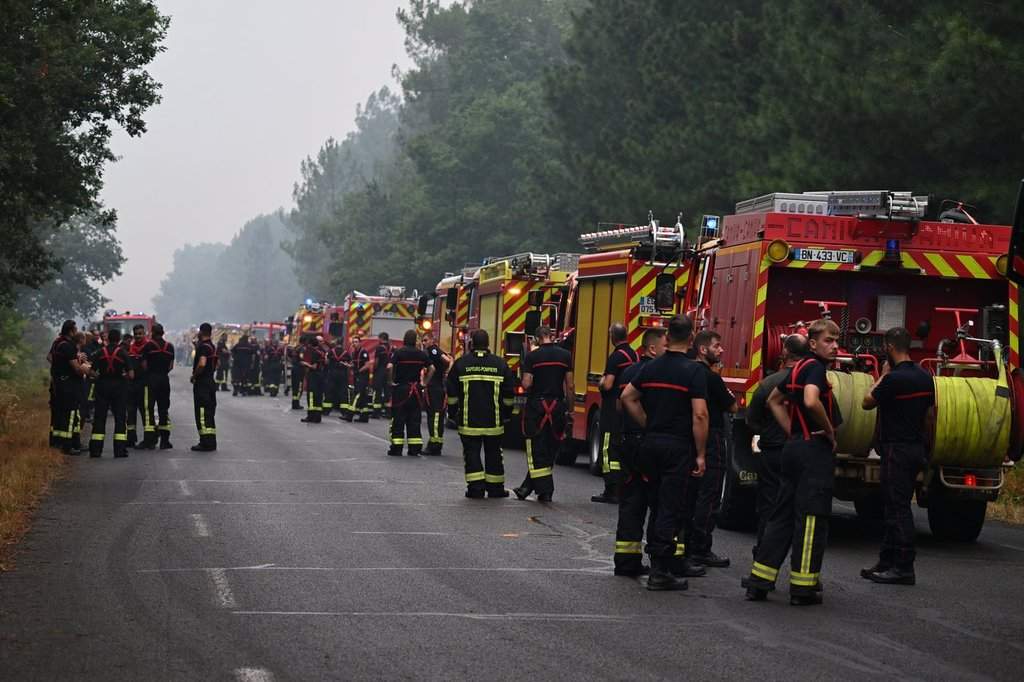
Ash does not fall like snow. Snow has a grace to it, a gentle drift from a gray sky, melting softly against a jacket sleeve. Ash is different. Ash is the ghost of a pine tree, the skeleton of a living room, the weight of a summer's worth of heat condensed into a gritty, black smear that clings to your skin and tastes like copper.
Over a quarter of a million people learned that taste in a matter of days across France and Spain.
Consider a hypothetical family sitting down to dinner in the Gironde department of southwestern France. The window is open to catch the evening breeze off the pine forests. Except the breeze is missing. In its place is a low, rolling growl—not the sound of thunder, but something heavier, something that vibrates through the floorboards before it ever reaches the ears. That is the sound of a crown fire moving through timber, leaping from treetop to treetop at the speed of a galloping horse.
The statistics are staggering. More than 250,000 evacuees. Tens of thousands of hectares of scorched earth. Homes reduced to brick foundations and twisted metal frames. But numbers are defensive armor. They keep us from feeling the raw edge of the blade.
Let us strip the armor away.
Imagine packing a single suitcase while the orange glow paints your ceiling. What do you take? The laptop? No, too heavy. The tax documents? Too clinical. You grab the photo albums, the worn stuffed animal from a child's crib, and a bottle of water. You close the front door behind you, turning the key for the final time, fully aware that when you return, the door might be the only thing left standing.
This is the reality of the modern wildfire season in Southern Europe. It used to be an August problem. Now it arrives in June, sometimes May, stretching its blackened fingers across regions ill-equipped for a year-round threat.
The science behind this is brutally simple, yet we spent decades getting it backward. For generations, we treated fire as an intruder to be exterminated instantly. Every spark was hunted down. Every flare-up was smothered. But forests are living lungs. By starving them of small, controlled burns, we inadvertently built giant, hyper-dense tinderboxes. When the climate warms—pushing temperatures past forty degrees Celsius in regions like the Iberian Peninsula—and the soil dries out like a bone, that accumulated fuel doesn't just burn. It explodes.
Dry winds from North Africa sweep up through Spain, pushing across the parched plains of Extremadura and Castilla y León. They act like a blowtorch. Firefighters call it erratic behavior. That is a polite term for a monster that changes its mind every three minutes, driven by swirling gusts that leap over firebreaks as if they were sidewalk cracks.
Evacuation is not an orderly military maneuver. It is a slow, agonizing crawl of bumper-to-bumper traffic on narrow rural roads, illuminated by the hellish neon of amber flames licking at the guardrails. Old people who have lived in the same stone cottage for eighty years are lifted into ambulances, clutching plastic bags containing their medications. Tourists who came for the sun-drenched vineyards of the Landes find themselves sleeping on gym cots in municipal sports halls, staring up at fluorescent lights, listening to the hum of industrial fans.
And yet, in the middle of the ash, something else happens.
Neighbors who barely nodded hello across a hedge share water bottles on the shoulder of a jammed highway. Vintners who spent decades tending ancient vines watch them turn to charcoal, then immediately turn to help clear livestock pens for neighboring farms. Resilience is a worn-out word, but on the ground, it looks less like a slogan and more like a blistered hand holding a garden hose against a wall of heat.
The fire eventually slows. The winds drop. The air clears just enough to reveal a pale, bruised sun hanging in a sky the color of a wet slate roof.
The headlines will fade. The evacuees will eventually be allowed back to sift through the gray dust for wedding rings and melted porcelain. But the landscape has changed permanently, and so have the people who lived through it. They know now what the wind sounds like when it carries the forest away. They know how thin the line is between a summer evening and a vanishing world.
The smoke clears, but the horizon stays charred.