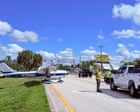
When a single-engine aircraft loses power over a densely populated corridor in the Sunshine State, pilots are trained to look for the longest, flattest strip of concrete available, which increasingly means landing directly on active interstates and state roads—sometimes colliding with pickup trucks and commuter traffic in the process. While local news outlets treat every highway touchdown as a freak miracle or a terrifying anomaly, the reality is far more systemic. Florida’s combination of year-round flight training, sprawling suburban development right up to airport fence lines, and aging general aviation fleets has turned multi-lane asphalt into an unofficial, unlit auxiliary runway system.
Every motorist sitting in gridlock along I-95, I-4, or U.S. Highway 1 assumes the biggest threat to their safety is a distracted driver in the next lane. Almost nobody checks their mirrors for a descending Cessna or Piper. Yet for a pilot staring at a dead propeller at 1,500 feet, a highway isn't a reckless gamble. It is often the only survivable option left on the board.
The Anatomy of an Off-Airport Landing
To understand why a small plane ends up smashing into the bed of a pickup truck, you have to understand what happens inside a cockpit the second an engine quits. Most general aviation aircraft—the two- and four-seat piston planes that dominate local skies—do not drop like stones when they lose power. They become gliders.
The physics are unforgiving. A typical single-engine trainer has a glide ratio of roughly 9 to 1. For every thousand feet of altitude, the pilot can travel about nine thousand feet forward, or roughly a mile and a half. If the engine fails at 2,000 feet, the pilot has less than three miles of reach in any direction and roughly two to three minutes before the wheels touch whatever is beneath them.
In rural states, three miles gives a pilot dozens of empty cornfields, pastures, or dirt roads. In coastal and central Florida, three miles often yields nothing but retention ponds, cypress swamps, power lines, and tightly packed subdivisions.
Emergency landing procedures taught from day one of flight school prioritize maintaining airspeed and finding an open stretch of ground into the wind. When trees and rooftops fill the windshield, a wide, paved road looks like salvation. The problem is perspective. From a thousand feet up, a four-lane highway looks wide and open. At fifty feet above the pavement, moving at 65 knots, the visual picture changes entirely.
Overpasses suddenly appear out of nowhere. Light poles line the medians like goalposts. Overhead signage spans the lanes. Worst of all, traffic moves in the exact direction the pilot is trying to land, creating a closing-speed nightmare where a pilot cannot see the pickup truck directly beneath the aircraft's nose cowling.
Why Drivers Never Hear Them Coming
A common question after any highway crash is why the driver didn't swerve out of the way. The answer lies in basic acoustics and vehicle design.
Modern pickup trucks and SUVs are engineered like rolling sound booths, insulated against wind noise, tire hum, and exhaust rumble. Meanwhile, a small plane executing an emergency descent is running with a dead or idling engine. Without the roar of a full-throttle propeller, a descending aircraft is remarkably quiet.
Add to that the blind spot created by a vehicle's roof. Drivers look forward, backward, and sideways. Nobody has a skylight built for scanning a 45-degree angle behind their rear bumper. By the time a shadow falls across the hood of a truck, the impact has already happened.
Florida’s Unique Aviation Pressure Cooker
Florida is not just another state on the aviation map. It is the undisputed epicenter of global flight training and recreational flying, and that concentration creates statistical inevitability.
Consider the sheer volume of operations. Ideal winter weather draws student pilots from Europe, Asia, and across North America to flight schools clustered around Daytona Beach, Sanford, Lakeland, Fort Lauderdale, and Vero Beach. Thousands of takeoffs and landings happen every single day at municipal airports that were built decades ago on the outskirts of small towns.
Cities grew. Airports stayed put.
Local zoning boards spent the last forty years approving shopping centers, apartment complexes, and highway expansions directly under the departure and arrival paths of regional airfields. In aviation, the first two minutes after takeoff and the final two minutes before landing represent the highest-risk phases of flight. If an engine sputters at 600 feet right after liftoff, a pilot cannot turn back to the runway—a maneuver known in aviation circles as the impossible turn because attempting it frequently results in an aerodynamic stall and a fatal spin.
The pilot must land straight ahead. In modern Florida, "straight ahead" almost always intersects a major roadway.
The Aging Fleet Factor
Look closely at the tail numbers of the aircraft involved in highway incidents, and a clear pattern emerges. Many of these airframes were built during the general aviation boom of the late 1960s and 1970s.
While federal regulations require rigorous annual inspections and regular maintenance, mechanical fatigue and human error still slip through the cracks. Carburetor ice, fuel starvation, clogged fuel injectors, and magneto failures remain leading causes of power loss in piston engines. Even a meticulously maintained 1974 airframe operates on technology designed half a century ago, running on leaded aviation fuel through systems that offer zero redundancy if a single critical component fails.
The Legal and Financial Wreckage Left Behind
Once the fire trucks clear the foam off the asphalt and the tow trucks haul away a crumpled fuselage and a crushed pickup bed, a quieter, equally brutal collision begins in the offices of insurance adjusters and aviation attorneys.
Most motorists assume that if an airplane falls out of the sky onto their truck, the pilot's insurance company immediately writes a check for a brand-new vehicle, medical bills, and lost wages. That assumption is dangerously wrong.
Aviation insurance operates under a completely different set of rules than standard auto coverage. While states mandate minimum liability coverage for every car on the road, federal law does not require private pilots to carry liability insurance at all.
Many aircraft owners do carry policies, often with standard limits of $1 million per occurrence, capped at $100,000 per passenger. If a small plane clips a utility pole, sparks a brush fire, destroys a commercial pickup truck, and sends two motorists to the trauma center, that $1 million ceiling evaporates before the emergency room doors even close.
When the Pilot isn't the Owner
The legal web gets thicker when the aircraft belongs to a flight school, a flying club, or a private leaseback arrangement.
Suppose a student pilot on a solo cross-country flight experiences an engine failure and hits a commuter vehicle. Who holds liability?
- The pilot faces scrutiny over decision-making, fuel management, and whether an empty field was available instead of the highway.
- The flight school faces claims regarding maintenance logs, aircraft airworthiness, and whether the instructor properly signed off the student for the flight.
- The maintenance shop that signed off the last 100-hour inspection can be dragged into litigation if a mechanic left a fuel line loose or missed a worn gasket.
For the driver of the pickup truck, navigating this maze takes years. Standard auto insurance policies contain specific exclusions and subrogation clauses that stall payouts while lawyers argue over federal aviation preemption versus state tort law. In the meantime, the motorist is left paying out of pocket for physical therapy and a rental car, entirely because they happened to be driving mile marker 42 at the wrong thirty-second window.
The Investigation Timeline Nobody Waits For
Local television crews pack up their satellite trucks the evening of the crash. By the next morning, the news cycle has moved on to a different traffic jam or a local political scandal.
That rapid disappearance creates a massive blind spot in public understanding. When a highway crash occurs, reporters quote eyewitnesses who say the plane "wobbled" or "sounded weird," and then the story dies. The actual cause remains locked away for months or years.
Both the Federal Aviation Administration (FAA) and the National Transportation Safety Board (NTSB) investigate these incidents, but they serve entirely different masters.
The FAA looks for regulatory violations. Did the pilot have a current medical certificate? Was the aircraft overdue for an inspection? Did the pilot bust airspace rules? If the FAA finds a breach, they can suspend or revoke a license.
The NTSB looks strictly for probable cause to prevent future accidents. Their investigators haul the wreckage to a secure hangar, tear down the engine piece by piece, drain fuel samples for chemical testing, and pull radar tracks and air traffic control audio. A preliminary report drops within two to three weeks, offering bare-bones facts without assigning blame. The final probable cause report routinely takes 12 to 24 months to publish.
By the time the NTSB reveals that a pilot simply forgot to switch fuel tanks—leaving one wing bone-dry while the other held twenty gallons of gas—nobody is watching anymore.
Can Highway Collisions Actually Be Prevented?
Aviation safety advocates and urban planners have argued for decades over how to keep airplanes and automobiles separated, yet almost every proposed solution hits a wall of cost, physics, or local politics.
Ballistic Parachutes
Modern manufacturers like Cirrus have revolutionized light aircraft safety by installing whole-airframe ballistic parachutes. If an engine fails over a congested area, the pilot pulls a red handle in the cabin roof, firing a rocket that deploys a massive canopy, lowering the entire plane gently to the ground.
It works. Hundreds of lives have been saved by airframe parachutes. However, retrofitting older Cessna and Piper fleets with ballistic systems is prohibitively expensive, structurally complex, and cuts heavily into the aircraft's useful payload. Tens of thousands of legacy trainers will keep flying without them for decades.
Engine Technology Overhauls
Electronic ignition systems, full-authority digital engine controls (FADEC), and modern diesel-cycle aviation engines drastically reduce the mechanical failures that plague legacy carbureted engines. Yet the certification process required by federal regulators makes upgrading older aircraft eye-wateringly expensive. A certified engine overhaul can easily exceed the total market value of the airframe itself.
Airport Buffer Zones
The most effective preventative measure has nothing to do with airplanes and everything to do with county commissioners. Protecting open land off the departure and approach ends of municipal runways gives pilots a fighting chance to put a disabled plane down in grass or dirt rather than on concrete filled with rush-hour commuters.
Developers hate empty buffer zones. Land near highway interchanges and regional airports is prime real estate for warehouses, strip malls, and high-density housing. Until local governments treat runway approach corridors with the same safety respect as flood zones, concrete will keep replacing grass right up to the perimeter fence.
What Motorists Should Actually Do
Drivers cannot control aircraft maintenance or urban sprawl, nor can they drive down I-95 staring straight up into the clouds. What you can control is situational awareness in high-density flight corridors—specifically within a three-mile radius of regional airports like Pompano Beach, Lantana, Kissimmee, or Albert Whitted in St. Petersburg.
If you ever see a low-flying small aircraft aligned with the highway ahead of you, do not slam on your brakes in the middle of a travel lane. A sudden stop triggers a multi-car pileup that traps you directly in the aircraft's rollout path.
Instead, signal immediately, check your blind spot, and pull completely onto the emergency shoulder or off the roadway onto grass or gravel. Pilots aiming for a highway desperately try to touch down in open gaps between packs of cars, using the center lanes to keep their wings clear of roadside signs and light poles. Moving onto the shoulder clears the runway they are trying to borrow.
If an aircraft touches down behind you, keep moving forward until you reach an exit ramp or a wide, protected pull-off. A plane landing on a highway has no reverse gear, limited braking power on smooth asphalt, and a massive wingspan that sweeps across multiple lanes at once. Getting out of the way isn't a courtesy—it is basic survival on roads that share the sky with thousands of aging engines.