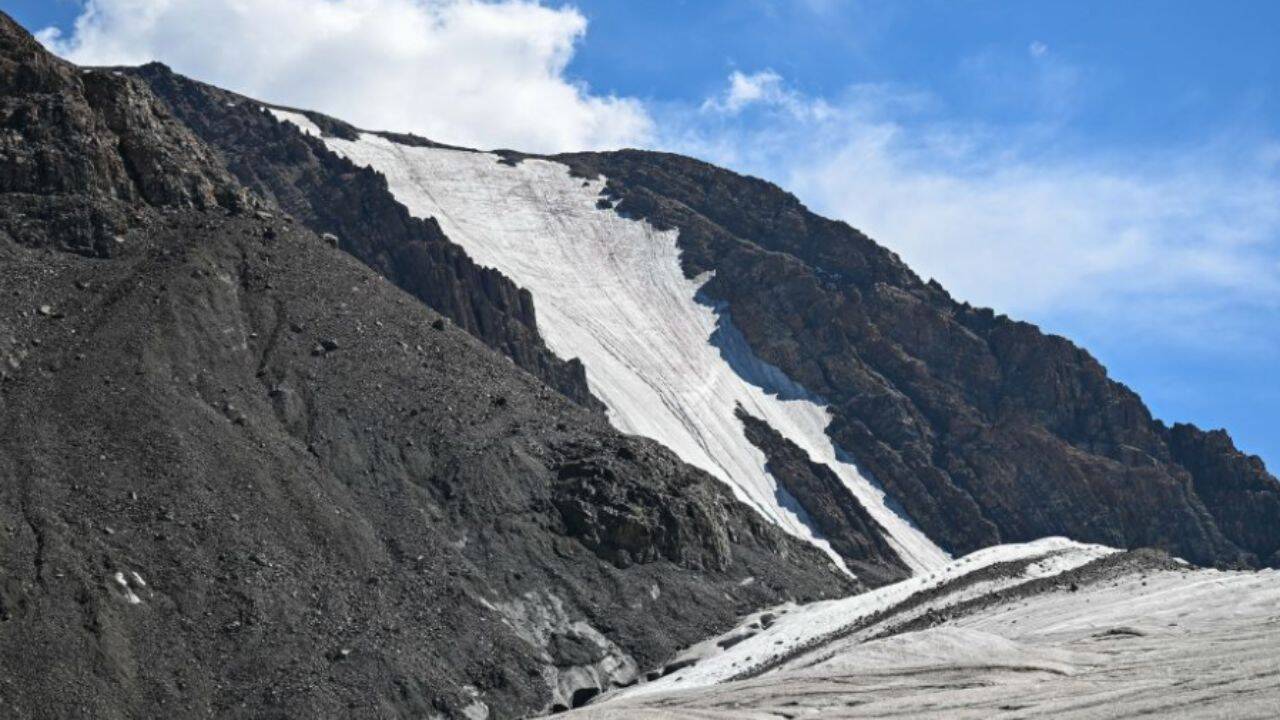
Water is heavy. Until you carry it up a mountain ridge in a frozen pack, watching your breath turn to ice on your eyelashes, you forget that rivers are just temporary things. They are not permanent fixtures of the earth. They are migrating ghosts, born in the high white towers of glaciers, rushing toward the sea to die, and begging for a resurrection that rarely comes anymore.
Stand at the foot of the Muz Taw Glacier in China’s Tien Shan range. Listen.
It does not sound like peace. It sounds like fracture. It sounds like a wet, heavy sigh as millions of tons of ancient ice surrender to a warmer century, sliding down the bedrock in a slow motion disaster that feels entirely too quiet to be real.
For generations, scientists watched this happen from behind binoculars and satellite screens. They measured the retreat in meters per year. They wrote papers that grew increasingly desperate, published in journals read mostly by other people who already knew the house was on fire. The math was simple, brutal, and utterly unyielding. The ice was melting faster than winter could ever hope to replenish it.
Until recently, the response to that disappearance was passive mourning.
We documented the death of the water towers. We cataloged the receding white lines. We accepted that the rivers feeding millions of downstream lives would eventually run dry, turning fertile valleys into dust bowls where farmers once argued over irrigation rights.
Then came the silver.
Cloud seeding is not a new idea. For decades, humanity has tried to scratch at the sky, coaxing rain out of stubborn clouds with silver iodide flares fired from airplanes or anti-aircraft artillery. Mostly, it was used to rescue parched wheat fields or clear the smog before an Olympic opening ceremony. It was weather modification as a blunt instrument.
But high-altitude glaciology requires a scalpel.
Consider what happens next: a team of researchers looks up at the towering, freezing crags of the Tien Shan. They aren't trying to make it rain over a city. They are trying to engineer a snowstorm precisely where the glacier is gasping its last breath. They load aircraft with silver iodide, targeting the upper atmosphere above the Muz Taw Glacier. They wait for the right humidity, the right wind shear, the thermal lift pushing moisture against the mountain wall.
And then they seed.
To understand the mechanics, picture a microscopic desert. Inside a cloud, moisture floats as supercooled water droplets, unable to freeze because they lack a solid core to cling to. They drift right past the mountain peaks, completely useless. Silver iodide crystals have a molecular structure remarkably similar to ice. When introduced into that cloud, they act as tiny anchors. Water molecules rush to them, wrapping around the foreign specks, freezing instantly.
Snow is born.
Millions of microscopic crystals clump together, growing heavy, heavy enough to break free from the updraft, tumbling downward through the freezing air until they blanket the high-altitude ice fields in a thick, insulating coat of fresh powder.
The numbers sound like dry laboratory stats until you walk out onto that newly fallen snow.
Fresh snow cut ice loss by 14% to 17%.
Pause on that. Read it again. Fourteen to seventeen percent of a vanishing glacier saved not by a global carbon tax, not by a miraculous political consensus, but by human intervention written directly into the clouds.
Why does fresh snow matter so much? Albedo.
Dark, melting glacial ice absorbs the sun’s energy like a black asphalt driveway in August. It drinks the heat, accelerating its own destruction in a vicious feedback loop. Fresh snow does the exact opposite. It is a mirror. It looks up at the sun and shoves the light right back into space, keeping the ancient ice underneath in the dark, cold shadow it needs to survive the summer.
It is an artificial winter, summoned on command.
Skeptics point out the obvious. This is a bandage on a hemorrhage. It does not fix the fever heating the planet. It does not stop the coal plants or quiet the shipping lanes. If you must rely on seeding the skies to keep a glacier from dying, you have already admitted defeat on a global scale.
They are right. And they are missing the entire point.
When you are drowning, you do not debate the philosophy of fluid dynamics. You grab the floating timber.
Communities downstream from the Tien Shan do not care about the geopolitical poetry of carbon emissions when their irrigation canals run dry in July. They care about meltwater. They care about the next harvest. They care about whether their children will have something to drink twenty years from now. For them, cloud seeding is not a geoengineering experiment gone rogue; it is a lifeline thrown into a rising flood.
Yet, walking this path is terrifying.
We are stepping into a strange era where humanity is no longer just managing the earth's surface; we are programming its atmosphere. Every time we drop silver iodide into a cloud to save a glacier in High Asia, we alter the moisture balance somewhere downwind. Where does that stolen snow not fall? Whose drought are we worsening while we nurse our own wounds?
We do not fully know. The atmospheric system is too vast, too chaotic, too profoundly complex for our current models to map with absolute certainty. We are flying blind, holding a box of matches inside a powder magazine, trying to keep warm.
We accept the risk because the alternative is unthinkable.
The Muz Taw Glacier is just one frozen monument among thousands across the Hindu Kush, the Himalayas, and the Tibetan Plateau. They form the Third Pole, the largest reservoir of ice outside the polar regions, feeding the great rivers of Asia. Indus, Ganges, Mekong, Yangtze. Billions of lives hang in the balance of those melting heights.
If we can shave off fifteen percent of the melt by teaching the clouds how to snow on command, we buy time. And time is the one commodity the climate crisis refuses to manufacture on its own.
The plane banks away from the jagged ridge, leaving behind a sky heavy with manufactured crystals. Below, the glacier sleeps under its new, blindingly white blanket, safe for at least one more season from the relentless sun.
Up here, the air is thin enough to make your chest ache. The silence is absolute, save for the wind hissing over the ice and the faint, distant echo of water finding its way home.