Four in the morning on a Pennsylvania interstate smells like wet asphalt, sulfur, and burned coffee.
If you have ever pulled a twelve-hour shift behind the wheel of a Freightliner, or stood behind a stainless-steel counter watching headlights bleed through the pre-dawn fog, you know the exact rhythm of a highway truck stop. It is an ecosystem built on minutes. Every sixty seconds saved at an exit ramp is a minute a driver can bank against federal hours-of-service clocks, a minute closer to home, or simply a minute spent eating something hot before the next two hundred miles of blacktop.
Now, picture wanting to cut a rectangular hole in a brick wall.
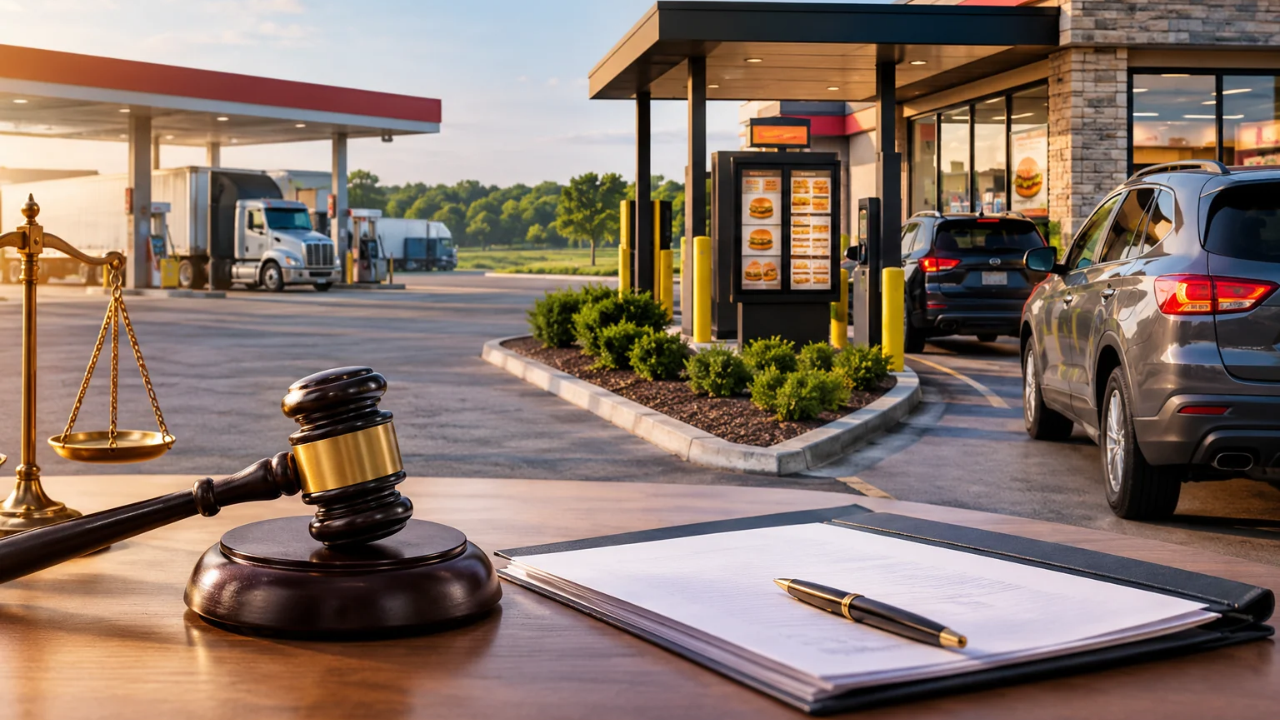
That is what this is about. Not a nuclear reactor. Not a sprawling strip mall tearing up an untouched wetland. Just a drive-through window at an existing Pennsylvania truck stop—a simple lane designed so exhausted motorists and commuters could grab a meal without unbuckling, locking up, and trekking across a lot shared with eighty-thousand-pound semi-trucks.
Yet for six years, a Pennsylvania couple has been locked in a grueling, expensive war of attrition with local bureaucracy over that exact window. And recently, a state appellate court finally stepped in, reviving their fight and handing a rare, bruising rebuke to the zoning machinery that tried to bury them.
To understand why a court ruling over a truck stop drive-through matters to anyone who doesn't own a commercial property, you have to look past the concrete. You have to look at what happens when local government stops regulating safety and starts suffocating survival.
The Invisible Wall of "No"
Let's step into the boots of a small business owner in rural or suburban Pennsylvania—call them Arthur and Elena, a composite sketch of the countless independent operators keeping America's highway corridors alive.
When you buy or operate a truck stop, you aren't buying a passive investment. You are buying a twenty-four-hour beast that demands constant feeding. Diesel margins are razor-thin, often dictated by global oil markets and undercut by national mega-chains with billion-dollar balance sheets. Where does an independent operator actually make a living? Inside the building. Coffee, hot sandwiches, cold drinks, convenience items.
Six years ago, the math of roadside retail began shifting under everyone's feet. Convenience stopped being a perk and became a prerequisite. Customers—especially commuters rushing to morning shifts and parents with kids strapped into car seats—didn't want to navigate a parking lot full of idling eighteen-wheelers just to buy a cup of coffee.
So the couple did what responsible business owners are supposed to do. They looked at their property. They hired engineers. They drew up plans to add a drive-through lane to their existing truck stop.
They expected questions. They expected traffic studies, drainage reviews, and lighting checks. What they walked into instead was a six-year bureaucratic quicksand trap.
In municipal zoning battles, "no" rarely arrives as a clean, honest rejection. Instead, it arrives disguised as endless process. A hearing gets postponed. A zoning board reinterprets a single word in a thirty-year-old ordinance. Neighboring objectors—sometimes sincere residents worried about headlights, sometimes competitors hiding behind civic concern—show up to raise hypothetical nightmares about queuing cars spilling onto the state highway.
Months turn into years. Legal retainers bleed dry the exact capital meant to pay for construction. Interest rates climb. Concrete costs double. All the while, the building sits unchanged, and the corporate travel plaza three exits down quietly captures the morning rush.
Why Zoning Boards Fear the Drive-Through
If you've never sat in the folding chairs of a township municipal building at nine o'clock on a Tuesday night, the hostility toward a drive-through can feel baffling. Why would local officials fight so hard to stop an existing business from modernizing?
Think of a municipal zoning ordinance like an old house that has been remodeled fifty times without ever updating the blueprints. Most township codes in Pennsylvania were written decades ago, long before mobile ordering, contactless pickup, and high-volume commuter drive-throughs became the backbone of food service.
When a property owner proposes adding a drive-through to a truck stop, the zoning board faces a fork in the road. Under Pennsylvania land-use law, if a use is permitted by right or by special exception, the board isn't supposed to act like a king granting favors. They are supposed to act like referees checking rules. If the applicant meets the objective criteria—setbacks, traffic flow, parking spaces, lot coverage—the permit is supposed to issue.
Instead, boards frequently fall into the trap of speculative denial.
Consider what happens when a board denies a project not because the engineer's traffic study failed, but because board members feel the drive-through might change the character of the intersection, or worry that cars might back up during a hypothetical peak hour. In legal terms, that is an abuse of discretion. In human terms, it is moving the goalposts after the ball is already in the air.
I have watched small operators sit at kitchen tables surrounded by three-ring binders full of site plans, trying to figure out how to prove a negative. How do you prove to five skeptical board members that a line of six cars won't cause chaos on a road that already handles ten thousand vehicles a day? You pay a traffic engineer twenty thousand dollars to model peak-hour trip generation. And when the board ignores the engineer's data anyway, you pay an appellate lawyer another thirty thousand dollars just to ask a judge to read the transcript.
That is the hidden tax of local obstruction. It doesn't show up on a municipal budget, and no politician campaigns on it, yet it quietly decides who gets to stay in business and who gets forced to sell out to a national conglomerate.
The Courtroom Turning Point
For six years, the Pennsylvania couple's bid to add that drive-through looked like another cautionary tale about fighting City Hall. Lower rulings leaned toward municipal deference—the long-standing judicial habit of letting local boards have the final word on neighborhood planning.
Then the appellate court took a hard look at the record.
When appellate judges review a zoning battle, they strip away the emotional theater of public comment sessions and look strictly at the law and the evidence. What they found in this case was a textbook breakdown of fair process. Under settled Pennsylvania precedent, a municipality cannot use vague, generalized fears about traffic congestion to block a lawful expansion when the applicant has satisfied the specific, objective standards laid out in the zoning code.
Traffic increases are a natural byproduct of any commercial growth. If "more cars might show up" were a valid legal excuse to deny a permit, no grocery store, pharmacy, or coffee shop could ever be built anywhere in the Commonwealth. To justify a denial on traffic grounds, objectors or the board must prove a high probability that the specific proposal will generate abnormal traffic patterns—something far beyond what the zoning code already anticipated when it zoned that land for commercial or highway use in the first place.
By reviving the couple's appeal, the court sent an unmistakable shockwave back down to the township level. You cannot weaponize ambiguity. You cannot hold a family's livelihood hostage for half a decade simply because you dislike the idea of a drive-through window at a truck stop.
The Invisible Stakes on the Asphalt
It is easy to treat a legal victory like this as dry administrative housekeeping—a procedural remand, a technical correction of a zoning board's overreach. That misses the pulse of what actually happens on the ground when a project like this finally moves forward.
Walk outside onto a truck stop lot at dusk and watch the choreography of heavy freight and passenger cars trying to coexist. It is an inherently tense environment. You have eighty-foot tractor-trailers swinging wide to back into tight spaces, blind spots the size of small houses, and exhausted drivers climbing down from cabs after eight hours of staring at white lines.
Now add a family in a Honda Civic just trying to grab dinner, or a nurse coming off a hospital shift who wants a hot meal without walking across an unlit, diesel-slicked apron in freezing rain.
A well-designed drive-through at a truck stop isn't just a revenue stream for the owners. It is a physical separation of hazards. It keeps passenger vehicles in a controlled, predictable lane, away from the heavy maneuvering zones where trucks turn and park. It turns a chaotic, shared parking lot into an organized flow of traffic.
Yet for six years, the very officials claiming to protect public safety fought to keep those commuters walking across the truck lot instead of letting them stay safely inside their vehicles.
What Every Property Owner Should Know About the Fight
If you own a small business, a commercial parcel, or even a piece of family land that sits in the crosshairs of municipal regulation, this Pennsylvania saga offers a hard-earned blueprint for survival.
First, the record at the initial hearing is everything. Courts rarely let you introduce new evidence later. When the couple in this case eventually reached the appellate level, their survival depended entirely on the engineering reports, traffic counts, and legal objections placed into the transcript years earlier. If you walk into a zoning hearing assuming common sense will prevail without sworn expert testimony, you have already lost.
Second, know the difference between a variance and a permitted use. Municipalities love to treat every business modification as a request for special mercy—a variance—which carries an almost impossible legal burden of proving "unnecessary hardship." Smart land-use counsel forces the board to stay inside the box of objective rules. When an ordinance allows food service or accessory commercial uses, the burden shifts: the town has to prove why you can't build, not the other way around.
Third, prepare for the clock to be used as a weapon. Bureaucracy never pays overtime, and municipal solicitors bill by the hour while small business owners pay out of pocket. Six years is longer than most presidential administrations, longer than many small business loans, and longer than most couples' marriages can comfortably absorb the stress of constant litigation.
The Long Road Back to the Starting Line
Reviving a case in appellate court is not the same thing as pouring concrete tomorrow morning. A judicial win in land-use law often means returning to the exact table where the fight began, armed now with a court order telling the local officials to follow the rules they ignored the first time.
Think about the sheer grit required to reach that point. Six birthdays. Six winters of snowplows pushing slush across the same unchanged asphalt. Six years of watching competitors adapt to a changing economy while your own blueprints gather dust in a lawyer's filing cabinet.
Most people quit in year two. They run out of cash, or they run out of stomach for walking into a room full of neighbors who treat their livelihood like a public nuisance. They sell the property to a real estate investment trust or a national chain that has an in-house legal department on salary and ten million dollars to burn on litigation without blinking.
And when that happens, the town doesn't preserve its small-town charm. It just trades a local family who sponsors the Little League team for a corporate logo answered by a call center three states away.
Out along the highway tonight, the diesel engines are still idling in the dark, the neon signs are still humming against the mist, and inside a small office behind a counter, a couple is finally looking at a set of blueprints that are no longer dead on arrival—just a quiet stretch of pavement, a painted yellow arrow, and a window waiting to be cut into the brick.