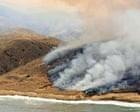
A stranded sailor fires a distress flare into the night sky, hoping for rescue. Instead, the signal hits dry brush, exploding into a massive wildfire. This nightmare scenario became a reality on Santa Cruz Island, where a frantic call for help triggered a California island fire that has now scorched over 10,000 acres of protected wilderness.
It sounds like a freak accident, but it happens more often than you think. Marine safety tools are literal lifesavers on the water. On land, they are explosives. When emergency gear meets a landscape parched by years of cyclical drought, the results are catastrophic. Building on this topic, you can find more in: Institutional Paralysis and the Strategic Delay of Israeli Judicial Proceedings.
The emergency began when a private vessel ran aground on the rugged, wind-swept coastline of Santa Cruz Island, the largest feature in the Channel Islands National Park. Stranded against the rocks with rough surf pounding the hull, the operator deployed a standard handheld or aerial visual distress signal.
The sailor got rescued. The island did not. Driven by fierce offshore winds, the fire leaped from the coastal bluffs into the interior canyons, moving faster than local crews could track. Within 48 hours, a single spark transformed thousands of acres of pristine conservation land into a charred moonscape. Observers at TIME have also weighed in on this trend.
The Unique Disaster of an Island Wildfire
Fighting a wildfire on an isolated island is a logistical nightmare. You cannot just drive a convoy of fire engines to the front lines. Every single piece of equipment, every gallon of retardant, and every hand crew must arrive by boat or chopper.
The Channel Islands National Park relies heavily on cooperation between the National Park Service, the U.S. Coast Guard, and mainland agencies like the Ventura County Fire Department. When a blaze hits 10,000 acres, local resources run thin instantly. Air tankers must fly back and forth from mainland airbases, losing precious time during the critical afternoon burning windows.
Geography dictates the tactics. The terrain on Santa Cruz Island is steep, riddled with deep ravines and thick, decades-old chaparral that has never seen a controlled burn. Ground crews face treacherous footing, shifting winds, and zero avenues for a quick escape if the flames turn on them.
The weather patterns out there are incredibly unpredictable. You get a marine layer in the morning that mimics high humidity, tricking you into thinking the fire is laying down. By afternoon, dry gusts rip through the canyons, wiping out whatever containment lines the crews managed to scratch into the dirt.
What Marinas and Boaters Get Wrong About Pyrotechnic Flares
The maritime community needs a serious wake-up call about emergency gear. Most boaters buy a pack of red aerial flares, toss them into a damp locker, and forget they exist until inspection day.
Standard visual distress signals contain strontium nitrate, potassium perchlorate, and magnesium. They burn at temperatures exceeding 3,000 degrees Fahrenheit. For context, that is hot enough to melt aluminum. When an aerial flare fires, it shoots a molten slag ball hundreds of feet into the air. If it drifts over land before it burns out, it acts as a heat-seeking missile for dry vegetation.
The U.S. Coast Guard requires all vessels operating on coastal waters to carry three day-and-night visual distress signals. Historically, this meant pyrotechnics. But times have changed, and the regulations have kept pace, even if casual boaters have not.
Electronic Visual Distress Signal Devices (eVDSD) are the modern answer to this problem. These high-intensity LED strobes flash the international SOS distress signal. They last for hours, unlike a pyrotechnic flare that sputters out in less than a minute. Best of all, they emit zero heat and carry zero fire risk.
If you run aground near a shoreline, firing a traditional flare toward the beach is an act of environmental negligence. If you must use pyrotechnics, you point them downwind, out over open water, away from the coast. Better yet, swap your outdated firesticks for certified electronic alternatives before your next voyage.
The Ecological Toll on the Channel Islands
The damage to Santa Cruz Island goes far beyond the raw acreage numbers. This island is a biological treasure trove, often called the Galapagos of North America. It is home to unique plants and animals found nowhere else on Earth.
The Channel Island fox, a housecat-sized predator that was saved from the brink of extinction just a couple of decades ago, faces immediate habitat loss. While these animals are clever and can sometimes outrun slow-moving fires, a fast-moving, wind-driven front traps them in their dens.
The plant communities are equally vulnerable. Island chaparral and coastal sage scrub evolved with fire, but not at this frequency or intensity. When a fire burns too hot, it sterilizes the topsoil, destroying the seed bank buried beneath the surface. This opens the door for invasive, highly flammable weeds like mustard and cheatgrass to take over, permanently altering the ecosystem and making future fires even more likely.
We also have to consider the cultural resources. Santa Cruz Island contains thousands of archaeological sites belonging to the Chumash people, who inhabited the area for millennia. Intense heat fractures ancient stone tools, destroys shell middens, and erases irreplaceable historical data before researchers can document it.
How to Handle an Onboard Emergency Without Starting a Fire
If you find your vessel in distress near the California coast, your primary goal is survival. But saving your life should not mean destroying an ecosystem.
First, rely on radio communication. A VHF radio tuned to Channel 16 is your most powerful tool. Digital Selective Calling (DSC) on modern VHF radios sends an automated distress alert with your exact GPS coordinates to the Coast Guard at the push of a button. It works instantly and safely.
Second, activate an Emergency Position Indicating Radio Beacon (EPIRB) or a Personal Locator Beacon (PLB). These satellites-linked devices broadcast your location directly to rescue coordinators without bright flashes or extreme heat.
If you are forced to use pyrotechnic flares because your electronics failed, follow these strict safety rules:
- Assess your surroundings and identify the wind direction.
- Never fire an aerial flare toward land or low-flying rescue aircraft.
- Hold handheld flares over the leeward side of the boat so dripping slag falls into the ocean, not on your deck or into coastal brush.
- Keep a fire extinguisher handy on your own vessel, just in case the launcher malfunctions.
Check the expiration dates on your emergency gear every single season. Old flares become unstable. They can misfire, explode in your hand, or drift wildly off-course upon launch. Dispose of expired pyrotechnics safely through local hazardous waste programs or fire departments; never fire them off just for fun or practice.
The unfolding disaster on Santa Cruz Island serves as a stark reminder that our choices on the water have massive consequences on land. Upgrading to electronic distress signals and practicing smart emergency protocols keeps you safe without burning down the places we love to explore.