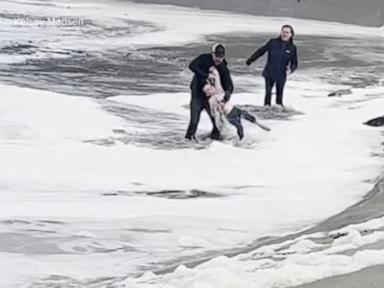
A viral rescue video showing a young girl nearly swept away by a massive wave on the Oregon coast exposes a lethal, misunderstood ocean hazard known as a sneaker wave. Unlike standard surf, these abnormally large surges strike without warning, rushing far up dry sandbars and dragging beachgoers into freezing, turbulent currents before they can react. The footage serves as a stark reminder that Pacific Northwest beaches operate under entirely different physical laws than the gentle coastlines most tourists expect.
Watch the viral clip, and your stomach drops. One second, a child is walking along what looks like safe, packed sand, well clear of the foaming edge of the tide. The next, a wall of water surges forward with terrifying speed, knocking her off her feet and pulling her backward toward the churning Pacific. Only the split-second reaction of a bystander prevented a tragedy that plays out far too often along this rugged 363-mile stretch of shoreline.
Local news outlets love these videos because they offer instant drama and a happy ending. They run the thirty-second clip, add a brief blurb about beach safety, and move on to the next story. That surface-level coverage misses the real story entirely. The near-drowning of a child in Oregon is not a freak accident or a case of bad luck. It is the predictable result of unique coastal bathymetry, deceptive weather patterns, and a massive gap in public awareness regarding how the North Pacific actually behaves.
The Physics Behind the Ambush
Most people understand the basic rhythm of the ocean. Waves roll in, break, wash up the beach, and recede in a predictable cadence. You watch the water for two minutes, find the high-water mark, and set your towel ten feet above it. On the Oregon coast, that instinct will get you killed.
Sneaker waves do not follow the standard rhythmic set of incoming surf. They are caused by the constructive interference of multiple wave trains traveling across the Pacific Ocean from distant storms. When two or more distinct swells—often generated by massive low-pressure systems thousands of miles away in the Gulf of Alaska—align in just the right phase, their energy combines. The result is a single, disproportionately massive wave that carries vastly more water volume and momentum than the waves preceding or following it.
Because these waves carry so much extra water, they do not simply break and fizzle out at the shoreline. Instead, they surge up the beach slope like a localized tsunami. On flat, wide Oregon beaches—such as those found in Cannon Beach, Seaside, or Lincoln City—a sneaker wave can easily travel 100 to 200 feet beyond the normal wet-sand line.
The danger lies in the backwash. What goes up must come down, and the massive volume of water dumped onto the upper beach rushes back toward the ocean with tremendous velocity. Because the water is shallow, it moves fast enough to sweep a grown adult off their ankles, let alone a small child. Once knocked down, a person is tumbled in water heavy with suspended sand, losing all sense of direction as the backwash drags them directly into deeper troughs and rip currents.
Why the Pacific Northwest Traps Unsuspecting Visitors
Tourists arrive in Oregon expecting a classic beach vacation, bringing mental habits formed on the Atlantic coast or in Southern California. Those habits are lethal here.
Consider the water temperature. Off the coast of Oregon, the California Current pulls cold, nutrient-rich water down from the subarctic. Even in the dead of summer, ocean temperatures along the Oregon coast hover between 48 and 55 degrees Fahrenheit. In winter and spring, they drop even lower.
When a sneaker wave knocks someone down and drags them into the surf, they do not just face the risk of drowning from turbulence. They face immediate cold water shock. Immersion in water below 60 degrees triggers an involuntary gasp reflex. If your head is underwater when that reflex hits, you inhale seawater instantly. Within minutes, blood vessels constrict, extremities lose dexterity, and swimming becomes physically impossible—even for Olympic-level athletes.
Add heavy coastal clothing to the equation. Unlike beaches in Florida or Hawaii where visitors wear lightweight swimsuits, Oregon beachgoers wear jeans, heavy sweatshirts, rain jackets, and waterproof boots to combat the perpetual coastal wind and mist. The moment a sneaker wave saturates those garments, they become anchors. A heavy fleece hoodie and denim jeans soaked with cold seawater can add twenty to thirty pounds of dead weight, dragging a person down and making it nearly impossible for a rescuer to pull them back onto the sand.
The Deceptive Calm of Clear Days
Statistically, many of the worst sneaker wave incidents occur on sunny, seemingly calm days. Storms out in the Pacific send long-period swells toward the coast long before or after local weather systems pass through. A beachgoer standing under a blue sky with a light breeze has no visual cue that a massive energy surge is barreling toward the shore beneath the surface.
The ocean looks flat. The waves breaking near the shore look small, maybe two or three feet high. Because long-period swells have wavelengths stretching hundreds of yards between crests, the water rises slowly and quietly until it hits the shallow coastal shelf, shoals rapidly, and surges onto the dry sand. By the time the water reaches your ankles, the wall of water behind it is already pushing at your knees.
The Myth of the Safe Distance
Watch any safety briefing from Oregon State Parks or the National Weather Service, and you will hear the same core advice: never turn your back on the ocean. While sound in theory, that advice fails in practice because human attention spans are not built for continuous vigilance over a three-hour beach walk.
Parents watch their kids play near driftwood logs. Photographers frame shots of Haystack Rock while standing on what appears to be completely dry, powdery sand. Dog owners throw tennis balls along the flat expanses of low tide. In every single one of those scenarios, people believe they are at a safe distance because the sand beneath their feet is dry.
Dry sand on the Oregon coast is a lie. During high tide, winter storms, and king tide events, the ocean routinely reclaims the entire width of the beach, slamming directly into the sea cliffs and foredunes. Massive driftwood logs—some weighing several tons—sit high up on the dry sand near the dune grass. Tourists climb on these logs for photos, completely failing to ask the most obvious question: how did a fifty-foot cedar tree get pushed two hundred feet above the water line?
The ocean put it there. And when a sneaker wave rolls in, that same ocean will pick that log up and roll it right over anyone standing near it. In fact, being crushed by rolling driftwood is one of the leading causes of blunt-force trauma and fatality during sneaker wave events. The water surges in, floats the timber, and then pins victims underneath as the backwash recedes.
Anatomy of a Viral Rescue and the Bystander Dilemma
In the viral video that sparked the latest round of headlines, the rescue happened fast. A bystander saw the surge, realized the child was going down, and lunged into the rushing water to grab her before the backwash pulled her past the breaking waves. It makes for incredible television. It also highlights a terrifying reality about emergency response along the Pacific coast.
Oregon beaches are vast, remote, and largely unguarded. Unlike the heavily staffed lifeguard towers of Los Angeles County or the Jersey Shore, almost no beaches in Oregon have full-time municipal lifeguards patrolling the sand. If you get swept out in Cannon Beach, Manzanita, or Bandon, nobody in a red swimsuit is going to sprint down the beach with a rescue buoy within thirty seconds.
Rescue relies entirely on volunteer fire departments, local police, and the United States Coast Guard. Even with rapid dispatch, it takes ten to twenty minutes for a rescue swimmer or a Coast Guard MH-65 Dolphin helicopter from Astoria or North Bend to reach a victim in the water. In 50-degree water, twenty minutes is an eternity.
This leaves immediate rescue to whoever happens to be standing nearby—usually a parent or a stranger. And this is where tragedy multiplies. Every year along the Pacific Northwest coast, rescuers die trying to save someone who was knocked down by a sneaker wave. A child gets swept off their feet, a parent runs into the surging backwash without a flotation device, and both get dragged out into the rip current. The child is sometimes washed back onto the sand by a subsequent wave, while the exhausted, hypothermic parent drowns fifty yards offshore.
The Counter-Intuitive Rules of Survival
If you are caught in a sneaker wave or watching someone get swept away, your natural instincts will betray you. Fighting the current directly is a guaranteed path to exhaustion.
- If you are swept off your feet: Do not try to stand up while the backwash is rushing past your legs. Standing up creates maximum surface area for the rushing water to push against, ensuring you will be knocked down repeatedly and slammed into the hard-packed sand. Instead, let the initial surge carry you, keep your feet pointed toward the shore if possible to fend off rocks, and wait until the rushing backwash slows down before trying to crawl or swim.
- If you are dragged past the breakers: Never swim straight back toward the beach against a rip current. Swim parallel to the shoreline—north or south—until you exit the narrow channel of outgoing water. Once out of the rip, use the incoming whitewater waves to push you back toward the beach.
- If someone else is swept away: Do not run into the water after them unless you have a flotation device tethered to the shore. Call 911 immediately, keep your eyes locked on the victim so you can point rescuers to their exact location, and look for anything that floats—a cooler, a boogie board, a piece of foam—to throw toward them from the dry sand.
Why Warning Signs Keep Failing
Walk onto almost any public beach access point in Oregon, and you will pass wooden or metal signs warning of sneaker waves, rip currents, and rolling logs. State agencies spend thousands of dollars maintaining these signs, updating digital reader boards during high-surf advisories, and issuing press releases ahead of holiday weekends. Yet the rescues—and the body counts—keep piling up.
The failure is one of risk communication. Warning signs along highways and park entrances suffer from visual fatigue. When visitors see twenty different signs listing rules about leashing dogs, packing out trash, protecting snowy plover nesting areas, and watching for sneaker waves, the critical life-safety warning gets lost in the bureaucratic noise.
Furthermore, the term "sneaker wave" itself sounds almost playful. To someone unfamiliar with oceanography, a "sneaker" sounds like a mild inconvenience—a wave that might sneak up and get your shoes wet. In Washington and parts of Northern California, coastal authorities increasingly refer to them as killer waves or surge waves to convey the violent, sudden nature of the phenomenon. Words matter when you are trying to override a tourist's relaxed vacation mindset in three seconds.
What Needs to Change on the Coast
Coastal municipalities in Oregon rely heavily on tourism dollars, creating a quiet tension between promoting the rugged beauty of the shoreline and scaring visitors away with grim mortality statistics. Hotels, restaurants, and local chambers of commerce market the Oregon coast as a serene, family-friendly escape. Nobody puts a warning about cold-water shock and rolling logs on the cover of a travel brochure.
That culture of soft-pedaling the danger has to end. Real coastal safety requires aggressive, unavoidable intervention at the exact point where visitors transition from parking lots to the sand.
First, coastal towns and state parks need to strip away the clutter at beach access trails. Replace multi-bullet rule boards with stark, high-contrast warnings dedicated solely to wave surges and cold water, placed directly at eye level on narrow boardwalks where visitors cannot walk around them without looking.
Second, public rescue equipment needs to become standard infrastructure. Several progressive coastal communities in California and Australia have installed bright yellow or red public rescue tubes—buoyant foam torpedoes mounted on posts right at the beach entrance—allowing bystanders to grab a flotation device before running toward the water. Oregon has begun piloting similar stations in high-traffic areas like Cannon Beach and Seaside, but they remain far too rare across the state's hundreds of access points.
Finally, visitors must stop treating the Oregon coast like a theme park. The Pacific Ocean in the Northwest is an untamed, subarctic wilderness that operates with zero regard for human comfort or safety. You do not casually stroll along its edge while checking your phone, and you never let a small child wander toward the wet sand out of arm's reach.
Watch the viral rescue video again, not for the thrill of the save, but for the terrifying speed of the water. That girl survived because a stranger happened to be standing in the right spot at the exact right second. Next time, the beach might be empty, the water will still be fifty degrees, and the Pacific will not give anyone a second chance.