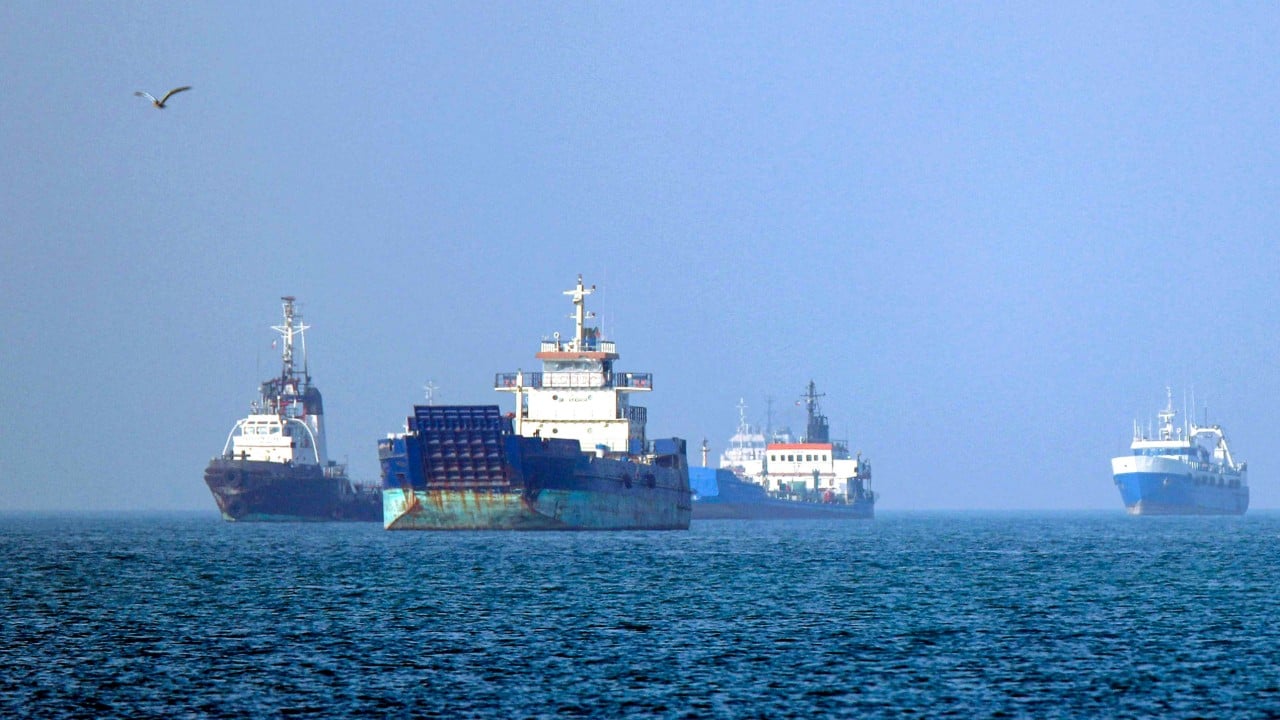
The coffee in the captain’s mug has gone cold for the fourth time this morning. It sits on the console of a bridge that cost millions to build, surrounded by flickering monitors tracking a world that has suddenly decided to stop moving. Outside the reinforced glass, the Persian Gulf is a flat, deceptive blue. Somewhere beneath that surface, and scattered across the horizon, are the invisible lines of a conflict that doesn't care about shipping schedules or quarterly earnings.
This isn't just a delay. It is a paralysis.
Deep in the Strait of Hormuz, a geographical choke point narrower than some cities, the heartbeat of global trade is skipping. We talk about "supply chains" as if they are abstract mathematical formulas, but they are actually made of steel, salt air, and the nerves of tired men. Right now, roughly 100 ships with direct links to Hong Kong are caught in a geopolitical vice. They are sitting ducks in a gallery where the hunters use ballistic missiles and suicide drones.
The Geography of a Nightmare
To understand why this matters, you have to look at the map not as a student, but as a navigator. The Strait of Hormuz is a needle's eye. On one side sits Iran; on the other, the United Arab Emirates and Oman. Almost a third of the world’s liquefied natural gas and a quarter of its total oil consumption passes through this tiny strip of water.
When war flared in the Middle East, the needle’s eye began to close.
For the crews aboard these 100 Hong Kong-linked vessels, the statistics are personal. Imagine a hypothetical third officer named Chen. He’s twenty-four, sending half his paycheck back to a small apartment in Kowloon, and his three-month stint has just hit day one hundred and twenty. He watches the radar, not for other ships, but for the erratic signature of a low-flying drone.
The ships are "stranded" not because they cannot move, but because moving has become an act of gambling with lives. Insurance premiums have skyrocketed. Security firms are charging eye-watering fees to put armed guards on deck. For a vessel flying the regional flags of a global financial hub like Hong Kong, the complexity is doubled. These ships represent the intersection of Chinese investment, international maritime law, and Western-aligned trade routes. They are a microcosm of the modern world, and right now, that world is stuck.
The Invisible Toll on the Shoreline
While the sailors watch the horizon, the rest of us are beginning to feel the ripples. In the boardrooms of Central and the logistics hubs of Kwai Tsing, the tension is palpable. This isn't a problem that stays in the Middle East.
Shipping is the quiet engine of our existence.
When 100 ships stop, the cost of everything—from the fuel in your car to the plastic in your toothbrush—begins to vibrate with uncertainty. We are used to a world of "just in time." We want our goods yesterday. But the Strait of Hormuz operates on a much older, more brutal logic: "might makes right."
The logistical nightmare is a cascading failure. If these vessels don't reach their destinations, they aren't available for their next pick-up. The containers they carry are full of electronics, textiles, and raw materials that factories are waiting for. When the line breaks here, a factory in Dongguan goes quiet. A retail shelf in London stays empty. A family in Ohio wonders why the price of a heater just jumped twenty percent.
The uncertainty is the real poison. If we knew the Strait would be closed for exactly thirty days, we could plan. We could reroute around the Cape of Good Hope, adding weeks and millions of dollars to the journey, but we would have a date. But no one knows if the next missile is coming in five minutes or five months. So, they wait. They drift. They burn fuel just to keep the lights on while they sit in a graveyard of stalled ambitions.
A Masterclass in Fragility
We spent decades building a global economy that prizes efficiency above all else. We trimmed the "fat" out of the system. We made ships bigger, routes more direct, and buffers thinner. What we didn't realize is that "fat" is often another word for "resilience."
The 100 ships linked to Hong Kong are the canary in the coal mine. They represent a specific kind of vulnerability—the vulnerability of the middleman. Hong Kong has always thrived by being the bridge between East and West. But when the bridge is located in a war zone, the architecture begins to groan under the weight of history.
Think of the legal quagmire. A ship might be owned by a company in Hong Kong, managed by a firm in Singapore, flagged in Panama, and crewed by sailors from the Philippines. When that ship is threatened in the Strait of Hormuz, who protects it? The answers are messy, political, and often nonexistent.
The sailors know this. They see the gray hulls of warships in the distance, but they also know that a destroyer cannot be everywhere at once. There is a specific kind of silence on a stalled ship. The main engines are off. The vibration that usually hums through the soles of your boots is gone. Instead, you hear the wind, the water slapping against the hull, and the constant, rhythmic ticking of a clock that is costing someone, somewhere, thousands of dollars every second.
The Human Cost of Hardware
Behind every news report about "tonnage" and "vessels," there is a human story that rarely makes the headline.
There are families in Hong Kong checking maritime tracking apps every hour, watching a tiny digital triangle that represents a husband or a father. That triangle hasn't moved in three days. The "Strait of Hormuz" isn't a strategic location to them; it's a place that is stealing their peace of mind.
War is often described as a series of explosions, but for most of the world, war is a series of delays. It is the sudden absence of things we took for granted. It is the realization that the thin line of water between the Gulf of Oman and the Persian Gulf is the only thing keeping the global economy from a heart attack.
The 100 ships are still there. They are painted in bright reds and deep blues, rusted by the salt, carrying the physical weight of our modern lives. They are waiting for a signal that may not come for a long time. They are symbols of a world that thought it had outgrown geography, only to be reminded that a few miles of water and a handful of missiles can still bring the masters of the universe to their knees.
The sun sets over the Strait, turning the water into a sheet of hammered gold. On the bridges of those 100 ships, the night shift is coming on. They will stare into the darkness with thermal binoculars, looking for the shape of a threat that moves faster than a human can react. They aren't thinking about global trade or the Hong Kong Stock Exchange. They are thinking about the sound of the engine starting back up, the feeling of the bow finally turning toward home, and the simple, desperate wish for the world to start moving again.



