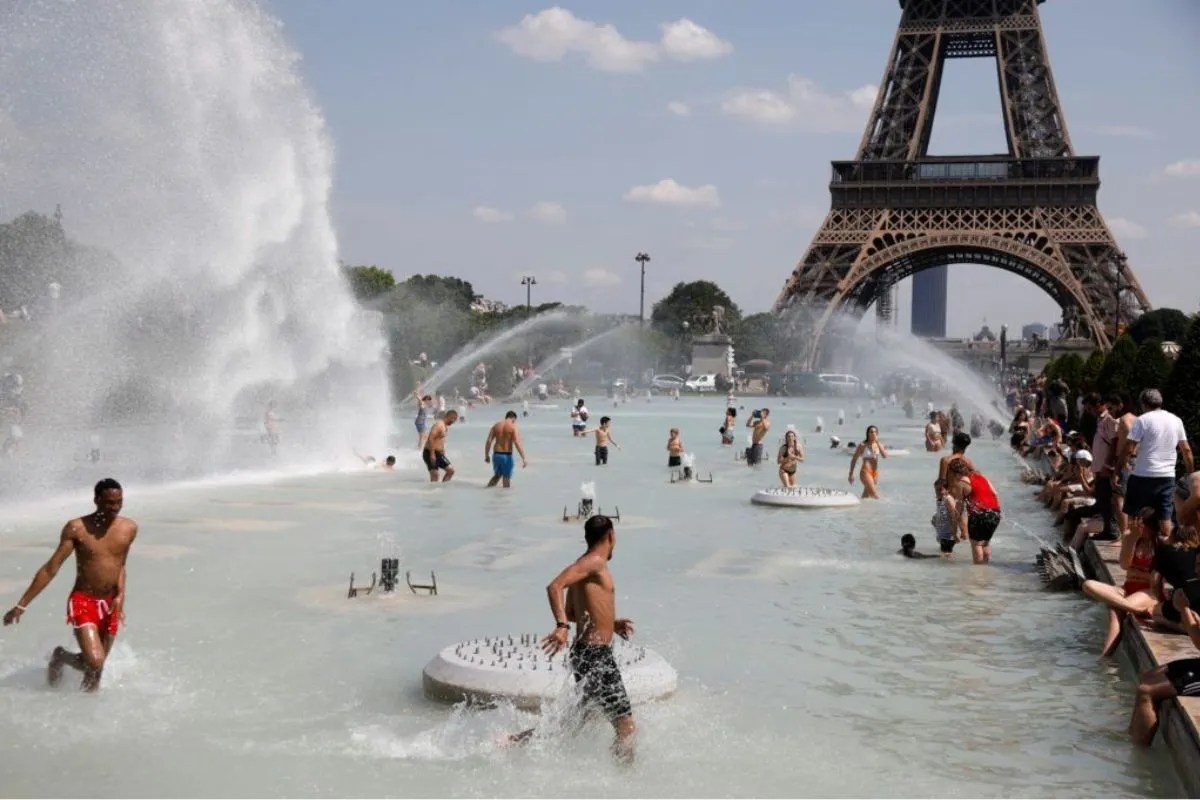
The air inside the apartment on Rue de Belleville did not move. It felt heavy, almost liquid, pressing down on the chest with the weight of an invisible furnace.
For seventy-two years, Madeleine had watched Paris change from her third-floor window. She had seen political movements rise and fall, winter blizzards blanket the cobblestones, and decades of tourists chasing the romance of the Seine. But she had never felt a summer like this. The fan on her bedside table did nothing but whip the trapped, 42°C air into a frenzy. Her skin was dry. Her water glass sat empty on the counter, just a few meters away, but her limbs felt like lead. You might also find this similar coverage insightful: The Chaos and Grit of Lone Wolf Disaster Rescue in Venezuela.
Outside, the city of light looked exactly the same. The cafes were full of travelers drinking chilled rosē. The Eiffel Tower gleamed against a cloudless blue sky.
That is the terrifying thing about a heatwave. It leaves no rubble. It breaks no windows. It does not howl like a hurricane or roar like a flash flood. It is a quiet killer, moving house to house, targeting the vulnerable behind closed shutters while the rest of the world goes about its day. As extensively documented in latest articles by NPR, the effects are notable.
By the end of that single week, Madeleine would become a statistic. One of exactly 1,000 additional deaths recorded in France within a seven-day window. A surge of mortality so sharp it sent shockwaves through the European public health sector, forcing a continent famous for its mild summers to confront a brutal new reality.
The Mirage of the European Summer
We have been conditioned to view the European summer through a specific lens. We think of sun-drenched plazas in Rome, late-night strolls along the Rhine, and long afternoons in Parisian parks. It is an idealized vision of leisure.
But beneath that postcard-perfect surface lies an infrastructure designed for a completely different era.
Europe was built to keep the heat in, not out. For centuries, architecture from Paris to Berlin prioritized thick stone walls, deep insulation, and compact windows designed to trap every precious calorie of winter warmth. Air conditioning is not a standard household utility here; it is historically viewed as an American luxury or an unnecessary environmental tax. In France and Germany, fewer than one in ten homes have cooling systems installed.
When the mercury shatters records, these historic buildings transform. They stop being shelters and start acting like ovens.
Consider what happens next: the concrete and asphalt of major metropolitan areas absorb the relentless solar radiation all day. At night, when the human body desperately needs the temperature to drop below 20°C to recover, the city begins to radiate that trapped heat back into the environment. This is the urban heat island effect. It means that even when the sun goes down, there is no relief. The thermometer stays stubbornly high, denying the cardiovascular system the crucial rest it requires to cool the blood.
When the Body Shuts Down
To understand why a temperature spike in Germany or France can claim thousands of lives in days, we have to look at what happens inside us when the environment turns hostile.
Think of the human heart as a radiator in a car. When the engine gets hot, the pump has to work faster to push fluid to the surface and release the heat. When ambient temperatures surpass 35°C, your heart begins to beat with furious urgency. It pumps blood furiously to your skin, trying to dump the internal warmth into the air via sweat.
But if the air around you is just as hot as—or hotter than—your internal temperature, this mechanism fails. The sweat stops evaporating efficiently. The heart pumps faster and harder, trying to compensate.
For a healthy twenty-five-year-old backpacker drinking water under an awning in Munich, this is an uncomfortable inconvenience. For an elderly citizen with a mild heart condition, an infant whose thermoregulation system isn't fully developed, or a construction worker hauling materials in Frankfurt, it is a medical emergency.
The blood thickens as dehydration sets in. The kidneys strain to filter the sluggish fluid. Eventually, organs begin to suffer from a lack of oxygenated blood. It isn't a dramatic event; often, the individual simply becomes confused, grows sleepy, and quietly slips away in a darkened bedroom.
This is exactly what played out across Germany as national temperature records tumbled like dominoes. Towns accustomed to mild July afternoons found themselves registering temperatures that would feel more at home in the North African desert. Emergency rooms filled not with victims of sudden accidents, but with thousands of people suffering from severe dehydration, heat exhaustion, and systemic organ failure.
The Broken Compass of Predictability
The real problem lies in our collective psychological inertia. We are calibrated to the past.
When meteorologists in Germany announced that temperatures were pushing past historical boundaries, many residents treated it as an invitation to go to the lake. The cultural instinct in Western and Central Europe is to celebrate the sun. It is a scarce commodity for nine months of the year.
This deep-seated behavioral pattern creates a dangerous disconnect. People do not fear the sun the way they fear a dark storm cloud. They do not ration their energy or alter their daily routines until it is far too too late.
Medical professionals across the continent are now shouting into the wind, trying to reframe how we talk about extreme heat. It can no longer be framed as "good beach weather" on the nightly news. It needs to be treated with the same institutional gravity as a Category 4 cyclone.
When a thousand people die over the baseline average in a single nation in seven days, it is not an anomaly. It is a systemic failure of adaptation. It reveals that our cities, our medical triage systems, and our daily habits are completely out of alignment with the actual climate we now inhabit.
Redefining the Architecture of Survival
Fixing this requires more than just buying millions of portable air conditioning units, which would only gorge on electricity and worsen the broader environmental feedback loop. It demands a fundamental rewrite of how European society functions during the hottest months.
Change is starting to arrive, though it is measured in small, agonizing steps. Paris is experimenting with "cool islands"—designated green spaces, air-conditioned public halls, and misting stations scattered across the grid where vulnerable residents can seek refuge during the peak hours of the day. Urban planners are looking at ancient Mediterranean architecture, exploring ways to use reflective white roofing, vertical gardens, and natural wind-tunnel designs to lower street-level temperatures without relying on the power grid.
But these are long-term structural overhauls. They do nothing for the immediate crisis when the next high-pressure system parks itself over Central Europe, locking the heat in place for weeks on end.
True resilience requires a shift in human solidarity. It looks like postal workers in Germany checking in on isolated seniors during their delivery routes. It looks like neighbors noticing that the shutters across the courtyard haven't opened in forty-eight hours and knocking on the door with a pitcher of ice water.
We must learn to see the invisible disaster. We must look past the glittering terrace cafes and the sparkling rivers to recognize the quiet struggle happening behind the limestone facades.
The sun will rise again tomorrow, blazing and indifferent, casting a golden light across the rooftops of Europe while the concrete beneath our feet continues to cook.
:max_bytes(150000):strip_icc()/parts-of-a-swamp-cooler-2718628-a477e6f0787b4f8bb62ddf2def31d495.png)