The mud in the Donbas does not care about theology. It is a thick, primordial soul-crusher that clings to the boots of a nineteen-year-old conscript with the same indifferent weight it applied to his grandfather’s generation. In the trenches near Bakhmut, the air usually tastes of pulverized concrete and old iron. But for a few hours, there was a strange, terrifying lightness.
It was Easter. Meanwhile, you can find other stories here: Haiti Mourns After a Massive Stampede Claims 25 Lives.
For weeks, the diplomatic wires had hummed with the fragile possibility of a truce. It was meant to be a pocket of oxygen in a room filled with gas. The Orthodox calendar, shared by many on both sides of the contact line, offered a rare point of intersection. High-level rhetoric from the Vatican and local religious leaders had pushed for a cessation of hostilities, a moment where the thunder of 152mm howitzers would give way to the ringing of bells.
The concept of a holiday ceasefire is a ghost that haunts military history. We remember the Christmas Truce of 1914, where men stepped out of frozen ditches to exchange cigarettes and play football. We want to believe that the human spirit has a breaking point where it simply refuses to hate. But modern warfare is a different beast. It is managed by algorithms, long-range drones, and command structures located hundreds of miles from the mud. To see the full picture, we recommend the excellent analysis by Reuters.
The Anatomy of a Pause
A truce is not just a lack of noise. It is a logistical nightmare.
When the word comes down from command that the "quiet" is in effect, the tension actually increases. Imagine being a spotter in a forward observation post. You see a figure moving across the ruins of a village. Is he a civilian looking for water? Is he a soldier repositioning a mortar? Under the rules of a temporary ceasefire, you hesitate. That hesitation is where the psychological toll is paid.
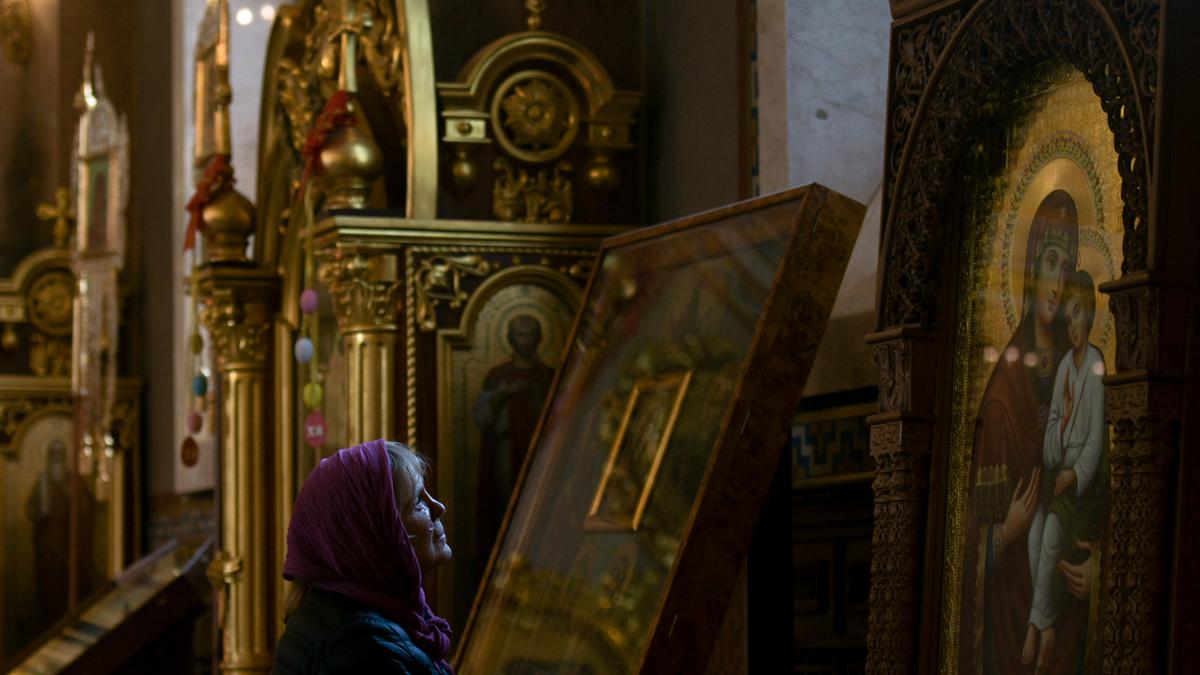
During this particular Easter window, the statistics looked promising on paper. Reported artillery exchanges dropped by significant percentages in the early morning hours. Both sides leaned into the optics of the moment. Images emerged of soldiers standing in candlelit bunkers, their rifles propped against dirt walls while priests splashed holy water on their helmets.
It felt like a victory for the human element. For a heartbeat, the war was a background hum rather than a deafening roar.
But the quiet was brittle. It was a glass floor built over an abyss.
The Cost of Cold Iron
The reality of the situation was that the strategic goals of the Kremlin and the defensive necessities of Kyiv remained fundamentally unchanged. A truce, however noble, does not move the border. It does not return the dead.
Consider the "invisible stakes" of such a pause. For a commander, a truce is a period of vulnerability. It is a chance for the enemy to rotate fresh troops into exhausted positions or to replenish stockpiles that had been depleted by weeks of grinding attrition. While the world saw a spiritual respite, the satellites saw a massive reshuffling of the deck.
The logistical reality:
- Ammunition resupply: Trucks that would have been targeted by FPV drones can suddenly move with relative freedom.
- Fortification: Trenches are deepened, and minefields are expanded under the cover of the "peace."
- Intelligence gathering: Electronic warfare units don't turn off their sensors just because there is a ceasefire. They listen even harder to the sudden clarity of the radio waves.
By mid-afternoon on Sunday, the glass floor began to crack. It started with small arms fire—the kind of staccato popping that could be a mistake or a provocation. Then came the mortars. Then the heavy stuff.
The Return of the Storm
When a truce ends, the transition is rarely gradual. It is a violent correction.
The "ending" of the Easter truce wasn't marked by a formal declaration or a press release from a ministry of defense. It was marked by a sudden, coordinated barrage that lit up the horizon near Avdiivka. The facts are stark: within six hours of the truce’s expiration, the volume of fire returned to its pre-holiday baseline.
The human cost of this cycle is a specific type of exhaustion. It is the whiplash of hope. To be told you might not die today, only to have that promise retracted by sunset, does something to the psyche that a constant state of combat does not. It reminds the soldier that peace is possible, which makes the return to the kill-box feel even more absurd.
Think about a family in a cellar in Kharkiv. For twelve hours, they didn't hear the whistle of incoming S-300 missiles. They perhaps walked to the end of the block to see the sun. They spoke to a neighbor without shouting over the sirens. When the first explosion finally rattled the jars on their shelves at 9:00 PM, the darkness felt heavier than it had on Saturday.
The truce didn't fail because of a lack of faith. It failed because the machinery of the conflict has grown larger than the humans caught inside it.
The Mirage of Diplomacy
We often treat these pauses as "steps toward peace." In reality, they are more like the eye of a hurricane. The storm is still moving; the pressure is just temporarily lower.
The diplomatic community uses these moments to gauge the willingness of the combatants to negotiate. If a three-day truce can hold, perhaps a week-long one can. If a week holds, perhaps a settlement. But in this instance, the quick collapse of the quiet proved that the geopolitical objectives are currently irreconcilable.
There is a grim logic to the resumption of fire. In a war of attrition, time is a resource. Neither side feels they can afford to give the other a moment of true recovery. The "Easter Truce" became a footnote, a brief interval of silence that served only to make the subsequent noise more jarring.
As the sun went down on that Sunday, the reports started flooding back in. Missiles hitting power grids. Drones hunting in the twilight. The mud remained, thicker than before.
A soldier in the Donbas doesn't need a calendar to know when a truce is over. He only needs to listen to the wind. When the wind stops carrying the sound of distant bells and starts carrying the scream of outgoing rockets, he knows the world has returned to its senses.
The most haunting thing about the end of the truce wasn't the violence. It was the realization that the violence had become the new normal, and the peace was the anomaly. The candles in the bunkers were snuffed out. The rifles were picked back up. The mud waited for its next contribution.
Somewhere in the darkness, a drone operator stared at a thermal screen, waiting for a heat signature to move. The holiday was over. The work of the iron had begun again.