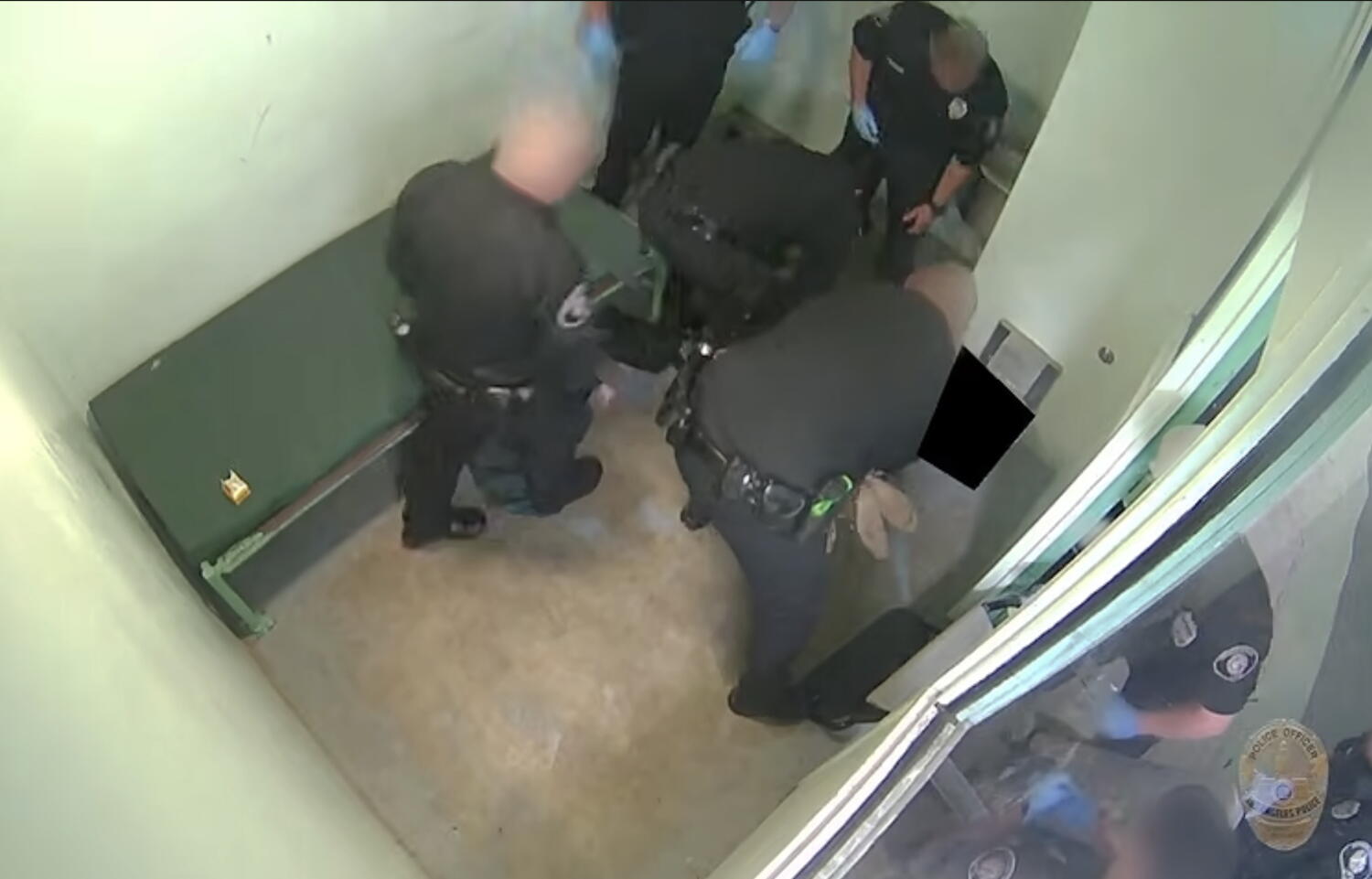
The fluorescent lights of a booking room do not flicker. They hum. A steady, chemical vibration that settles behind the eyes and stays there long after the doors lock. To anyone who has never stood on the wrong side of that concrete threshold, it is just a room. To the people who find themselves pushed against its walls, it is an environment stripped of air, where every second stretches into a lifetime, and the baseline assumption of safety simply evaporates.
We talk about accountability in statistics. We measure police misconduct in annual reports, settlement payouts, and grainy frame grabs released to the public weeks after the damage is irreversible. But numbers do not bleed. Numbers do not gasp for breath against a cold floor. Behind every headline involving the Los Angeles Police Department and the tragic death of a handcuffed inmate lies a terrifyingly mundane breakdown of human empathy, followed instantly by institutional armor.
Consider what happens when a body is restrained.
The mechanics of cuffs are designed for control, not comfort. Steel bites into wrists. Weight presses downward. The human instinct when pinned is panic, a violent thrashing born of the primal need for oxygen. But in a confined booking area, surrounded by personnel trained in tactical dominance, panic is rarely read as fear. It is read as resistance. And resistance, in that specific ecosystem, demands an escalation of force until the body stops moving.
When the LAPD releases footage of officers subduing a handcuffed individual who subsequently dies in custody, the public reaction follows a predictable, exhausting script. Outrage flares on social media. Press conferences are scheduled. Officials lean into familiar lexicons, promising transparent investigations and thorough reviews. Yet for those who have watched this theater play out across decades, the cycle feels less like justice in motion and more like damage control dressed up as reform.
The invisible stakes here extend far beyond a single precinct or a specific set of officers. They touch the core of what it means to grant the state the monopoly on violence. When you hand someone a badge, a firearm, and the legal authority to curtail freedom, you are placing an immense amount of trust in their emotional regulation. You are trusting that when adrenaline spikes, restraint will prevail over retaliation. You are betting that uniform personnel can distinguish between a threat that requires lethal or near-lethal force and a person experiencing a medical crisis, a mental health breakdown, or sheer, unadulterated terror.
Too often, that bet fails.
The mechanics of these tragedies often defy simple villainy, which makes them harder to fix and harder to digest. We look for monsters in uniforms because monsters are easy to categorize and condemn. The reality is far more uncomfortable. Often, you are looking at ordinary people caught in a culture of aggressive compliance, where de-escalation is viewed as a weakness and where the primary objective of a shift is simply making it home alive, by any means necessary. That survival instinct, weaponized against the very public it is meant to protect, creates an inverted reality. The citizen in handcuffs becomes the primary threat in the room.
Watch the footage closely, not for the spectacle of violence, but for the posture of the bystanders. Look at the way hands move, the casual distribution of weight, the chilling normalcy with which an escalation unfolds. That is the true fingerprint of institutional decay. It is not always a roaring storm of malice; sometimes, it is an ambient, chilling indifference.
When a human being dies while in the physical custody of law enforcement, a sacred contract is broken. The state has taken total responsibility for that life. To return that person in a body bag, after a struggle in a controlled environment, represents a catastrophic failure of duty.
We must ask ourselves what kind of society we are building when the default response to vulnerability is physical dominance. We must look past the bureaucratic language of internal affairs and confront the raw, uncomfortable truth of what happens behind closed doors in the dark hours of the morning.
The silence that follows the release of these videos is deafening. It settles over the city like fog, waiting for the next cycle to begin, waiting for the next life to be reduced to a file number and a pixelated clip. Until we change the fundamental culture of how authority meets vulnerability, that silence will remain the loudest sound in the room.