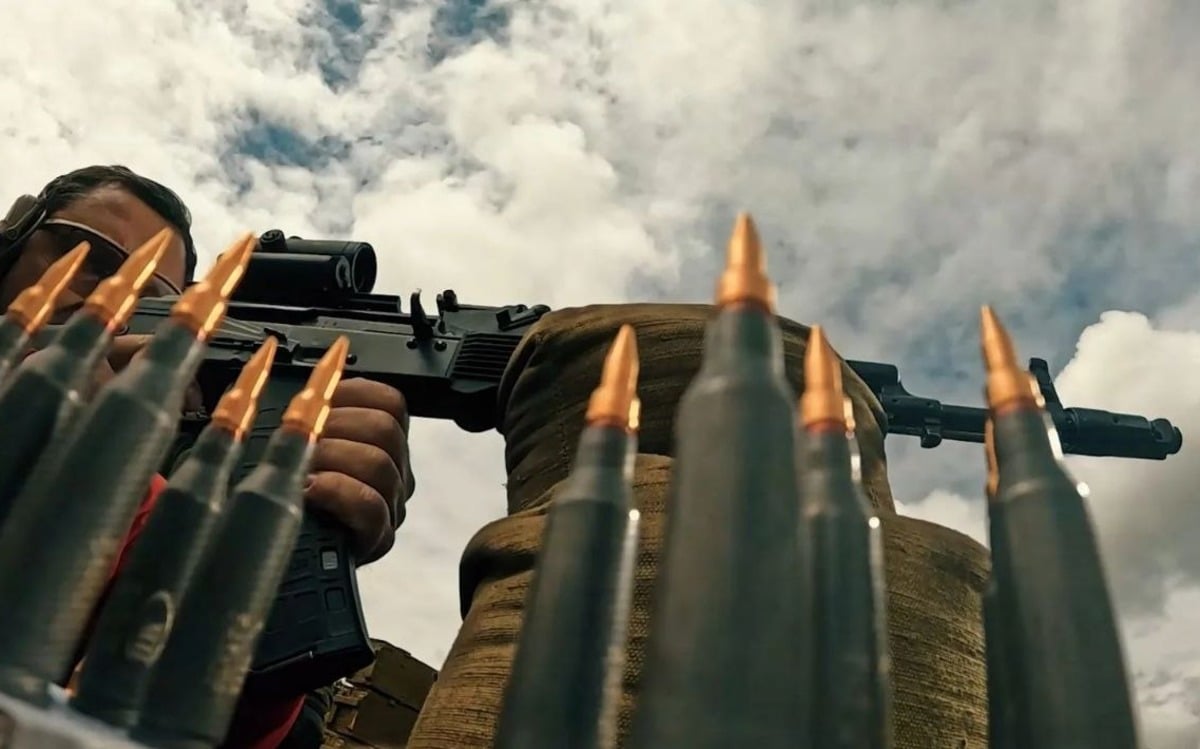
The mainstream defense press is swooning over Moscow’s latest announcement. Rostec is shipping new remote-detonation anti-drone ammunition to Russian troops. The narrative is comforting in its simplicity. Drones are a menace, so the military-industrial complex built a smarter bullet to swat them down. Heavy tanks like the T-90M or T-72B3 can now simply blast first-person view (FPV) loitering munitions out of the sky before impact.
It sounds logical. It fits perfectly into classic military procurement folklore. It is also completely detached from the physics and economics of modern trench warfare.
I have spent years analyzing weapon systems design and procurement bottlenecks. If there is one universal truth in state-backed defense manufacturing, it is this: bureaucracies love complex, expensive solutions to cheap, asymmetric problems. This new ammunition initiative is not a strategic breakthrough. It is an expensive band-aid on a structural wound.
The defense industry wants you to believe that active defense via fragmentation shells is the antidote to the drone swarms dominating the battlespace. They are wrong. Relying on tank-delivered shrapnel to stop a $500 quadcopter is a fundamental misunderstanding of the modern geometry of engagement.
The Mathematical Delusion of Airburst Interception
To understand why this approach fails, look past the PR handouts and examine the firing chain. The premise relies on a tank's fire control system (FCS) detecting a target, calculating its trajectory, laser-ranging the exact distance, programming a time-fuse on a 125mm shell, and firing. The shell travels downrange and detonates a few meters in front of the drone, shredding it with tungsten or steel fragments.
It looks great in a controlled testing range against a steady, non-evasive target. On a real battlefield, the math breaks down completely.
An FPV drone does not fly in a straight line at a constant velocity. Experienced pilots use erratic, low-altitude flight paths, hugging tree lines and terrain depressions. They approach at speeds exceeding 100 kilometers per hour. A tank’s primary optics are designed to track objects moving on a two-dimensional plane, like armored vehicles or infantry squads. Forcing an armored beast to track a highly agile, three-dimensional threat is an ergonomic and mechanical nightmare.
Consider the latency of the engagement loop:
- Detection: The crew spots a drone through a panoramic sight.
- Lasing: The laser rangefinder must illuminate a target that has a cross-section smaller than a bird.
- Programming: The electronic fuse-setter inputs the detonation time into the shell.
- Flight Time: The shell travels toward the interception point.
If the drone pilot changes direction by just two degrees or drops altitude by half a meter during that window, the airburst occurs in empty space. The fragment density drops exponentially with distance from the detonation point. A miss by two meters means the drone flies right through the gaps in the shrapnel cloud untouched.
The Storage Bottleneck No One Talks About
Let’s talk about logistics, the unglamorous reality that decides wars. A standard Russian tank autoloader holds between 22 and 28 rounds of ammunition. The remainder is stored in hull cavities, highly vulnerable to catastrophic secondary explosions.
Every single specialized anti-drone round loaded into that carousel is a round that cannot be used for the tank's actual mission: destroying enemy fortifications, suppressing infantry positions, and engaging opposing armor.
Armored crews do not know what threat they will face next. If you pack a carousel with 40% anti-drone shrapnel shells, you run out of high-explosive fragmentation (HE-FRAG) or armor-piercing fin-stabilized discarding sabot (APFSDS) rounds during a prolonged breakthrough attempt. If you only carry two or three anti-drone rounds, you lack the volume of fire needed to survive an attack by a coordinated drone swarm.
You cannot simply reload a tank carousel on the fly while under fire. The crew is locked into whatever tactical gamble they made before leaving the staging area.
The Asymmetry is Scaling Against Heavy Armor
The most brutal truth is economic. An FPV drone costs less than a cheap smartphone. They are built in improvised workshops using off-the-shelf carbon-fiber frames, commercial motors, and basic analog video transmitters. They are manufactured by the tens of thousands every single month.
A 125mm programmable airburst shell requires precision-machined casings, specialized electronic time fuses, and advanced propellant. The fire control system upgrades required to program these shells cost hundreds of thousands of dollars per vehicle.
Imagine a scenario where a T-90M faces an onslaught of five FPV drones simultaneously. Even if the crew successfully intercepts the first two drones with perfect, miraculous shots, the reload time of a mechanical autoloader is roughly 7 to 8 seconds per round. By the time the third shell is chambered, the remaining three drones have already struck the tank's vulnerable engine deck or rear turret bustle.
You are using a multimillion-dollar asset and scarce, high-tier ammunition to fight an endless stream of expendable plastic toys. It is an attritional equation that the defender will always lose.
Where True Drone Defense Lies
Stop trying to turn tanks into anti-aircraft guns. It is an archaic reflex born out of a desire to make traditional platforms feel relevant in an era that has outpaced them.
If you want to protect armor on the modern battlefield, the solution is not kinetic ordnance fired from a main gun. The solution must match the cost and scale of the threat.
Active protection systems (APS) must evolve toward dedicated, automated hard-kill sub-munitions or directional radio-frequency directed energy weapons integrated directly into the vehicle's electronic architecture. Electronic warfare (EW) suites must become modular and adaptive, capable of scanning the local spectrum and jamming control frequencies automatically, rather than relying on static, omnidirectional jammers that burn out their own power supplies and give away the tank's position to signals intelligence units.
Until those systems are mature and deployed at scale, these headline-grabbing shipments of specialized ammunition are nothing more than a psychological security blanket for crews staring down a terrifying tactical reality.
The era of the tank dominating the battlefield through sheer firepower is undergoing a violent correction. Believing that a smarter artillery shell will restore the old status quo is not just naive; it is a fatal miscalculation.