Headline projections linking waterpipe tobacco to a million lung cancer cases by mid-century compress complex epidemiological mechanics into a single alarming number. A rigorous analysis requires separating known toxicant exposures from long-horizon modeling assumptions, mapping the behavioral dynamics of social smoking, and identifying where public health interventions succeed or stall.
Deconstructing the Headline Claim
A projection of one million new lung cancer cases by 2050 serves a clear communicative purpose: it converts abstract cumulative exposure into a stark global ledger. Yet a single aggregate figure obscures how risk is actually generated across populations. Lung cancer incidence over a twenty-four-year window reflects a lagged interplay of historical smoking prevalence, demographic aging, baseline air pollution, diagnostic capacity, and competing causes of mortality.
In epidemiological modeling, long-range disease forecasts typically combine baseline cancer incidence, projected population growth, relative risk estimates from observational cohorts, and scenarios of tobacco prevalence. When a headline states that a specific exposure will cause a fixed count of cases, it can give the impression of deterministic certainty where conditional modeling actually operates.
Two distinct analytical layers must be kept separate in any serious evaluation:
- Known biological and chemical facts: Waterpipe smoke contains combustion products and tobacco-specific compounds—including polycyclic aromatic hydrocarbons, volatile organic compounds, carbon monoxide, and fine particulate matter—alongside nicotine. Prolonged inhalation of combusted tobacco and charcoal exposes respiratory epithelium to established carcinogens and irritants.
- Educated hypotheses and modeled projections: The exact share of future global lung cancer cases attributable specifically to shisha smoking depends on assumptions about future initiation rates, quitting trajectories, session frequency, depth of inhalation, and how researchers partition risk among dual or sequential users of cigarettes, heated tobacco, and waterpipes.
Treating a modeled projection as an immutable countdown misleads policymakers who need to know which parameters drive the curve. If a model assumes steady prevalence among young adults in high-growth regions, changing youth initiation alters the 2050 total far more than marginal shifts in older cohorts. Conversely, if a model relies heavily on relative risks derived from cigarette studies or small waterpipe cohorts, its uncertainty interval is wider than a round headline implies.
The Exposure Architecture of Waterpipe Smoking
Standard tobacco epidemiology often treats "a smoke" as a rough equivalent across products, a shortcut that breaks down for shisha. A waterpipe session is structurally different from smoking a factory-made cigarette in duration, fuel source, aerosol physics, and social pacing.
Fuel Combustion and Aerosol Mechanics
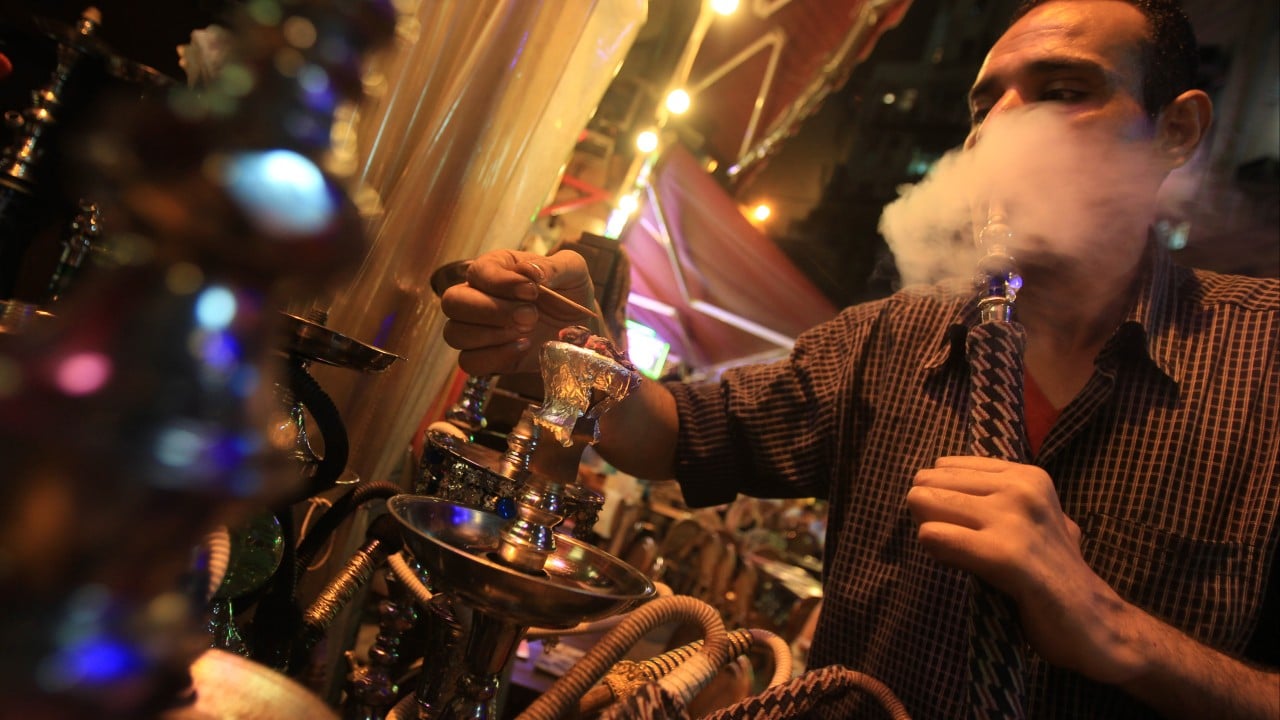
A typical waterpipe setup pairs flavored or unflavored tobacco—often moistened with humectants such as glycerol and sweeteners—with burning charcoal placed above a perforated foil or heat-management device. Air drawn through the coals passes over or through the tobacco mixture, travels down a stem, bubbles through water, and enters the smoker's respiratory tract.
Water cooling makes the aerosol feel smoother and less harsh on the throat than dry cigarette smoke. That sensory moderation is a critical mechanism in exposure biology: reduced immediate irritation allows deeper and longer inhalations, increasing the volume of smoke drawn into the lungs per puff. Bubbling through water traps a fraction of certain water-soluble compounds, but it does not filter out fine particulates, carbon monoxide, or many lipophilic toxicants generated by burning charcoal and tobacco.
Session Duration Versus Puff Frequency
Cigarette smoking usually consists of a discrete bout lasting several minutes with a predictable number of puffs. Waterpipe use is commonly measured in sessions rather than single units, and a single session can last thirty to ninety minutes or longer. Across that span, cumulative puff volume can exceed that of multiple cigarettes, even when puffing occurs at a leisurely pace.
This distinction creates a measurement trap in surveillance surveys. Asking respondents whether they smoked "yesterday" or "in the past 30 days" captures prevalence, yet two people who both report weekly shisha use can have vastly different cumulative exposures depending on session length, whether they smoke alone or share a hose, and whether they top up bowls during a gathering.
Consider a common analytical error in comparing exposure: analysts sometimes divide total session toxicant output by ten to create a "cigarette equivalent" and treat that ratio as a universal law. Dose-response relationships for carcinogenesis are rarely linear across every chemical constituent, and individual puff topography—puff volume, interpuff interval, and breath-hold duration—varies widely from person to person.
The Three Pillars of Shisha Risk Dynamics
To move beyond raw case counts, public health strategists and analysts can evaluate waterpipe risk through three structural pillars: Toxicant Generation, Behavioral Throughput, and Structural Friction. Each pillar governs how exposure translates into population harm.
Toxicant Generation
Toxicant generation is the chemical output of the heat-fuel-substrate system. Charcoal combustion produces substantial carbon monoxide and polycyclic aromatic hydrocarbons, while pyrolysis and combustion of the tobacco and humectants generate aldehydes, benzene, and other hazardous constituents. Nicotine delivery varies depending on tobacco type, heat intensity, and session duration, sustaining dependence even when users perceive the product as mild.
The first bottleneck in reducing harm at this pillar is product heterogeneity. Unlike standardized cigarettes, waterpipe setups are assembled from interchangeable bowls, charcoals, hoses, and flavor blends, making uniform toxicant measurement across real-world use difficult.
Behavioral Throughput
Behavioral throughput captures how frequently and intensely people actually use the device in daily life. Waterpipe smoking thrives in cafes, lounges, homes, and social gatherings where extended sitting is normalized. Social rituals—passing a hose, pairing flavors with food or drinks, using social media to share lounge visits—lower the perceived friction of starting a session.
A second bottleneck emerges here: intermittent or episodic use often escapes the mental category of "being a smoker." Many young adults who reject daily cigarette use view occasional or weekend shisha as a harmless leisure activity, overlooking how repeated sessions accumulate over years.
Structural Friction
Structural friction represents the regulatory, economic, and environmental barriers that either accelerate or restrain consumption. These include excise taxes, indoor smoke-free laws, flavor restrictions, age-of-sale enforcement, health warning requirements, and licensing rules for lounges.
Where structural friction is weak—for example, when waterpipe lounges are exempted from indoor clean-air rules or taxed differently from cigarettes—social venues act as demand engines. Where friction is strong, casual initiation faces higher cost and fewer convenient settings.
Cause-and-Effect Chains Missed in Surface Reporting
Surface-level coverage of global health projections frequently stops at the correlation between rising popularity and projected disease. That framing misses several causal chains that determine whether forecasts materialize or diverge.
Misperception of Harm Fuels Early Initiation
A widespread belief that water bubbling purifies smoke reduces perceived risk, especially among adolescents and young adults. Lower perceived risk increases willingness to try a product, and repeated social exposure normalizes it within peer groups. Once nicotine dependence takes hold—even subtly—occasional social use can harden into habitual reliance or dual use with cigarettes.
Flavored Formulations Mask Harshness and Expand Appeal
Sweetened and fruit- or mint-flavored molasses blends mask the acrid taste of burning leaf and charcoal. For novice users, flavor acts as an entry ramp, softening the initial aversion that often deters first-time cigarette smokers. The cause runs from sensory palatability to longer sessions, deeper inhalation, and sustained engagement.
Regulatory Blind Spots Create Arbitrage
Tobacco control frameworks built around single-stick cigarettes often leave gaps when applied to waterpipes. A tax calculated per stick does not apply cleanly to a tub of shisha molasses or a box of quick-light charcoal. A health warning printed on an outer carton may never be seen by a customer sitting in a lounge where the pipe is prepped behind a counter.
This regulatory mismatch creates a structural arbitrage: consumers and operators gravitate toward formats where rules are ambiguous or lightly enforced. The result is a persistent gap between nominal tobacco policy and actual point-of-sale exposure.
Lagged Oncology Timelines Mask Present Trends
Lung cancer typically develops over decades of cumulative cellular injury and mutation accumulation. Because clinical diagnoses lag exposure by twenty to thirty years or more, current lung cancer rates reflect past smoking behavior, while today's youth initiation shapes future incidence.
That time lag produces a strategic hazard for decision-makers. When current cancer registries do not yet reflect a surge in waterpipe popularity, policymakers may treat the issue as secondary, missing the window when preventive measures have the highest leverage over mid-century outcomes.
What Surveillances and Models Still Get Wrong
Even well-intentioned epidemiological models face structural blind spots when tracking waterpipe tobacco. Relying on them without examining their inputs leads to overconfidence in point estimates.
First, exposure misclassification distorts risk estimates. Cohort studies frequently group "ever users," "current users," and "occasional users" together, or fail to separate exclusive shisha smokers from dual cigarette-and-shisha smokers. If a study cannot cleanly isolate waterpipe exposure from active or secondhand cigarette smoke, attributing downstream lung cancer strictly to one source carries inherent ambiguity.
Second, surveillance gaps vary sharply by geography. Countries with high waterpipe use do not all maintain uniform longitudinal cancer registries or detailed tobacco-type modules in household surveys. Where empirical data are sparse, models rely more heavily on extrapolation, widening the plausible range of future cases.
Third, competing risks and shifting demographics complicate long-horizon forecasts. Between now and 2050, changes in ambient air pollution, occupational exposures, screening uptake, treatment survival, and cardiovascular mortality will reshape who develops and dies from lung cancer. A static attribution model cannot predict every shift in background risk over two decades.
Acknowledging these limitations does not invalidate the underlying health concern. Rather, it sharpens how analysts read the number: one million cases should be treated as a directional warning of substantial preventable disease burden under business-as-usual assumptions, not as a literal tally immune to policy or behavioral change.
Operationalizing Prevention and Policy Response
Translating epidemiological analysis into practical action requires matching interventions to the specific mechanisms driving exposure. Broad slogans rarely shift entrenched social habits; targeted operational levers work better.
Step 1: Audit Local Exposure and Venue Rules
Health departments and researchers can start by mapping where shisha is actually consumed—private homes, commercial lounges, or outdoor courtyards—and checking how existing clean-air and licensing laws apply. Clear definitions of waterpipe tobacco and charcoal within tobacco legislation eliminate legal ambiguity before enforcement begins.
Step 2: Close Tax and Pricing Gaps
Pricing policy works best when it covers the full consumption bundle rather than a single component. Evaluating excise structures across flavored tobacco blends, unflavored leaf, and charcoal helps prevent price differentials that keep waterpipe smoking cheap relative to taxed cigarettes.
Step 3: Enforce Point-of-Sale Visibility and Age Controls
In lounge settings, patrons often do not see health warnings if tobacco is portioned out of sight. Requiring clear health warnings at the point of service, prohibiting unverified "reduced-harm" claims, and enforcing strict age verification at entry and service address the environment where initiation occurs.
Step 4: Upgrade Surveillance Questions
Public health surveys gain analytical power when they ask about waterpipe frequency, typical session length, sharing behavior, and concurrent use of other nicotine products. Better exposure granularity turns blunt prevalence counts into actionable risk stratification.
Step 5: Pair Public Education with Cessation Support
Educational campaigns are more credible when they explain why smooth, flavored smoke still carries serious respiratory and cardiovascular risks, rather than relying solely on shock statistics that audiences may dismiss as exaggerated. Pairing awareness with accessible cessation resources helps dependent users quit without stigma.
No single measure acts as a silver bullet. Taxation without enforcement leaves loopholes; education without supportive environments struggles against social norms; regulation without surveillance flies blind. Effective strategy coordinates these levers while monitoring unintended shifts toward other nicotine products.
The Strategic Play for Mid-Century Risk Reduction
The decisive strategic play for curbing waterpipe-driven lung cancer before 2050 is front-loaded primary prevention paired with comprehensive tobacco-control parity. Because lung cancer incidence in 2050 depends heavily on cumulative exposure acquired over the next five to fifteen years, delaying action until disease rates climb sacrifices decades of preventable risk reduction.
Practitioners and policymakers should treat waterpipe tobacco under the same rigorous regulatory and surveillance standards as combustible cigarettes—closing lounge and taxation exemptions, correcting harm misperceptions with mechanistic clarity, and tracking session-level exposure rather than relying on headline totals alone. Changing the trajectory of a twenty-five-year projection requires changing the rules and norms governing initiation today.