The air in North London usually tastes of exhaust fumes and the yeasty exhale of bakeries. On a Tuesday morning in Stamford Hill, that rhythm is rhythmic, predictable, and safe. Men in long black silk coats walk with a purposeful tilt to their stride. Children with bouncing side-curls navigate the pavement like small, energetic satellites. It is a neighborhood defined by its boundaries—not of wire or stone, but of tradition and shared memory.
Then the screaming started.
It wasn't the sound of a city argument or a car horn. It was the jagged, visceral sound of a community’s nightmare breaking into the daylight. Two Jewish men, standing near a shopfront, were suddenly no longer part of the morning’s quiet routine. They were targets. The flash of a blade in the gray London light changed everything. Within minutes, the Metropolitan Police arrived, the yellow tape went up, and the word "terrorism" began to ripple through the digital ether, turning a local tragedy into a national wound.
The Weight of the Blade
When we read a headline about a stabbing, our brains often reduce the event to a statistic or a blur of blue lights. We look at the map, see it isn't our street, and keep scrolling. But for the victims in Stamford Hill, the world didn't just change; it collapsed into the space of a few seconds.
Terrorism is a unique kind of violence because it carries a payload of intent. It isn't just about the physical injury—the cold steel meeting skin—but about the message the act is meant to send. To the two men who were rushed to the hospital, the pain was literal. To the thousands of people watching from behind their curtains in the surrounding blocks, the pain was a haunting familiarity.
Consider a hypothetical resident named Ari. He has lived in this borough for sixty years. He remembers his grandfather talking about the same feeling of looking over one's shoulder in Europe. When Ari hears that the police have declared this a terrorist incident, he doesn't just think about the crime. He thinks about the fragility of his right to exist in the open. The "invisible stakes" of this attack aren't about the number of stitches required; they are about the erosion of the psychological sense of home.
The Anatomy of an Investigation
The Metropolitan Police do not throw the word "terrorism" around lightly. It is a legal and operational lever that shifts the entire weight of the state. Initially, the local officers handle the scene. They secure the perimeter, gather the discarded evidence, and check the pulses of the wounded. But once the Counter Terrorism Command takes the lead, the lens narrows.
They aren't just looking for a motive; they are looking for a network, a manifesto, or a radicalization trail that leads into the dark corners of the internet. The "why" becomes as important as the "how." In this specific case, the early declaration of a terrorist incident signals that the authorities found enough evidence of ideological intent to move beyond a simple assault charge.
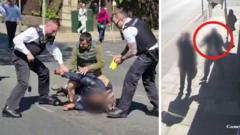
The suspect, a 28-year-old man, was detained by members of the public before the police even arrived. That detail is often lost in the shuffle of the "dry" news reports. Imagine the sheer, terrifying adrenaline required to move toward a man with a knife when everyone else is running away. That is the human element that a bullet point cannot capture. It is the moment where communal instinct overrides individual survival.
The Echo Chamber of Fear
The ripples of a stabbing in London don't stop at the English Channel. In the age of instant connectivity, a photo of a blood-stained pavement in Stamford Hill is seen in New York, Tel Aviv, and Paris within seconds.
This is the oxygen that terrorism breathes.
The goal is to make a specific group of people feel that the most mundane acts—buying bread, waiting for a bus, walking to prayer—are acts of defiance. It creates a low-grade, constant hum of anxiety. You start to notice the way someone looks at you on the Tube. You tuck your necklace inside your shirt. You wonder if the car idling too long at the curb is just a delivery driver or something else.
We often talk about "resilience" as if it’s a muscle you can just flex. It isn't. Resilience is a heavy, exhausting duty. It is the act of Ari deciding to go back to that same shop the next day, even though his hands are shaking. It is the community refusing to let the yellow tape define their borders.
The Logic of the Unthinkable
Why here? Why now?
Security experts often point to the "contagion effect" of global tensions. When the world feels like it is tilting on its axis, individuals on the fringes of society often find a sense of purpose in the most horrific ways. They latch onto a cause to give their own internal chaos a name.
In London, the police presence has been dialed up to a frantic degree in recent months. The resources required to monitor potential threats are staggering. We are talking about thousands of hours of surveillance, undercover work, and community outreach. Yet, as this incident proves, the "lone actor" remains the hardest variable to solve. You cannot police a thought that hasn't been spoken. You cannot arrest a man for the knife in his kitchen drawer until he takes it into the street.
The vulnerability is the point.
The police declaration of terrorism serves a dual purpose. It allows for specialized interrogation and detention powers, but it also serves as a public acknowledgment of the victims' reality. It says: We see that this was not a random accident of fate. We see that you were targeted for who you are.
The Quiet After the Siren
The headlines will eventually move on. The news cycle demands fresh blood and newer scandals. But the stains on the pavement in Stamford Hill don't wash away that easily in the minds of those who walk past them every day.
The two men who were attacked are more than "victims." They are brothers, sons, and neighbors. Their recovery will be measured in physical therapy and the slow mending of nerves, but their psychological recovery is tied to the collective health of the city. When one thread of the London fabric is cut, the whole garment begins to fray.
We like to believe we live in a world governed by logic and law. We want to believe that if we follow the rules, the rules will protect us. An incident like this is a brutal reminder that the social contract is a thin veil. Beneath it lies a capacity for senselessness that defies explanation.
But there is a counter-image that lingers.
It is the image of the bystanders—ordinary Londoners—who didn't wait for the experts or the authorities. They saw the blade, they saw the victims, and they stepped in. They didn't ask for a manifesto or a motive. They saw a human being in danger and they chose to act. In the shadow of a terrorist incident, that is the only fact that truly matters.
The sirens eventually fade, leaving only the sound of the wind through the trees and the distant hum of traffic. The shop doors open again. The children go back to school. The silk coats once again tilt into the breeze. Life continues, not because the danger has vanished, but because the alternative is to stop living entirely.
The bravery isn't in the absence of fear, but in the steady, quiet refusal to let that fear have the final word.