The sound of a rainforest at dawn is not quiet. It is a chaotic, layered wall of noise—the electric hum of cicadas, the sharp crack of falling branches, the territorial hoots of gibbons shaking the morning mist. But if you walk deep into the Batang Toru forest of Sumatra, past the steep limestone cliffs where the air smells of damp earth and rotting vegetation, you might notice a sudden, heavy void.
It is the absence of a whistle. A long, trembling call that used to cut through the canopy.
We measure tragedies in numbers because numbers are clean. They fit into spreadsheets. They look objective on a news ticker. When Cyclone Senyar tore through the Indonesian skies, the subsequent reports settled on a precise, chilling figure: seven percent. Seven percent of the Tapanuli orangutan population, wiped out in a matter of days.
To the casual observer scanning a headline, seven percent sounds like a manageable loss. A company losing seven percent of its quarterly revenue expects to bounce back by winter. A traveler delayed by seven percent of their total flight time merely buys an extra coffee at the terminal. But biological math does not operate like corporate accounting. When you are dealing with the rarest great ape on Earth, seven percent is not a setback.
It is a freefall.
To understand why those few days of howling wind changed everything, you have to look at a map, and then you have to look at a mother.
The Geography of a Fragile Fortress
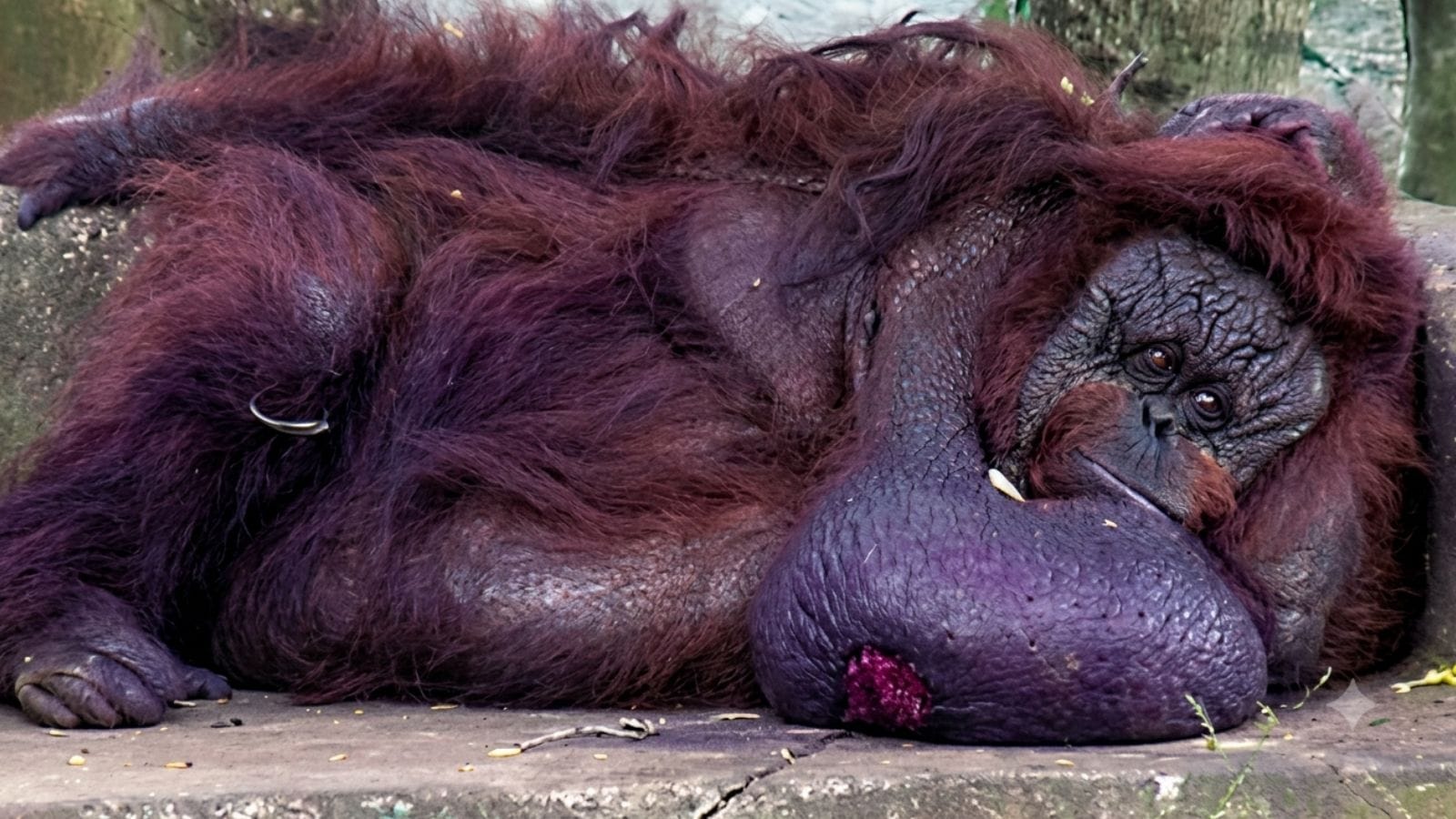
The Tapanuli orangutan does not have the luxury of vast, sprawling territories. They live exclusively within a tiny fragment of forest in North Sumatra, an area roughly one-fifth the size of Chicago. Before Cyclone Senyar struck, scientists estimated their total remaining population at roughly eight hundred individuals.
Eight hundred. That is fewer people than attend a modest neighborhood high school.
Imagine that population split across three isolated pockets of forest, separated by roads, agricultural fields, and human encroachment. They cannot cross the clearings to find each other. They are marooned on green islands in a sea of development. When a massive climate event like Cyclone Senyar hits, there is no backup population to sweep in and regenerate the loss. There is no evolutionary safety net.
Consider a hypothetical female orangutan—let us call her Bulu, the Indonesian word for fur. Bulu does not know she is a member of a critically endangered species. She only knows the weight of the rain. When Senyar’s winds reached their peak, ripping century-old dipterocarp trees out by their roots, Bulu would have been high in the canopy, cradling a single dependent infant.
Unlike birds, orangutans cannot fly away from a collapsing forest. Unlike tigers, they cannot run beneath the falling timber. They climb higher, holding onto the very things that are breaking. When the canopy shatters, they fall with it.
When the storm passed, the immediate tally of the dead was only the first layer of the disaster. The deeper crisis lies in the invisible clock of orangutan biology. A female Tapanuli orangutan gives birth only once every eight to nine years. It is the longest inter-birth interval of any land mammal on the planet. If a mother dies, her dependent offspring dies with her. If a young female dies, a decade of potential population recovery vanishes instantly.
The loss of seven percent means that roughly fifty-six individuals were erased from the gene pool. In a population already suffering from extreme inbreeding depression, losing fifty-six unique genetic profiles is akin to removing vital pillars from a suspension bridge. The bridge doesn't just sag; it loses the structural integrity required to hold its own weight.
The Human Cost of a Distant Storm
It is easy to compartmentalize this loss as an environmental tragedy happening "over there," a localized crisis for biologists and conservationists to worry about in their academic journals. But the destruction of the Batang Toru ecosystem is intimately tethered to our own lives.
The people who live on the fringes of the Tapanuli habitat—the farmers who tend small plots of durian, rubber, and cacao—are the first to feel the ripples of a destabilized forest. When the canopy is torn open by a storm like Senyar, the local microclimate shifts. The dense layers of leaves that once acted as a natural sponge, absorbing torrential tropical rains and releasing them slowly into the river systems, are gone.
Without that canopy, the rain hits the bare mountain soil directly. The result is a predictable, devastating cycle of flash floods and mudslides that wash away downstream villages and destroy livelihoods.
The locals know this. They do not view the orangutans as adversaries; they view them as the ancient keepers of the mountain. There is a quiet reverence among the older generation of villagers, who remember a time when the forest felt infinite. They understand that the apes are the ultimate seed dispersers. Without them, certain heavy-seeded tree species simply stop reproducing. The forest changes character. It becomes younger, thinner, less resilient to the next storm.
Yet, the pressure on this ecosystem builds from the outside. Large-scale infrastructure projects, including a controversial hydroelectric dam project, continue to slice through the remaining habitat corridors. The storm merely accelerated a process that human ambition started decades ago. We fragmented the forest, trapped the apes in tiny corners, and then expressed shock when a single extreme weather event devastated them.
The Fragility of the Last Stand
To walk through Batang Toru after a major storm is to witness a landscape in mourning. The air is thick with the smell of splintered wood and sap. Mudslides leave raw, orange scars across the steep hillsides.
For the researchers who spend their lives tracking these animals, the aftermath of Cyclone Senyar was a exercise in heartbreak. Imagine spending years learning the distinct facial features of individual apes, tracking their nesting habits, and documenting their social structures, only to find their habitats reduced to a tangle of broken branches.
The confusion is palpable. You sit in a research camp, listening to the rain beat against a tarpaulin, wondering if the nest you observed last week still exists. You realize how precarious our knowledge really is. The Tapanuli orangutan was only recognized as a distinct species in 2017. We barely discovered them before we began losing them.
This is the emotional core that statistics fail to capture. It is the realization that we are watching a unique branch of the evolutionary tree snap in real-time. These are sentient, deeply intelligent creatures that share over ninety-seven percent of our DNA. They possess distinct cultural behaviors, passing knowledge down from mother to child over decades. When a population shrinks past a certain threshold, that culture dies too.
Changing the Currency of Conservation
The traditional approach to saving endangered species is built on a model of defense. We draw lines on maps, call them national parks, and hope for the best. But Cyclone Senyar proved that lines on a map cannot stop a changing climate. As oceans warm, tropical storms are moving with greater intensity into areas that historically rarely experienced them. The old boundaries are obsolete.
If the Tapanuli orangutan is to survive the next decade, the strategy must pivot from passive protection to aggressive, active restoration.
First, the remaining isolated forest fragments must be physically reconnected. This means creating wildlife corridors across agricultural lands and infrastructure projects, allowing the remaining individuals to migrate, mix, and diversify their gene pool. It requires working with local communities to plant native fruit-bearing trees on degraded land, turning economic buffers into ecological bridges.
Second, we must change how we value these forests. The Batang Toru ecosystem cannot simply be viewed as a source of timber, mineral wealth, or hydroelectric power. Its worth must be calculated through the lens of carbon sequestration, watershed protection, and biodiversity preservation. We need an economic framework where the preservation of a intact forest is more lucrative for local governments and communities than its destruction.
But more than policy, it requires a shift in human perspective. We must move away from the arrogance that suggests we can always fix what we break. Some losses are permanent. Some thresholds, once crossed, cannot be uncrossed.
The seven percent lost to Cyclone Senyar cannot be brought back. Those individuals are gone, their unique genetic markers erased, their places in the canopy empty. The remaining ninety-three percent are currently settling into their night nests, high above the forest floor, unaware of how close they are to the edge.
The true tragedy would not be that a storm came and tore through the trees. The tragedy would be if we stood by, watched the canopy thin out year after year, and did nothing until the silence in the Batang Toru forest became absolute.