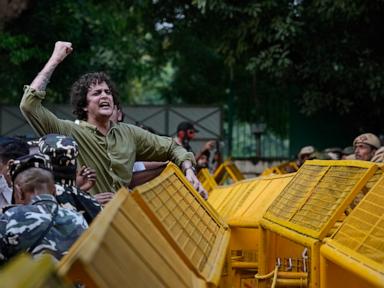
Civil unrest events targeting urban centers trigger immediate operational adjustments within state security apparatuses, shifting standard policing models toward high-density containment strategies. When a movement organizes mobilization efforts under specific monikers, the response from municipal governance and federal agencies follows a predictable escalation matrix designed to neutralize logistical viability before physical convergence occurs.
The Operational Matrix of Urban Containment
State security responses to decentralized political or social movements operate on three distinct vectors: intelligence harvesting, spatial denial, and communication disruption. Understanding how authorities manage these vectors reveals the underlying vulnerabilities of protest movements and the limits of state enforcement.
Intelligence harvesting relies on pattern recognition, digital footprint tracking, and informant networks within urban hubs. Security forces map movement nodes days in advance, identifying staging grounds and transit chokepoints. This phase transitions into spatial denial once a threshold of mobilization is met.
Spatial denial utilizes barricades, transit throttling, and heavy personnel deployment to fracture unity of movement. In dense metropolitan zones like New Delhi, sealing transit corridors creates friction that exhausts resources and discourages participation from peripheral actors. The objective is not merely dispersal, but the elevation of friction costs for every individual attempting to join the collective action.
Economic and Logistical Friction Points
Every mobilization carries an operational cost function. The state leverages its monopoly on physical infrastructure to manipulate this function directly.
- Transit Interruption: Restricting metro stations and arterial highways forces logistical bottlenecks, preventing critical mass formation.
- Information Asymmetry: Selective throttling of communications infrastructure degrades decentralized coordination, forcing groups to rely on vulnerable, localized relay methods.
- Resource Allocation: Sustained deployment drains municipal budgets, creating a counter-pressure on state actors to resolve the standoff quickly through negotiation or forceful clearance.
When these friction points are applied simultaneously, the movement's capacity to maintain momentum degrades exponentially rather than linearly.
Strategic Assessment and Forward Forecasting
The efficacy of state containment measures depends on the adaptability of the mobilizing coalition. Static rallies face high attrition rates under rigorous spatial denial, whereas fluid, highly networked groups can bypass traditional chokepoints. As urban governance increasingly integrates predictive policing tools, future movements must account for algorithmic pre-emption of their logistical pipelines. The structural outcome remains consistent: state apparatuses will prioritize infrastructural paralysis over direct engagement until the movement's operational costs outweigh its political leverage.