The mainstream media loves a hero story. For decades, paleoanthropology has been obsessed with the "Man the Hunter" trope—a cinematic vision of our ancestors standing tall on the African savannah, outsmarting lions and bringing down megafauna with nothing but grit and sharpened sticks. A recent analysis of 1.6 million-year-old bones from Koobi Fora is being touted as the "smoking gun" for this apex predator narrative.
They’re wrong. Expanding on this topic, you can also read: The Dinner Table Divide and the Quiet Fear of a Knock at the Door.
The data doesn’t show a rise in dominant hunting. It shows a desperate, tactical shift into high-stakes theft. We weren't the kings of the jungle; we were the world’s most dangerous kleptomaniacs. If you want to understand why humans succeeded, stop looking at our ability to kill. Start looking at our ability to wait for someone else to do the heavy lifting and then steal the paycheck.
The Bone Surface Fallacy
The "consensus" view hinges on butchery marks. Researchers look at fossilized limb bones, see a few cut marks from stone tools, and declare that Homo erectus was running the show. This is a massive leap in logic that ignores the biological reality of the Pleistocene. Experts at Associated Press have also weighed in on this situation.
In any modern ecosystem, the primary killer leaves a specific signature. If you find a carcass today, the lion or the hyena gets the "prime cuts"—the meat-heavy hindquarters. What the mainstream articles skip is that many of these 1.6 million-year-old bones show stone tool marks on top of carnivore tooth marks.
In the world of taphonomy (the study of how organisms decay and become fossilized), the sequence of marks is everything. If the tooth mark is on the bottom, the cat killed it. If the tool mark is on top, the human was a latecomer. We weren't the ones taking down the wildebeest; we were the ones throwing rocks from the bushes, waiting for a bored leopard to leave its leftovers so we could rush in and scrape the scraps off the bone.
Marrow is the Real Lever
We need to stop talking about "meat" as if our ancestors were eating ribeye steaks. Meat rots. Meat is guarded by pride-sized headaches. But bone marrow? Marrow is a sealed, sterile, high-calorie fat bomb.
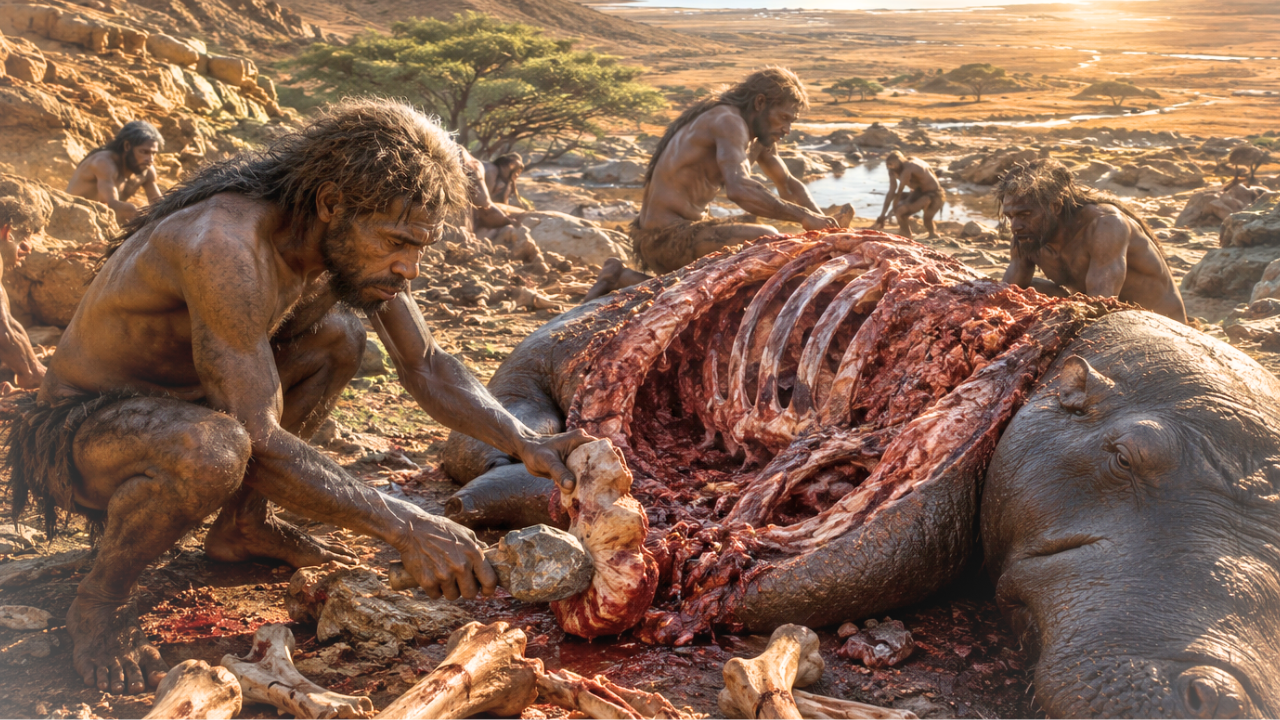
While the "Hunter" narrative focuses on the glory of the kill, the "Scavenger" reality focuses on the efficiency of the calorie. Breaking a femur to get at the lipids inside requires a specific technology: the hammerstone. This wasn't a weapon of war; it was a kitchen utensil for the desperate.
The brain is an expensive organ. It consumes roughly 20% of your daily energy. To grow that brain, Homo erectus needed fat, not just lean protein. Hunting is a high-risk, high-expenditure activity with a low success rate. Scavenging for marrow is a low-risk, high-reward strategy. The "Lazy Consensus" refuses to admit that we likely "brain-hustled" our way to the top by being the guys who cleaned up the mess after the real predators went to sleep.
The Endurance Running Fairy Tale
You’ve heard the pitch: humans evolved to run long distances to "persistently hunt" prey into heat exhaustion. It sounds poetic. It’s also biologically absurd for a 1.6 million-year-old hominid.
To engage in persistence hunting, you need an incredible water-carrying capacity and a cooling system that doesn't exist in a vacuum. While we have eccrine sweat glands now, there is zero evidence that Homo erectus had the physiological setup to chase a kudu for six hours in the midday sun without dying of a heatstroke themselves.
The "Man the Hunter" crowd uses this theory to explain our long legs. A more cynical—and likely—explanation? Those legs weren't for chasing prey. They were for outrunning the other scavengers. If you see a flock of vultures circling five miles away, you need to get there before the hyenas arrive. Evolution didn't build a predator; it built a fast-moving, tool-using opportunistic thief.
The Danger of Narrative-Driven Science
Why does the "Hunter" myth persist? Because it’s a better brand. It fits the Western ideal of the rugged individualist. Admitting that our lineage survived by eating the rotting remains of a lion's lunch feels... gross.
But science isn't supposed to be comfortable. When we look at the energetics of the Early Pleistocene, the math for pure hunting doesn't add up.
Consider the "Encephalization Quotient." As our brains grew, our guts shrank. We couldn't digest low-quality plant matter anymore. We needed nutrient density. If you bet your entire species' survival on the chance of stabbing a buffalo, you go extinct during the first dry season. If you bet your survival on the fact that big cats will always leave bones behind, you have a sustainable business model.
The Competitive Edge was Social, Not Physical
The real disruption here isn't about what we ate, but how we got it. Scavenging at a kill site is a team sport. A lone Homo erectus gets eaten by a saber-toothed cat. Ten Homo erectus screaming and hurlings rocks? That’s a deterrent.
The stone tools found at Koobi Fora aren't just "knives." They are symbols of a coordinated heist. We didn't develop social complexity to hunt; we developed it to manage the risk of being near much larger, much faster killers.
The Flawed "People Also Ask" Premises
- Did humans start eating meat 2 million years ago?
The question assumes "meat" was the goal. The evidence suggests we started processing carcasses. There is a massive difference. We were foragers of fat. - How did hunting change human evolution?
It didn't—at least not initially. The acquisition of animal protein changed us. Whether that animal was killed by a spear or a leopard is irrelevant to the protein. The shift was in the calories, not the kill. - What tools did the first hunters use?
They used rocks to break bones. You don't need a sophisticated projectile to be a scavenger. You need a blunt object and a lack of shame.
The Strategy of the Scrape
Look at the lithic record. The Oldowan toolkit—the first major stone tool industry—is remarkably boring. It consists of choppers and flakes. These are not the weapons of an apex hunter. You can't kill a giraffe with an Oldowan chopper unless the giraffe is already tied down and sedated.
These tools are, however, perfect for "power scavenging." This is the practice of driving a predator away from its kill shortly after the kill has been made. It’s aggressive, it’s dangerous, and it’s the only way to get fresh meat without the energetic cost of the hunt.
I’ve seen modern analysts try to "model" early hunting success rates using skewed data that ignores the presence of massive Pleistocene carnivores. We were living in a world of giants. The idea that we walked out there and dominated the field with a sharp rock is the ultimate height of modern arrogance.
The Hidden Cost of the Hunting Myth
By clinging to the Hunter narrative, we miss the most important lesson of human history: adaptability. We didn't survive because we were the best at one thing. We survived because we were the best at exploitation.
We exploited the kills of others. We exploited the calories hidden inside bone. We exploited the social fear we could instill in solitary predators through group aggression.
The bones from 1.6 million years ago don't tell a story of triumph. They tell a story of a scrappy, marginalized ape finding a loophole in the ecosystem. We found a way to let the lions do the work while we took the credit and the nutrients.
Stop looking for the "first hunter." You’re looking for a ghost. The ancestor you should be looking for is the one with a blood-stained rock and a keen eye on the horizon, waiting for the vultures to land.
Nature doesn't reward the "bravest" species. It rewards the one that gets the most calories for the least amount of work. We aren't the descendants of warriors. We are the descendants of the world's most successful opportunists.
Accept the scrap. It’s why you’re here.