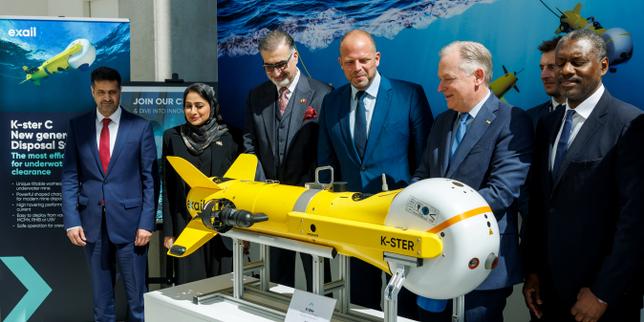
When electromagnetic interference turns standard satellite coordinates into a guessing game, military survival depends on systems that do not need the sky. That hard truth explains why aerospace giant Thales moved to acquire Exail Technologies, a specialist in inertial navigation and maritime robotics. Modern conflict zones from Eastern Europe to contested maritime choke points have proven that space-based positioning signals are remarkably fragile. Jamming and spoofing transmitters can blind a warship or an autonomous drone within seconds. Exail built its reputation on surviving that blackout. By combining its proprietary Fiber-Optic Gyroscope architecture with advanced subsea positioning, the company positioned itself as an indispensable asset for naval forces seeking un-jammable operations.
The End of Absolute Satellite Trust
For decades, global positioning satellites felt permanent. Militaries and commercial shippers alike built entire operational doctrines around the assumption that latitude and longitude could always be pulled effortlessly from orbit. That comfort vanished as electronic warfare matured from a specialized intelligence niche into a crude, pervasive blanket over modern battlefields.
Signal denial is no longer a theoretical exercise. In active theater operations, GNSS spoofing alters digital maps, dragging vessels miles off course, while broad-spectrum jamming creates dead zones where conventional receivers are entirely useless. When an adversary can flood the local radio frequency spectrum with noise, relying on an external signal becomes an existential liability.
This environment created an immediate premium for internal dead-reckoning technology. Inertial navigation systems calculate position, velocity, and orientation using onboard accelerometers and gyroscopes without checking in with external transmitters. They look inward rather than upward. Yet, building an inertial unit accurate enough to guide a nuclear submarine or a mine-hunting drone across weeks of submerged transit is an extraordinarily difficult engineering challenge. Traditional systems suffered from drift, accumulating microscopic errors that multiplied over time until coordinates became dangerously inaccurate.
Exail attacked this problem through uncompromising vertical integration. Instead of sourcing components from third-party vendors, the company designs and manufactures its core optical components in-house. That control over the manufacturing chain allows its navigation systems to maintain positional drift metrics low enough for prolonged, covert naval operations. When Thales announced its multi-stage plan to absorb Exail, the move reflected an industry-wide realization. Control over internal navigation is no longer just a hardware feature. It is the core determinant of operational survival.
Inside the Technology Fiber Optics Versus Ring Lasers
To understand why this corporate pairing matters, one must look closely at the physics inside the metal housings. Navigation relies primarily on two competing high-end technologies for high-precision motion sensing: Ring-Laser Gyroscopes and Fiber-Optic Gyroscopes.
Thales historically built its reputation around Ring-Laser Gyroscope systems, widely deployed across aviation and defense platforms. These devices route laser beams around a closed cavity, measuring rotation through optical interference patterns. They excel in high-speed, high-stress aviation environments where rapid orientation changes and extreme vibration are standard operating conditions.
Exail carved out its dominance through Fiber-Optic Gyroscope technology. Instead of a rigid optical cavity, a FOG uses kilometers of specialized optical fiber wound onto a spool, sending light beams in opposite directions. The Sagnac effect measures phase shifts induced by rotation. For underwater deployment, surface vessels, and uncrewed maritime vehicles, FOG architecture offers distinct structural advantages. It features zero mechanical moving parts, yielding a solid-state design that drastically reduces acoustic signatures.
In naval warfare, acoustic silence is everything. A noisy gyroscope creates subtle vibrations that sensitive enemy sonar arrays can pick up, compromising the stealth of a submarine or a covert reconnaissance drone. Exail’s solid-state design eliminates those internal mechanical vibrations. Furthermore, FOG systems scale effectively from heavy capital warships down to compact autonomous underwater vehicles where space and power budgets are severely constrained.
By bringing these two optical philosophies under one roof, the resulting corporate entity commands a comprehensive technological spectrum. Aviation and high-speed missile guidance requirements handled by Ring-Laser units sit alongside deep-sea, long-duration submarine navigation powered by advanced Fiber-Optic systems. Competitors who rely on a single technical approach find themselves squeezed between conflicting demands for speed, stealth, and extended endurance.
The Autonomous Underwater Imperative
The commercial logic behind the acquisition extends far beyond traditional surface fleets. Naval doctrines worldwide are shifting aggressively toward uncrewed systems. Sending human crews into unswept minefields or contested littoral zones is rapidly becoming obsolete when autonomous drones can perform the same reconnaissance and neutralization tasks at a fraction of the human risk.
Mine countermeasures represent the immediate proving ground for this shift. Maritime chokepoints are littered with smart, pressure-sensitive, and acoustic mines designed to target traditional steel-hulled sweepers. Autonomous underwater vehicles must navigate these hazardous waters entirely blind to GPS, since satellite signals cannot penetrate salt water. They rely entirely on high-precision inertial measurement units coupled with acoustic logs and advanced sonars to map the seabed, identify threats, and neutralize them autonomously.
Thales recognized that building a dominant position in uncrewed mine warfare and anti-submarine operations required more than software. It required complete ownership of the hardware stack. Exail brings not only navigation units but also a mature portfolio of autonomous surface and subsea drones already deployed by dozens of international navies. Integrating these uncrewed platforms with Thales combat management systems eliminates the integration friction that typically plagues defense procurement. Instead of forcing separate contractors to share interface protocols, a single industrial house delivers a fully sovereign, plug-and-play ecosystem.
This operational integration addresses a major frustration among defense ministries. For years, buying modular defense equipment meant assembling a complex network of disparate sensors and navigation black boxes from different suppliers. When communication protocols failed or cybersecurity vulnerabilities emerged in contested environments, assigning accountability became a bureaucratic nightmare. A consolidated supplier base changes that calculus entirely.
Sovereign Industrial Realities
National sovereignty in defense technology has returned to the forefront of political discourse across Europe. Decades of post-Cold War consolidation created massive prime contractors, but it also introduced dangerous supply chain dependencies and bureaucratic inertia. When international trade regulations or specialized component bottlenecks threaten production lines, military modernization programs stall.
Exail maintained an intentional advantage by engineering its systems to remain free from restrictive export controls, ensuring that international clients could purchase and maintain critical defense hardware without seeking external clearance for every component replacement. Preserving that operational agility while plugging into a massive prime contractor's global maintenance network requires delicate corporate engineering.
At the same time, both companies have directed substantial capital toward quantum sensing research. Traditional inertial systems, despite their resilience against radio frequency jamming, still suffer from accumulated drift over extremely long missions. Quantum gravimeters and cold-atom inertial sensors promise to eliminate drift entirely by measuring local variations in Earth's gravitational field with absolute precision. Merging Exail's advanced photonics division with Thales's vast research budget accelerates the timeline for bringing quantum-assisted navigation out of the laboratory and into operational military hardware.
The convergence of quantum physics, autonomous robotics, and jam-proof guidance marks a permanent break from past military procurement cycles. Navies can no longer afford to treat navigation as a commodity item bought off the shelf from civilian suppliers. It is the central nervous system of modern force projection.
The market will watch closely to see if the integration unfolds without institutional friction. But the strategic trajectory is already established. In a world where the skies are increasingly contested and electronic warfare silences standard signals, those who control the art of moving unseen in the dark hold the ultimate advantage.


