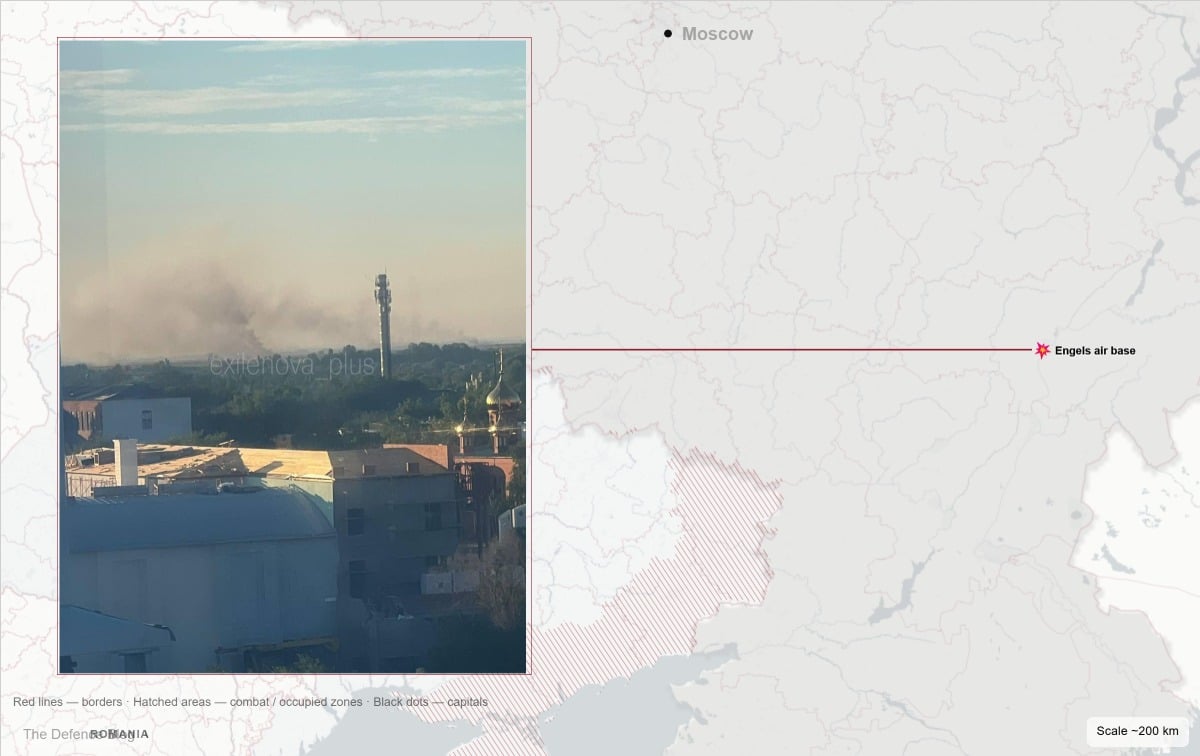
You can't hide a fleet of massive, lumbering strategic bombers when your airspace has holes large enough to fly a fleet of long-range drones through.
That is the stark reality facing the Kremlin right now. Overnight on July 16, 2026, explosions tore through Russia’s Saratov region. Local social media immediately lit up with videos of distinctive engine hums, flashes of light, and subsequent blazes illuminating the night sky. The target wasn't a mystery. It was the Engels-2 military airfield, a critical nerve center for Russia’s long-range aviation and the base responsible for launching devastating cruise missile strikes deep into Ukraine.
Independent war monitoring channels and geolocated footage quickly confirmed that fires broke out inside the facility. It is just the latest incident in a highly coordinated, relentless campaign targeting deep behind Russian borders.
The Strategic Importance of Engels Two
Engels-2 isn't just any military runway. Located roughly 600 kilometers (370 miles) from the front lines in Ukraine, it acts as the primary hub for the 121st Guards and 184th Heavy Bomber Aviation Regiments. The base houses the crown jewels of Russian air power: the Tupolev Tu-95 (Bear) and the nuclear-capable Tu-160 (Blackjack) strategic bombers.
Engels Air Base Distance to Front Line: ~600 km (370 miles)
Primary Aircraft: Tu-95, Tu-160, Tu-22M3
Primary Munitions: Kh-101 and Kh-22 Cruise Missiles
These planes routinely take off from Engels to fire Kh-101 and other cruise missiles at civilian infrastructure and energy grids across Ukraine. For Russia, keeping these planes safe is vital to maintaining its aerial campaign. For Ukraine, taking them out or forcing their relocation is a matter of survival.
The immediate fallout of this latest strike remains murky, as Russian state media traditionally downplays these incidents. However, independent open-source intelligence (OSINT) groups like Astra confirmed that a substantial fire erupted at the airfield following the drone arrivals. Air sirens wailed across the twin cities of Saratov and Engels, while local residents reported power outages and scattered debris hitting residential structures during the air defense chaos.
A History of Air Defense Failures
If you feel like you have heard this story before, you have. This isn't a one-off security breach. It's an ongoing, systemic failure of Russian domestic air defense that dates back years.
The vulnerability of Engels-2 first became glaringly obvious back in December 2022, when early Ukrainian drone strikes managed to damage two Tu-95 bombers right on the tarmac. Since then, Ukraine has regularly returned to the site. A massive raid in March 2025 reportedly struck fuel depots and ammunition storage facilities on the base, triggering secondary explosions that burned for hours. Just weeks before this July attack, a drone strike hit the nearby Saratov oil refinery, choking off fuel supplies to the region.
Russia has tried everything from basic camouflage to downright bizarre defensive measures. In late 2023, satellite imagery exposed Russian ground crews placing car tires on top of the wings of Tu-95 bombers. Western intelligence officials noted the move was likely a desperate attempt to confuse the image-recognition algorithms used by Ukrainian strike drones. Clearly, the tires didn't work.
What This Means for Global Security
The reality is that Russia cannot easily replace these strategic bombers. The production lines for Tu-95s are long gone, and the Tu-160 fleet is incredibly small and expensive to maintain. Every airframe damaged, or even worn down by forced relocations to Arctic bases like Olenya, degrades Russia's long-term conventional capability.
Furthermore, the persistent vulnerability of an airfield housing nuclear-capable bombers raises serious questions about the security of Russia’s nuclear triad. If low-cost, slow-flying kamikaze drones can consistently penetrate 600 kilometers of protected airspace to strike a high-value base, it reveals a structural deficit in Russia’s radar coverage and surface-to-air missile deployment.
Ukraine's long-range drone program has matured from a makeshift tool into a synchronized, strategic weapon system. These operations show that no military asset in western Russia is truly safe, regardless of how far it sits from the border.
Military planners must expect Ukraine to keep pressing this advantage. Keep a close eye on upcoming commercial satellite imagery of the Engels-2 flight line over the next 48 hours. Those images will reveal whether Russia lost more irreplaceable airframes to the flames or if they will be forced to scatter their remaining bomber fleet even deeper into Siberia.