You never really think about the asphalt. Not unless it fails you.
When you drive over a pothole that rattles your teeth, or feel your tires hydroplane during a sudden summer downpour, the road suddenly stops being a silent, invisible floor and becomes an antagonist. We treat asphalt like the sky or the ground: a permanent fixture of the earth, waiting quietly to be driven upon. But roads are mortal. They age. They crack under the relentless crush of twenty-ton semi-trucks, heave during winter freezes, and soften when summer heat turns the surface into a sticky trap. You might also find this similar article insightful: The Billionaire Who Bought the Horizon Back.
For decades, the math of road building was brutal and simple. We mined virgin rock from the earth, pumped petroleum from deep underground to make the sticky black bitumen that glues it together, cooked it all at searing temperatures, and poured it down. Then, when it wore out—because it always wore out—we stripped it up, hauled it away, and buried it in a landfill. A linear, exhausting cycle of consumption.
Then came a Tuesday morning on Melbourne’s M80 Ring Road. As extensively documented in recent coverage by ELLE, the effects are significant.
Picture Sarah. She is a highway engineer who has spent twenty-five years watching heavy traffic carve canyons into asphalt. She knows the sound of the M80 at dawn: the low, vibrating roar of freight trucks carrying the pulse of Victoria’s economy from port to warehouse, city to suburb. Every single day, thousands of tons of metal and rubber hammer down onto those lanes. Sarah knows that every hairline fracture in that surface is a ticking clock.
For years, Sarah and her colleagues faced a frustrating paradox. They were drowning in waste. Glass bottles that couldn’t be recycled locally, soft plastics choking sorting facilities, printer toner cartridges, construction rubble—humanity creates an ocean of refuse, yet we keep digging up the pristine earth to build our infrastructure.
Someone finally asked the obvious, dangerous question. Why are we throwing away the materials we need while burying the waste we don't?
The answer wasn't found in a textbook. It was forged in a processing plant where old wine bottles were crushed into a fine, sparkling sand, and discarded plastic bags were melted down into stubborn, resilient polymers.
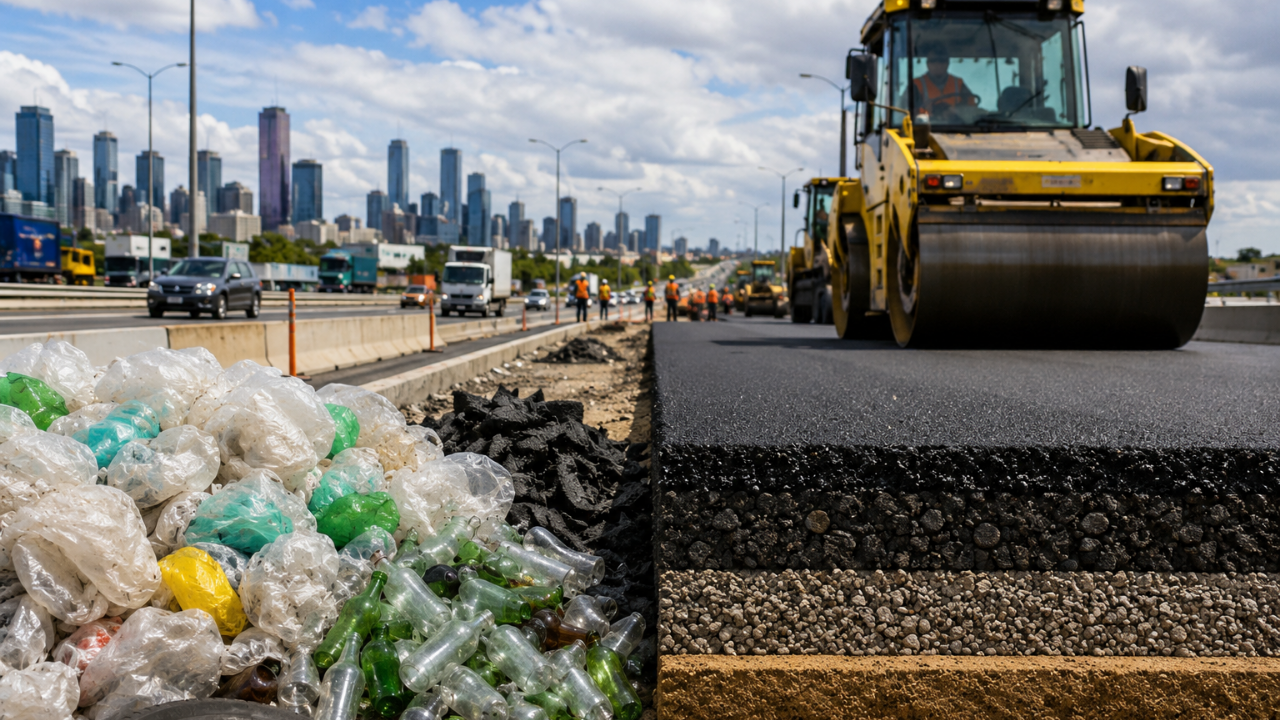
When the M80 Ring Road upgrade rolled around, it became the testing ground for a quiet revolution. This wasn't just about tossing a handful of recycled bits into the top layer to make a green marketing brochure. This was total transformation. For the first time in Victoria’s history, every single pavement layer of a major road—from the deep, stabilizing sub-base to the sleek, high-speed wearing course at the surface—contained recycled content.
Let us be entirely clear about what that means.
Imagine driving down the M80 today. As your tires hum against the asphalt, you are rolling over millions of recycled glass bottles that would otherwise be sitting in a landfill, now acting as aggregate that adds structural strength. You are driving on pulverized construction waste and repurposed soft plastics that make the binder more flexible, resisting the thermal cracking that destroys traditional roads during temperature swings.
(To be precise, when we talk about recycled content in every pavement layer here, we are looking at a masterclass in industrial alchemy. Crushed glass replaces natural sand, reclaimed asphalt pavement brings old roads back to life instead of gathering dust, and recycled plastics modify the bitumen to resist rutting under heavy loads.)
It sounds simple on paper. In practice, it required a seismic shift in engineering courage.
Road authorities are famously, and for good reason, conservative. Lives depend on these surfaces. A bridge or a highway cannot be treated like a software beta test. When you introduce recycled materials into a load-bearing structure meant to withstand millions of heavy vehicle axle loads, you are inviting failure if your chemistry is off by a fraction of a percent. The testing had to be exhaustive. The heat tolerances had to match. The moisture resistance had to equal or exceed virgin materials.
If you talk to the contractors who laid those lanes, they will tell you about the initial skepticism. There is an art to asphalt laying—a visceral dance of temperature, pressure, and timing. The crew has to watch the steam rise from the screed, smelling the thick, biting scent of hot bitumen, knowing that if the mix cools too fast or compacts unevenly, the whole batch is ruined.
When they first worked with the high-recycled polymer mix on the M80, the stakes were high. Would it behave? Would it stick? Would it crumble under a heatwave?
The trucks kept rolling. The summer heat came and went. The winter rains lashed the tarmac. And the road held.
In fact, it did better than hold. It performed. By re-engineering the asphalt matrix to incorporate recycled polymers and glass, the engineers discovered something remarkable: the modified pavement showed enhanced resistance to deformation and fatigue. By keeping waste out of landfills and reducing the demand for quarried rock, the project slashed carbon emissions without sacrificing an ounce of durability.
We often look at climate action and infrastructure upgrades as separate worlds—one belonging to activists with placards, the other to bureaucrats in hard hats. But the M80 proves they are the exact same thing. Sustainability is no longer just an ethical nice-to-have; it is a superior engineering specification. When you design a road that outsmarts waste, you build something stronger, smarter, and inherently more resilient.
Consider what happens next.
Once a major arterial route like the M80 proves that recycled content can shoulder the punishing weight of a capital city's freight network, the excuse evaporates. The old argument that "we have to use virgin materials because safety demands it" collapses under the weight of empirical proof. Every local council, every state transport department, and every civil contractor across the country takes notice.
The invisible stakes of this shift are massive. Roads are the skeletal system of modern civilization. If our skeletal system is built on a finite, polluting model, we are locked into a race to the bottom. But if we can pave our way forward using the very waste we generate, we close the loop. We turn our garbage into the bedrock of our daily lives.
Next time you find yourself stuck in traffic on the ring road, watching the brake lights bleed red into the dusk, look down at the dark, gleaming ribbon beneath your tires.
You aren't just driving on stone and oil anymore. You are driving on human ingenuity. You are rolling over the discarded bottles of forgotten dinners, the plastic packaging of morning groceries, and the stubborn refusal of engineers to accept that the old way was the only way.
The road beneath our wheels remembers everything we throw away. And now, quietly, it is carrying us toward somewhere better.