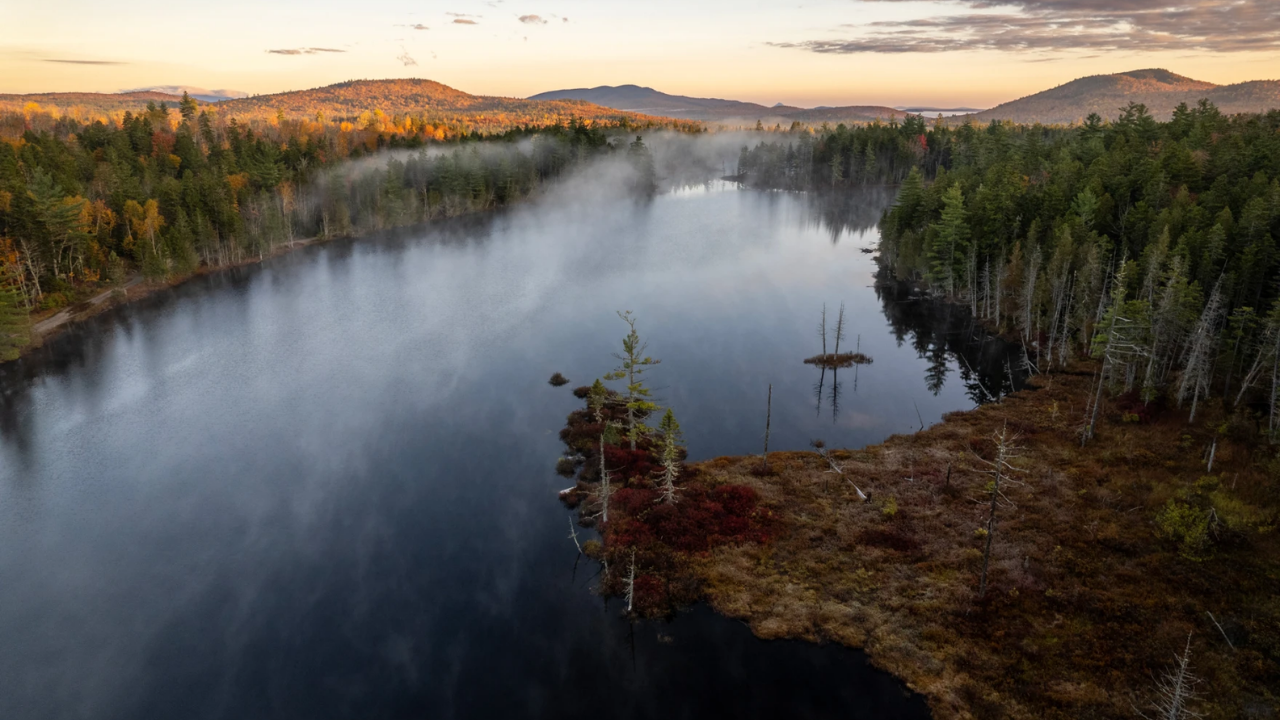
The water does not forget.
It carries the memory of white pines that once choked the horizon, of cedar canoes slicing through morning mist, of a language spoken in rhythms that mirrored the current itself. For generations, the Penobscot River has flowed past shores that were once home, bearing witness to a quiet displacement. Maps were drawn by hands that did not know the names of the eddies. Fences were built where cedar groves once offered shelter. Boundaries were inked on parchment, turning an ancient relationship into a transaction.
Then came a day that smelled of damp earth and woodsmoke.
On this day, the Penobscot Nation received 11,297 acres of their ancestral homeland back. One hundred years of separation dissolved in the rustle of a signature.
To understand what this means, you have to step away from the abstract language of real estate and look at the soil. Imagine standing on a ridge overlooking the vast expanse of Maine’s north woods, where the air tastes sharp with pine and the silence is so heavy it hums in your ears. (This hypothetical vantage point mirrors the real terrain where tribal members now walk, tracing old hunting trails with boots that press into familiar ground.) For a century, these woods were legally distant, locked behind gatehouses and private titles. They were timber investments, cordoned off by signs that might as well have been iron walls.
Now, the gate is open.
The return of these 11,297 acres is not an isolated transaction. It is the anchor of a $32.5 million effort, a massive financial and cultural undertaking designed to reclaim more than 30,000 acres in total. This is not about collecting dirt for the sake of ownership. It is about healing a fracture that runs deep through the heart of Maine’s geography.
History is heavy. It settles into the riverbeds and clings to the bark of old-growth hemlocks. A century ago, the legal and physical landscape shifted violently beneath the feet of the Penobscot people. Pressured by industrial expansion, political maneuvering, and broken promises, the tribe was systematically severed from the vast majority of their territorial base. The forests that had sustained their ancestors for millennia became someone else's balance sheet.
For the elders who grew up listening to stories of places they could no longer visit, the loss was personal. It was an absence that lingered at the edge of every community gathering. How do you teach the next generation to gather sweetgrass or strip birch bark when the groves are guarded by strangers? How do you maintain a unbroken cultural thread when the physical loom has been dismantled?
You wait. You plan. You organize.
The $32.5 million campaign did not materialize overnight. It is the result of decades of quiet endurance, strategic coalitions, and relentless advocacy. Conservation groups, private donors, and tribal leaders sat across tables, forging agreements that recognized a fundamental truth: stewardship and ownership must belong to the people whose history is written into the dirt.
Consider the sheer scale of the target. Reclaiming 30,000-plus acres is an administrative marathon. It requires navigating title searches, ecological assessments, funding distributions, and complicated municipal boundaries. But beneath the bureaucratic machinery lies a fierce heartbeat. Every acre returned represents a victory against erasure.
As the deed changed hands, the immediate reaction was not triumphant shouting. It was a profound, collective exhaling.
Older tribal members walked the newly liberated acreage, bending down to touch moss-covered rocks. They looked up at the canopy, checking for familiar landmarks—a split boulder, a twisted birch, the particular bend of a brook where trout once crowded in the spring. These are not just geographic features. They are historical archives. Every tree holds a generational secret. Every clearing is a page from a book that was forcibly closed.
The ecological implications are just as profound as the cultural ones. Modern forestry management, driven by short-term profit, often treats woodlands as fiber farms rather than living systems. When indigenous communities regain control of their ancestral ecosystems, the management philosophy shifts immediately. It moves from extraction to reciprocity.
In these recovered forests, ancient management practices are coming home. Controlled burns, selective harvesting, and the protection of wildlife corridors are guided by traditional ecological knowledge—a science refined over thousands of years of close observation. The goal is no longer to squeeze maximum board-feet of lumber from every acre, but to ensure that the deer, the bear, the brook trout, and the medicinal plants can thrive alongside human presence.
Carbon sequestration improves. Biodiversity rebounds. The watershed heals. When a people who view themselves as part of the ecosystem—rather than its masters—reclaim their place on the land, the entire biome responds.
Yet, the work is far from finished.
Hitting the milestone of nearly 12,000 acres is a monumental achievement, but the horizon stretches further. The remaining acres of the 30,000-plus goal wait in the wings, tangled in ongoing negotiations and funding phases. The campaign continues, fueled by the momentum of this recent success.
There is a lesson here about time. In a culture obsessed with quarterly reports and instant gratification, the Penobscot Nation’s victory is a masterclass in generational patience. They measured their struggle not in days or months, but in centuries. They understood that justice moves slowly, but it does move if you push against the weight of history long enough.
Think about the children walking through those woods today. They do not view these trees as real estate. They do not see boundaries or property lines. They see home. They see a legacy restored, a promise kept, and a future where their language can echo through the valleys without an echo of trespass.
The river keeps moving. It winds past the newly returned shores, cutting through granite and gravel, rushing toward the sea. But today, the water passes through land that finally recognizes the names carved into its banks.
The trees stand tall against the gray Maine sky. They have waited a hundred years to whisper back.