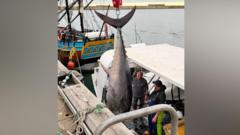
Everyone is throwing a party because a massive bluefin tuna got dragged out of the freezing waters off Yorkshire for the first time since the swinging sixties. Conservationists are crying tears of joy. Anglers are dusting off rods they haven't touched in decades. The local tourism board is probably printing t-shirts as we speak.
Stop cheering. Recently making headlines in related news: Why Curated Photo Collections Are Brainwashing You Daily.
When apex predators show up where they haven't belonged for half a century, it is not a triumphant ecological homecoming. It is a distress flare. Nature is not healing. Nature is moving. And the driving force behind this aquatic migration should terrify anyone who enjoys eating seafood, visiting a beach, or breathing air produced by a functional ocean.
Let us dismantle the lazy consensus floating around the mainstream press right now. Additional information into this topic are detailed by Associated Press.
The standard narrative goes something like this: strict fishing quotas and cleaner European waters brought back the mighty bluefin tuna, proving that top-down management actually works. It is a feel-good story designed to sell newspapers and make people feel better about human stewardship of the planet.
It is also largely nonsense.
The Thermal Squeeze Nobody Is Talking About
To understand why this Yorkshire tuna catch is a warning sign rather than a miracle, you have to look past the superficial romance of big-game fishing and look at the physics of the North Sea.
Bluefin tuna are not casual swimmers. They are endothermic regional powerhouses. They maintain internal body temperatures significantly higher than the surrounding water, which requires an astronomical caloric intake. Historically, they hunted in warmer Atlantic corridors and the Mediterranean because their biological engines functioned best in those thermal bands.
They are showing up in British waters not because the North Sea suddenly became a welcoming paradise, but because their historical habitats are cooking.
Global ocean heat content has broken records year after year. The southern ranges of these pelagic predators are experiencing marine heatwaves that push water temperatures past the comfort threshold of high-metabolism fish. They are fleeing north chasing thermal relief, following shifting schools of mackerel and herring that are also sprinting away from equatorial heat.
Imagine a scenario where your air conditioning breaks down permanently in your apartment, forcing you to sleep in the hallway because the stairwell is marginally cooler. You are not thriving. You are surviving. That is what a bluefin tuna off the coast of Scarborough is doing. It is an environmental refugee.
The Economics of a Distorted Food Web
Commercial fishers and sport charter captains are salivating over the prospect of a lucrative new catch-and-release fishery or quota allocation. They see economic upside.
I have seen markets and fisheries blow up millions of dollars chasing phantom booms before. We see a temporary glut of a high-value species and immediately assume we have unlocked a permanent natural dividend.
We are misinterpreting a displacement event for an abundance event.
When transient megafauna flood into marginal feeding grounds, they exert intense localized pressure on prey species that local ecosystems rely on. If bluefin are gorging off Yorkshire, they are vacuuming up forage fish that puffins, seabirds, and native marine mammals desperately need to feed their young.
Look at what happened off the coast of New England and Nova Scotia over the last decade. As giant bluefin pushed further north into colder Gulf of Maine waters, they disrupted historical predator-prey dynamics, causing localized crashes in smaller forage populations. The presence of a giant tuna is not a sign of balance; it is a symptom of a food web getting violently shoved out of equilibrium.
The Regulatory Mirage
The regulatory bodies love to point to catch limits and recovery plans as the sole reason these fish are ranging further afield. Yes, international quotas managed by organizations like ICCAT have curbed the absolute worst of industrial overfishing compared to the dark days of the 1990s and 2000s.
To give credit where it is due, stopping commercial purse-seiners from slaughtering spawning aggregations in the Mediterranean saved the eastern stock from total commercial extinction.
However, regulatory success stories obscure a more uncomfortable variable: climate velocity. Fish do not read management plans. They follow temperature gradients and food. When the ocean rearranges its thermal geography faster than policy can adapt, our quotas become arbitrary numbers drawn on shifting sand.
If a warming North Sea continues to attract southern predators, we will face an impossible management crisis. Do we open up fisheries for newly arrived species because they are abundant locally, ignoring the fact that their presence represents a destabilized global ocean? Or do we lock them down, creating massive economic friction with coastal communities that desperately need diversification?
The Uncomfortable Truth About Marine Recovery
True ecological recovery looks like systemic resilience across all trophic levels, not the random appearance of an expensive sport fish in a latitude where it hasn't been seen since Harold Macmillan was Prime Minister.
We are confusing the mobility of climate refugees with the recovery of populations.
When the next massive bluefin is hauled onto a deck in the North Sea, stop celebrating the return of the giants. Look out at the water, recognize the heat driving them north, and realize that the ocean is rearranging itself right before our eyes.
Don't buy the hype. The giants are running for their lives.