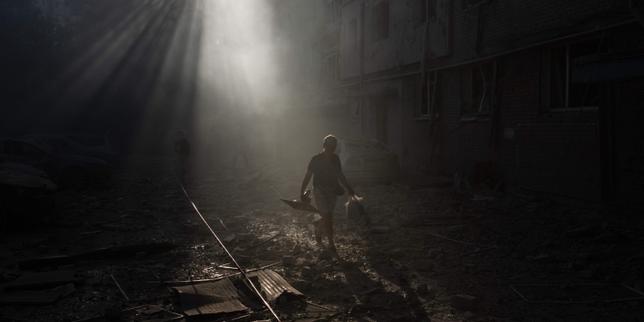
The headlines following the latest mass missile and drone strike on Kyiv focused heavily on the immediate tragedy. At least nine civilians dead, dozens pulled from the smoking ruins of apartment blocks, and emergency crews working through the night. While these human costs are devastating, treating these strikes purely as acts of terror misses the broader military calculation. Russia is not just lashing out. Moscow is actively executing a calculated strategy to bleed Ukraine’s air defense stocks dry before western replacements can arrive.
For months, the Kremlin has timed these massive aerial bombardments to exploit a critical window of vulnerability. By saturating the skies over Kyiv with a complex mix of cheap Iranian-designed Shahed drones, older cruise missiles, and high-velocity ballistic weapons, Russia forces Ukrainian commanders to make impossible choices. Do they protect the capital's civilian population, or do they hoard their dwindling stockpile of high-end interceptors for the frontline?
This is a war of attrition disguised as terror.
The Arithmetic of Exhaustion
To understand why Kyiv is being targeted with such ferocity, look at the economic and technical imbalance of modern air defense. A single Patriot interceptor missile costs millions of dollars. The Shahed drones used to swarm Ukrainian radar screens cost a fraction of that, often around twenty thousand dollars apiece.
Russia relies on volume. The tactics have evolved from simple waves into highly sophisticated, multi-layered operations designed to confuse radar operators.
- Wave One: Dozens of low-flying drones enter Ukrainian airspace from multiple vectors, forcing air defense systems to activate their radars and reveal their positions.
- Wave Two: Subsonic cruise missiles follow, changing flight paths mid-route to bypass known defense pockets.
- Wave Three: Ballistic and hypersonic missiles are launched at the exact moments Western-supplied systems are reloading or overwhelmed by the sheer number of targets.
When Ukraine successfully shoots down ninety percent of the incoming targets, the media reports it as a defensive victory. Military analysts see a different reality. Every successful interception represents an irreplaceable missile wiped from Ukraine's inventory. The Kremlin knows that Western industrial production cannot currently keep pace with the rate of consumption. They are hunting the defenders' ammunition supply.
The Frontline Fallout
The impact of the strikes on Kyiv radiates far beyond the capital's borders. Air defense is a finite resource. A battery deployed to protect a power plant in Kyiv is a battery that cannot be used to protect a bridgehead on the Dnipro River or an infantry brigade in the Donbas.
By keeping Kyiv under perpetual threat, Russia effectively anchors Ukraine’s most advanced defense systems to the interior of the country. This leaves frontline troops exposed to devastating attacks from Russian fighter-bombers deploying heavy glide bombs. These satellite-guided munitions, packed with hundreds of kilograms of explosives, are currently leveling Ukrainian defensive fortifications with near impunity because Ukrainian forces cannot risk moving their scarce air defense assets closer to the active combat zone.
It is a brutal, interlocking system. The agony of civilians in the capital directly facilitates the slow, grinding advance of Russian armor in the east.
The Choke Point of Western Aid
Western allies have promised a steady stream of advanced air defense systems, but logistics and political gridlock have slowed delivery to a crawl. Moving a complex system from a factory in Europe or a depot in the United States to a hidden launch site in Ukraine involves massive bureaucratic and transport hurdles.
Furthermore, training qualified operators takes time that Ukraine simply does not have. A soldier cannot learn to operate a complex radar system in a weekend. The gap between Western political announcements and actual operational capability on the ground is where Russia finds its opportunities to strike.
The Infrastructure Trap
As winter approaches, the targeting matrix shifts deliberately toward the energy grid. This is not merely about keeping civilians in the dark; it is about shutting down the domestic defense industry. Ukraine has rapidly spun up its own production of long-range drones, electronic warfare systems, and armored vehicles.
Factories require electricity. Massive, uninterrupted amounts of it.
By knocking out thermal power plants and switching substations around Kyiv and other major hubs, Russia chokes off Ukraine's ability to manufacture its own way out of this crisis. It forces the country into total reliance on foreign military assistance, making Kyiv politically vulnerable to the shifting winds of Western elections.
The true measure of these mass attacks is not found in the tragic tally of casualties or the craters left in suburban streets. It is found in the logistics ledgers of the Ukrainian military, where the line item for interceptor missiles is ticking down toward zero while the production lines in Russia continue to churn. Ukraine cannot win a war of attrition by playing pure defense against an adversary willing to spend thousands of lives and billions of dollars to achieve a breakthrough. Western partners must either dramatically scale up interceptor manufacturing and allow deep strikes on Russian launch platforms, or accept that Kyiv's shield will eventually crack under the weight of numbers.