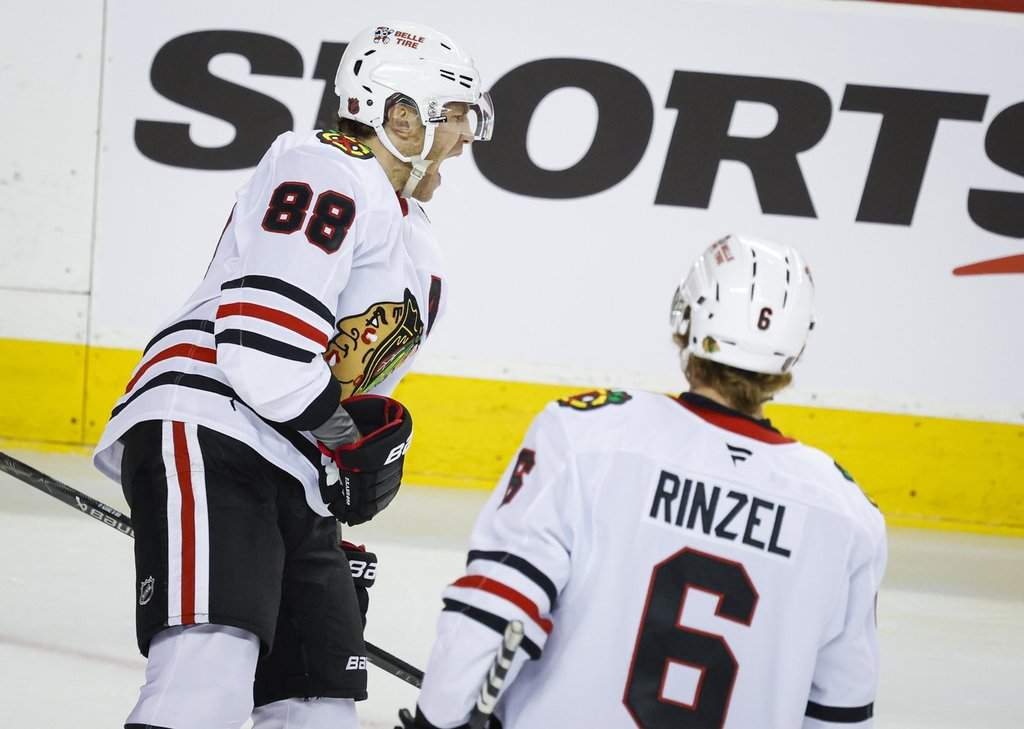
Sam Rinzel ended a tense, back-and-forth NHL matchup by burying an overtime winner to lift the Chicago Blackhawks past the Calgary Flames 4-3. On the surface, a single regular-season overtime victory between two franchises navigating different stages of roster construction looks like standard mid-season box-score fodder. Look closer at the ice, the deployment patterns, and the developmental arc of Chicago’s blue line, and that 4-3 result becomes a clear indicator of how the Blackhawks are transitioning from a lottery-bound rebuild into a team capable of closing out tight games against physical Western Conference opponents.
Most game recaps treat a 4-3 overtime finish as a coin flip decided by three-on-three chaos. That surface-level reading misses the structural shift happening in Chicago’s defensive core and how Calgary’s inability to lock down late leads continues to undermine their standing in the Pacific Division.
Why Three-on-Three Overtime Exposed Calgary’s Defensive Flaws
Three-on-three hockey strips away the comfort of five-man defensive shells and exposes every flaw in gap control, skating stride, and puck retrieval. When Sam Rinzel jumped into the play to finish the 4-3 win, he capitalized on a specific structural breakdown that has plagued Calgary in extended play.
Calgary builds its identity around heavy forechecking, structured neutral-zone traps, and physically taxing board battles during five-on-five regulation play. Those habits win grinding games in November and February. They become liabilities the moment the horn sounds for overtime.
In three-on-three hockey, man-to-man coverage replaces zone responsibilities. If a forward loses a step on a backcheck or a defenseman misjudges a pinch at the offensive blue line, there is no weak-side winger waiting in the high slot to bail out the mistake. Chicago recognized this mismatch immediately. Instead of cycling the puck conservatively along the perimeter, the Blackhawks used speed through the neutral zone to force Calgary’s defenders to pivot backward under pressure.
Rinzel’s skating profile is tailor-made for that exact environment. At 6-foot-4, he covers ice with long, effortless strides that allow him to join the rush as a trailer without abandoning his defensive recovery lane. Against a tired Calgary trio caught mid-change, Rinzel read the open ice, slipped into the soft spot between the hash marks, and converted the decisive goal.
The Mechanics of the Breakdown
To understand why Calgary surrendered the 4-3 decision, look at the three phases that precede almost every overtime winner in the modern NHL:
- Possession Off the Draw: Losing the initial overtime faceoff forces the defending team to chase the puck for thirty to forty seconds before touching it, draining anaerobic energy immediately.
- Line Change Vulnerability: Because the long change is in effect during overtime, a team trapped in its own zone cannot swap out tired skaters without risking an odd-man rush the other way.
- Blueline Activation: Modern offensive defensemen like Rinzel treat overtime like a four-forward alignment, attacking downhill whenever opposing wingers turn their backs to track the puck carrier.
Calgary failed on the second and third phases. When their forwards overcommitted to the strong-side wall to contain Chicago’s primary puck carrier, nobody accounted for the late-arriving defenseman. By the time a Calgary defender recognized the threat, Rinzel already had the puck on his stick in a high-danger scoring area.
What Sam Rinzel’s Development Means for the Chicago Blackhawks
For years, the conversation surrounding Chicago’s rebuild centered almost exclusively on high-end forward talent and draft lottery luck. Front offices know better. You do not win Stanley Cups—or even survive an 82-game grind—without right-shot defensemen who can eat twenty-plus minutes a night, move the puck out of trouble under heavy forechecking, and contribute on the power play.
Right-shot defensemen with size and mobility are the rarest currency in professional hockey. Teams routinely overpay in free agency or surrender multiple first-round picks at the trade deadline just to acquire a top-four right-handed blueliner. Chicago drafted Rinzel in the first round of the 2022 NHL Draft specifically because his physical tools projected toward that exact archetype, knowing full well that tall, lanky defensemen require years of strength training and tactical patience before their game translates to the NHL level.
During his collegiate career at the University of Minnesota, Rinzel showed flashes of elite offensive instincts paired with occasional lapses in defensive-zone positioning. Critics questioned whether his decision-making under pressure would hold up against seasoned NHL forecheckers. Games like this 4-3 win over Calgary provide the clearest answer yet.
Earning Trust in High-Leverage Minutes
Coaches do not put young defensemen on the ice in three-on-three overtime by accident. In the NHL, overtime ice time is the ultimate currency of trust. A single turnover ends the game and costs the team a crucial point in the standings.
Putting Rinzel over the boards with the game tied 3-3 tells you everything about how the coaching staff views his current trajectory:
- Puck Management Under Pressure: He is no longer forcing low-percentage stretch passes when simple plays off the glass or short D-to-D reversals are available.
- Stick Detail in the Defensive Zone: Using his reach to disrupt passing lanes rather than chasing hits behind the net keeps him in position to transition quickly to offense.
- Confidence to Shoot: Young blueliners often defer to star forwards in overtime, passing up prime shooting lanes to force one extra pass. Rinzel took the shot when the lane opened.
That willingness to shoot rather than over-pass is a subtle but vital separator. Goalies in three-on-three situations anticipate cross-crease backdoor plays. When a 6-foot-4 defenseman steps into a clean look from the slot and fires immediately, goaltenders rarely have time to set their feet.
The Hidden Cost of Surrendering Leads for the Calgary Flames
While Chicago leaves the arena celebrating a hard-earned two points and a milestone moment for a cornerstone prospect, Calgary faces a much more uncomfortable reality. Losing a 4-3 game in overtime still nets a single point in the NHL’s standings system, a quirk that often masks deeper structural problems until March and April arrive.
In a tightly packed Western Conference, "loser points" keep teams hovering near the playoff cutline on paper while hiding an inability to close out regulation games. Calgary’s roster is built to win low-event, structured hockey games. When they score three goals on the road or at home, their defensive system is supposed to lock the doors in the third period.
Giving up three goals in regulation and failing to secure the second point in overtime points to two recurring issues for the Flames:
- Penalty Kill and Defensive Zone Exits: Under late-game pressure, Calgary’s defensemen have struggled to make clean first passes out of the zone, leading to extended shifts where forwards ice the puck simply to survive.
- Goaltending Margin for Error: Without elite, game-stealing saves during third-period pushes, Calgary’s margin for error shrinks to zero whenever their offensive depth goes quiet.
The Standings Trap
Consider a hypothetical scenario that plays out every single spring in the NHL. Two teams finish the regular season tied at 94 points for the final Wild Card spot. Under league tiebreaker rules, the first tiebreaker is regulation wins (RW), followed by regulation plus overtime wins (ROW).
A team that consistently bleeds points in overtime—dropping 4-3 decisions instead of closing out 3-2 regulation wins—falls behind in both tiebreaker categories. Even when they collect the single overtime point, they hand a full two points to a conference opponent while watching their own regulation win total stagnate. Over an 82-game schedule, dropping five or six winnable third-period games in overtime is the exact difference between playing playoff hockey and cleaning out lockers in mid-April.
How the Blackhawks Survived Calgary’s Physical Push
To get to overtime tied 3-3, Chicago had to survive stretches where Calgary dictated the physical tempo. The Flames thrive on establishing an aggressive cycle down low, leaning on opposing defensemen along the half-wall until coverage breaks down in front of the crease.
Historically, young, rebuilding teams fold under that kind of sustained heavy pressure. They take lazy hooking or tripping penalties out of fatigue, lose track of weak-side cutters, and let a one-goal deficit snowball into a blowout.
Chicago avoided that collapse by simplifying their breakouts in the third period. Rather than trying to skate the puck through three layers of Calgary forecheckers, the Blackhawks utilized weak-side chip plays into the neutral zone, forcing Calgary’s defensemen to turn and retrieve pucks rather than hold the blue line.
Discipline and Special Teams Equilibrium
In modern NHL hockey, games decided by a 4-3 scoreline almost always hinge on special teams discipline. A single poorly timed stick infraction in the final ten minutes shifts momentum entirely.
Chicago’s ability to match Calgary’s physical intensity without parading to the penalty box kept the game within reach. When the Blackhawks did face defensive-zone draws late in regulation, their centers won enough clean tie-ups to let the wingers clear the zone without icing the puck. Those unglamorous, incremental wins—a clean tie-up at the faceoff dot, a smart chip off the boards at the red line, a blocked shot from the point—are what create the platform for an overtime hero like Rinzel to shine.
The Long-Term Blueprint Taking Shape on Chicago’s Blue Line
Zoom out from this single 4-3 result, and a clearer picture of Chicago’s organizational blueprint emerges. Front offices across the league talk endlessly about "building from the net out," yet few have the stomach to endure the growing pains required to develop young defensemen at the NHL level.
Defensemen take longer to mature than forwards. A nineteen-year-old forward can shelter on the wing, rely on raw speed and scoring instincts, and learn defensive responsibilities gradually. A young defenseman has nowhere to hide. Every misread on a two-on-one, every lost box-out in front of the net, and every turnover behind the goal line ends up on the scoreboard and in the video room the next morning.
By letting Rinzel play through those inevitable mistakes and rewarding his growth with critical overtime deployment, Chicago is accelerating his timeline toward becoming a true top-pair workhorse. Pairing a mobile, right-shot offensive catalyst like Rinzel with a steady, stay-at-home partner gives the Blackhawks a balanced top-four unit capable of matching up against the league’s elite scoring lines.
The 4-3 scoreline against Calgary will fade into the background of an 82-game schedule within a week. The precedent set on the ice will not. Chicago proved it can absorb a heavy Western Conference punch, execute disciplined third-period hockey, and rely on its young blue line to finish the job when the game is on the line.