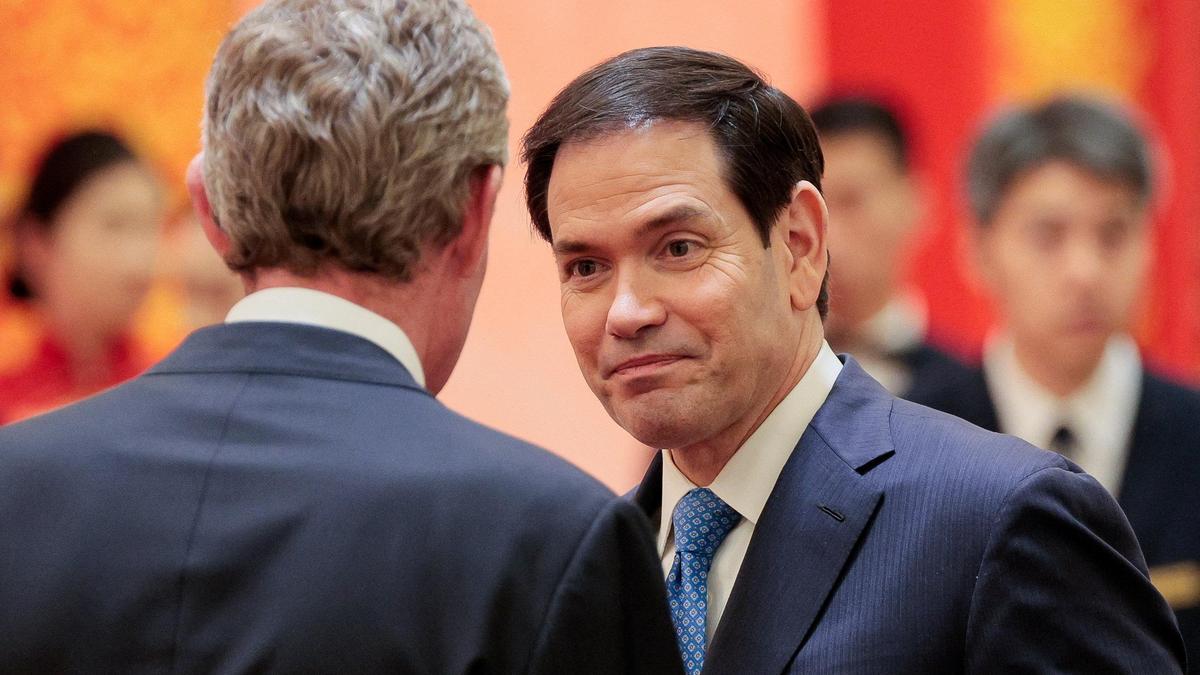
U.S. Secretary of State Marco Rubio is embarking on a high-stakes diplomatic tour to Sweden and India to salvage fractures in American foreign policy. The official itinerary frame is standard diplomatic maintenance: a NATO Foreign Ministers meeting in Helsingborg, followed by a four-city bilateral sprint across India. Beneath the polished press releases lies a much more volatile reality. Rubio is flying directly into a geopolitical storm generated by an administration that has fundamentally destabilized Washington's traditional alliance structures.
The trip, scheduled from May 22 to 26, 2026, serves as an urgent damage-control mission. In Europe, Rubio must pacify an alliance reeling from sudden American troop withdrawals. In New Delhi, he faces the delicate task of reviving a strategic partnership that has been frozen by transactional trade wars and diplomatic slights. Rubio is not merely representing American power abroad; he is attempting to manage the fallout of its unpredictability.
The Helsingborg Ultimatum
The first stop on Rubio’s itinerary is Helsingborg, Sweden, where NATO foreign ministers are gathering to lay the groundwork for the upcoming July summit in Turkey. The mood in Scandinavia is tense. The State Department has dryly noted that Rubio will discuss "greater burden sharing" and "increased defense investment." This language is a polite euphemism for a brutal transactional ultimatum.
The backdrop to this meeting is a recent White House decision to pull 5,000 U.S. troops out of Germany, disrupting defense plans at a moment when European security remains highly unstable. The official defense from Washington is that this is a simple logistical delay in troop rotations to Poland and Germany. The reality on the ground is political. The troop pullout followed a public falling out between the U.S. administration and German Chancellor Friedrich Merz, who criticized Washington's handling of the conflict involving Israel and Iran.
By using vital military deployments as a tool for political retaliation, Washington has broken a foundational rule of transatlantic deterrence. Rubio’s task in Sweden is to convince anxious allies that the American security umbrella remains intact, even as his own administration actively unplugs the wires. He will meet with Swedish Prime Minister Ulf Kristersson and NATO Secretary-General Mark Rutte to demand that Europe accelerate its military spending.
The Arctic Seven Calculus
Beyond the core NATO grievances, Rubio is convening a separate meeting with the Arctic Seven nations, which includes Canada, Denmark, Norway, Sweden, Finland, and Iceland. This is a deliberate geopolitical pivot. The High North has transformed from a frozen diplomatic backwater into an active theater of competition.
- Shipping Lanes: Melting ice caps are opening up new trade routes that bypass traditional, congested chokepoints.
- Resource Deposition: Massive, untapped reserves of oil, natural gas, and rare earth minerals are becoming accessible.
- Militarization: Moscow has steadily rebuilt its Soviet-era bases along the Arctic coastline, creating a permanent security challenge for northern Europe.
The European allies are highly skeptical of Washington's sudden focus on the region. Memories remain fresh of the administration's bizarre, unsuccessful attempt to purchase Greenland from Denmark. Rubio must move past these historical distractions to forge a coherent Arctic strategy, all while his European counterparts question whether America is a reliable partner or a volatile wildcard.
The New Delhi Reset
On May 23, Rubio will leave the European friction behind and land in India for a four-day visit. The itinerary is unusually expansive for a top diplomat, featuring stops in Kolkata, Agra, and Jaipur before concluding with formal state business in New Delhi. This sprawling tour is designed to show deep respect to a partner that feels neglected and insulted.
The U.S.-India relationship has entered a chilly patch. For decades, Washington courted New Delhi as a crucial democratic counterweight to Beijing. That strategic alignment broke down last year when Washington slapped punishing tariffs on Indian imports. The economic retaliation stemmed from a personal grievance: Prime Minister Narendra Modi refused to publicly credit the U.S. President for mediating the end of a brief military conflict between India and Pakistan.
While relations with India cooled, Washington aggressively courted Pakistan. Vice President J.D. Vance recently traveled to Pakistan for talks on the Middle East crisis, and Islamabad has positioned itself as a key mediator in regional conflicts. Compounding New Delhi’s anxiety, the U.S. administration recently conducted a high-profile diplomatic visit to China, signaling a willingness to cut deals with India’s primary regional rival. Rubio is arriving in New Delhi to convince the Modi government that Washington has not abandoned its strategic partnership in favor of its neighbors.
The Quad Strategy Under Strain
The climax of Rubio’s trip will take place on May 26 in New Delhi, where he will join the foreign ministers of Australia and Japan for a critical meeting of the Quadrilateral Security Dialogue. The Quad was designed to keep the Indo-Pacific free and open. Today, the alliance is struggling under the weight of Washington’s erratic global policy.
| Nation | Key Representative | Primary Strategic Focus |
|---|---|---|
| United States | Marco Rubio | Supply chain security, counter-China defense alignment |
| India | S. Jaishankar | Maritime sovereignty, regional energy security, technology transfers |
| Japan | Motegi Toshimitsu | Protection of East China Sea shipping lanes, technology standards |
| Australia | Penny Wong | Pacific Island diplomacy, resilient mineral supply lines |
The central challenge for the Quad is that its member states no longer trust Washington to maintain a consistent policy. While Australia and Japan have dutifully increased their defense budgets and aligned their supply chains with American standards, they watch the sudden U.S. troop withdrawals in Europe with deep concern. If Washington can abruptly abandon its commitments to Germany over a political dispute, it could easily do the same in the Indo-Pacific.
Rubio’s discussions will focus on energy security, trade, and defense cooperation. India is highly vulnerable to global oil price spikes driven by ongoing instability in the Middle East, making alternative energy supply chains a top priority. Rubio wants to offer American energy and defense technology, but New Delhi will likely demand long-term structural guarantees before signing any major agreements.
The Diplomat in the Middle
Marco Rubio has spent his political career establishing himself as a traditional foreign policy hawk. He believes in forward military deployment, strong alliances, and a confrontational approach to autocratic regimes. Now, as Secretary of State, he is forced to act as the clean-up crew for an administration that operates on pure transaction and personal loyalty.
This creates an unsustainable paradox for American diplomacy. In Helsingborg, Rubio must demand that Europe spend more on its own defense, while hiding the fact that Washington might withdraw troops regardless of what Europe spends. In New Delhi, he must pitch America as a reliable security partner, even as India watches Washington cozy up to Pakistan and Beijing.
The Secretary of State cannot fix these structural contradictions with charm or diplomatic platitudes. Foreign capitals have learned to look past the reassurances of American diplomats and focus entirely on the volatile actions coming out of the White House. Rubio’s tour of Sweden and India will likely prevent an immediate collapse in these relationships, but it cannot fix the fundamental trust deficit that now defines American foreign policy.