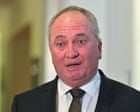
When former Deputy Prime Minister Barnaby Joyce appeared on ABC’s 7.30 to address Pauline Hanson’s recent podcast appearance with British far-right figure Tommy Robinson, viewers expected a tense political exchange. What they got instead was a bizarre live broadcast defined by defensive rhetoric, aggressive deflections toward the public broadcaster, and a barking farm dog disrupting the interview. Behind the absurdity lies a deliberate political strategy. Joyce’s refusal to disavow Hanson’s engagement with UK extremists signals a radical realignment within Australia's right-wing politics, where fringe populism is no longer a temporary protest vote but an organized campaign for parliamentary influence.
The interview was meant to confront a growing scandal. Hanson, the veteran One Nation leader, sparked widespread condemnation during a trip to the United Kingdom by joining a podcast hosted by Robinson, whose real name is Stephen Yaxley-Lennon. Robinson has a history of violent criminal convictions and anti-immigrant activism. During the recording, Hanson openly lamented the end of Australia’s White Australia policy and made sweeping, unsubstantiated allegations about Muslim communities exploiting social support schemes.
When pressed by presenter Sarah Ferguson on whether Hanson’s public association with a convicted extremist crossed a line, Joyce offered a combative defense. Appearing on camera, he argued that interviewing or speaking alongside Robinson did not equate to endorsing every action or belief of the controversial activist.
Key Controversies Surrounding the Interview
----------------------------------------------------------------------------------
1. Foreign Activism  | Hanson joined podcast with UK activist Tommy Robinson.
2. Rhetorical Shift  | Defended past White Australia policy during the UK trip.
3. On-Air Distraction| Dog interrupted interview twice, drawing sharp responses.
4. Funding Clashes   | Diverted questions about billionaire campaign donations.
The broadcast spiraled when an unseen dog off-camera began barking repeatedly. Joyce broke off mid-sentence to bark orders at his pet, shouting "Sit down!" at the animal before turning his irritation toward Ferguson. When the presenter asked him to focus on the question rather than the distraction, Joyce threatened to end the broadcast on the spot, warning her not to be "rude".
This theatrical friction served a clear purpose. By picking a fight with the interviewer and focusing on off-camera noise, Joyce deflected away from the substance of Hanson's extreme statements.
The Strategic Bet Behind the Chaos
To understand why a veteran political figure would put himself through such an uncomfortable broadcast, one must examine the realignment of regional conservative politics in Australia. Joyce spent decades as the dominant voice of the National Party, occupying high office and representing rural interests in Federal Parliament. His defect to One Nation marked a seismic shift in his strategy.
The rural voter base is changing. Traditional agrarian conservatism is being steadily replaced by a sharper brand of anti-establishment sentiment, fueled by anger over regional infrastructure deficits, energy transition costs, and immigration policies. By shielding Hanson from mainstream media scrutiny, Joyce reinforces his standing among voters who view public broadcasters and metropolitan media with deep suspicion.
"You have someone of the same political side just like the union movement is on the Labor Party side," Joyce argued during the interview when questioned about wealthy donors funding fringe political movements.
His strategy relies on a simple premise. The core voters he targets do not care about Tommy Robinson or London podcasts. They care about political figures who actively fight against mainstream institutions. Every sharp word exchanged with an ABC presenter serves as proof to his base that he remains unbowed by political correctness.
Money, Influence, and the Media War
The broadcast expanded beyond Hanson's UK trip into the financial mechanics supporting minor parties in Australia. When asked about corporate backing and private aviation access provided to political leaders, Joyce pivoted immediately to attack public funding. He questioned why taxpayers fund the ABC while private citizens are scrutinized for supporting conservative campaigns.
This counter-attack is a familiar tactic from the populist playbook. When confronted with hard questions regarding campaign finance or extreme rhetoric, the fastest escape route is to attack the venue conducting the scrutiny.
Political Strategy Breakdown
* Redirect Scrutiny   | Shift focus from policy substance to media bias.
* Mobilize Base       | Frame sharp questioning as elite hostility against regional voices.
* Unify Fringe Views  | Normalize international far-right commentary as standard debate.
The real danger in these exchanges is not the on-air distraction or the sharp retorts. It is the normalization of extreme rhetoric. By refusing to condemn Hanson’s nostalgic comments regarding racial immigration policies, senior minor-party figures create space for fringe ideologies to re-enter mainstream political discussions.
The live interview highlighted a clear pattern in Australian political broadcasting. When confronted with undeniable policy contradictions, experienced politicians use every tool available—from attacking the host to leveraging live distractions—to protect their party alignment.
Watch Barnaby Joyce's dog interrupts serious interview to see the original broadcast clip where the live disruption and heated exchange occurred.